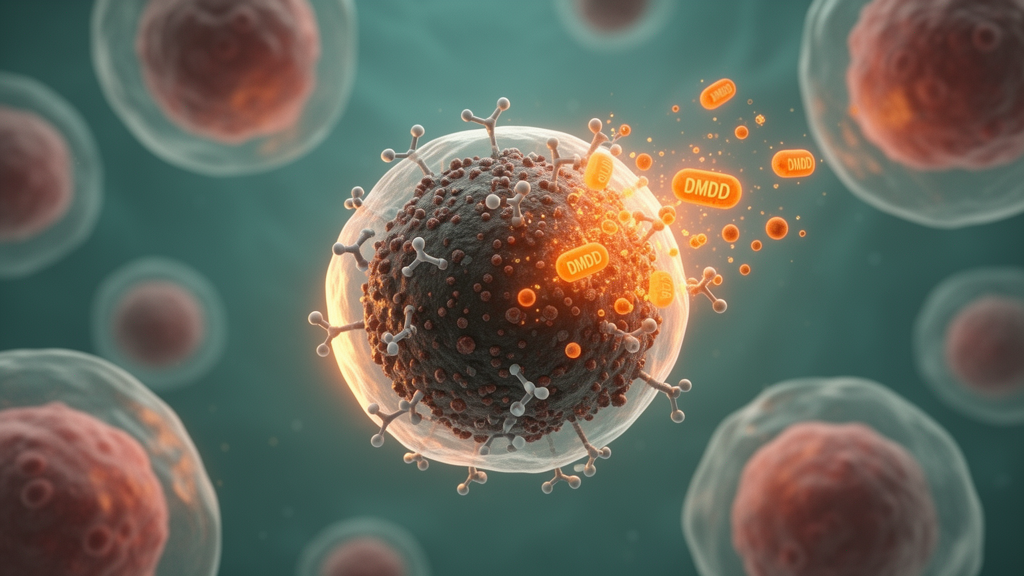
Researchers have developed an iron-engineered mesoporous organosilica nanoplatform, named DMDD@MON-Fe, designed to improve the delivery of DMDD, a natural small-molecule compound, and to reshape the immune microenvironment of breast cancer. The work, published in the journal Cancer Nanotechnology, combines autophagy induction with modulation of the PD-L1/PD-1 immune checkpoint axis, two processes that the authors link to the platform’s anti-tumor effects in laboratory and animal models.
The platform was assembled using a one-pot template method to prepare mesoporous organosilica nanoparticles, followed by introduction of iron species through a heating-sublimation strategy to yield MON-Fe. The natural compound DMDD was then loaded into this iron-containing scaffold. Characterization by transmission electron microscopy, scanning electron microscopy, X-ray photoelectron spectroscopy, dynamic light scattering, and BET measurements showed that the resulting particles had a spherical morphology.
In cell-based experiments, DMDD@MON-Fe inhibited breast cancer cell proliferation, migration, and invasion. Treated cells underwent cell-cycle arrest and showed increased apoptosis and elevated generation of reactive oxygen species. The researchers probed these effects with a battery of assays, including MTT and colony-formation tests for proliferation, Transwell assays for migration and invasion, and flow cytometry for cell-cycle and cell-death analysis.
Mechanistically, Western blot and immunofluorescence analyses showed that the nanoplatform downregulated protein expression in the PI3K/Akt/mTOR signaling pathway, activated autophagy, and suppressed PD-L1 and PD-1 expression.
In vivo, the team evaluated the formulation in a subcutaneous syngeneic tumor model, where DMDD@MON-Fe inhibited tumor growth. Transmission electron microscopy of tumor tissue revealed indicators of autophagy and chromatin condensation. Transcriptome sequencing of treated tumors showed enrichment of differentially expressed genes in PI3K-Akt signaling, autophagy, and immune-related pathways, providing a molecular map consistent with the in vitro findings.
Biosafety was addressed through several measures. Hemocompatibility testing supported blood compatibility of the particles, and in the animal study, H&E staining together with liver and kidney function tests indicated no evident toxicity from the treatment. Additional mechanistic confirmation came from RT-qPCR, immunohistochemistry, and blood biochemical analysis.
The authors position DMDD@MON-Fe as a potential nanomedicine-based strategy for improving DMDD delivery and alleviating PD-L1-associated immune suppression in breast cancer. Because resistance to PD-1/PD-L1 checkpoint therapy remains a major obstacle in advanced disease, a platform that pairs drug delivery with checkpoint modulation is of interest, although the findings reported here are preclinical and based on cell models and a single syngeneic mouse tumor model.
Several caveats frame the work. The study is an early-stage research effort, and the reported version is a peer-reviewed accepted manuscript shared ahead of final production editing. Efficacy and safety in patients have not been established, and the mechanisms described—ROS generation, PI3K/Akt/mTOR suppression, autophagy activation, and PD-L1 inhibition—were measured in the specific experimental systems used by the team. Further validation in additional models would be needed before any clinical translation.
Within those limits, the study adds to a growing body of work on mesoporous organosilica and iron-engineered nanocarriers for cancer therapy, illustrating how a single platform can integrate stimulus-responsive drug release, induction of tumor-cell death pathways, and immune microenvironment modulation in breast cancer models.
Subject of Research: Preclinical development of an iron-engineered mesoporous organosilica nanoplatform for DMDD delivery and immune modulation in breast cancer
Article Title: Efficient delivery of DMDD by an iron-engineered mesoporous organosilica nanoplatform reshapes the breast cancer immune microenvironment via autophagy activation and immune checkpoint modulation
Article References: Chen, J., He, Y., Chen, L., Chen, M., Mo, S., Xie, Q., Han, C., Chen, S., Lu, H., Li, M., Pham, T. T. H., & Luo, X. (2026). Efficient delivery of DMDD by an iron-engineered mesoporous organosilica nanoplatform reshapes the breast cancer immune microenvironment via autophagy activation and immune checkpoint modulation. Cancer Nanotechnology. https://doi.org/10.1186/s12645-026-00437-3
Image Credits: AI Generated
DOI: 10.1186/s12645-026-00437-3
Keywords: breast cancer, nanoplatform, DMDD, mesoporous organosilica, autophagy, PD-L1, PD-1, PI3K/Akt/mTOR, reactive oxygen species, drug delivery, preclinical study, Cancer Nanotechnology
News Source: Nathaniel Bowman. (October 28, 2026). Iron-Engineered Nanoplatform Delivers DMDD and Targets Immune Checkpoints in Breast Cancer Model. Scienmag.