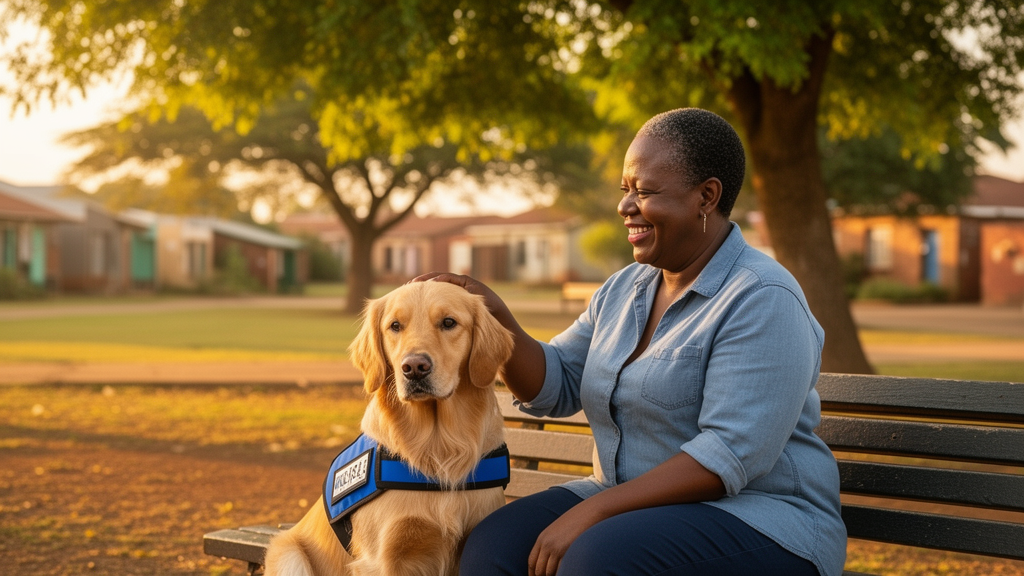
Adults in South Africa living with a wide range of mental health conditions described how partnering with a psychiatric service dog reshaped their social lives, according to a new qualitative study led by researchers at the University of Cape Town. Published in Frontiers in Psychiatry, the study reports that handlers consistently described reductions in loneliness, more frequent social contact, greater independence in public spaces, and a renewed sense of purpose — alongside persistent burdens such as access discrimination and intrusive public questioning.
The research addresses a notable gap in the evidence base. Much of the existing literature on psychiatric service dogs, or PSDs, comes from the United States and focuses largely on military veterans with post-traumatic stress disorder. The authors note that evidence from low- and middle-income countries has been almost entirely absent, even though service dogs are relatively new to South Africa, where the first diabetic service dog was trained in 2017 and a national coordinating body for accredited assistance dog organisations was founded only in 2023.
The team, led by Jacqueline Hoare and Fulufhelo Netshifhefhe of the University of Cape Town’s Department of Psychiatry and Mental Health, recruited 19 PSD handlers through three South African training organisations: Paws4Life, Honey’s Garden, and Smart Service Dog. To be eligible, participants had to have a mental health condition diagnosed by a qualified mental health professional and to have been actively working with a PSD for at least six months. The handlers — 15 women, three men and one non-binary person, aged 21 to 51 — represented a diagnostically diverse group: 13 had anxiety disorders, 11 depressive disorders, 10 neurodevelopmental conditions including autism spectrum disorder and ADHD, six bipolar and related disorders, and four trauma- and stressor-related disorders, with most carrying more than one diagnosis. Three organisational leads were also interviewed to provide context on training and placement practices.
Data came from semi-structured individual interviews lasting roughly 45 to 60 minutes, conducted either online or in person in Cape Town, and analysed using reflexive thematic analysis following the six-phase framework of Braun and Clarke. The second author, who conducted the handler interviews, served as the primary analyst, with the first author acting as a collaborative reflexive partner. The researchers maintained reflexive journals and explicitly discussed whether emerging themes were genuinely grounded in the data or shaped by constructs already present in the literature, such as the social catalyst hypothesis.
The analysis generated six themes. The most consistently described benefit was a direct reduction in subjective loneliness through non-judgmental companionship. Handlers described the constant, unconditional presence of their dog as free of the judgment, expectation and emotional labour they found exhausting in human relationships. One participant said her dog had ‘definitely alleviated feelings of disconnection and loneliness … she’s a constant companion.’ Others described the dog’s trained responsiveness to their emotional state — noticing leg jiggling or heavy breathing, or coming to comfort them during a heated work meeting — as a form of being known and witnessed that offset their sense of disconnection.
A second theme captured what the researchers call the social catalyst function: the dog’s presence in public created low-stakes opportunities for contact with strangers that anxiety would previously have foreclosed. Handlers described strangers commenting on their dog while out walking, leading to brief chats they would once have avoided. Over time, several participants said these repeated interactions rebuilt social confidence, with one participant with social anxiety and ADHD describing the dog as a platform from which she could speak to strangers, and another saying the experience showed her that ‘not everybody’s a threat.’ Some handlers reported that brief encounters eventually developed into sustained friendships and community connections, with one participant saying she had ‘made so many friends because of him.’
Three further themes described internal psychological mechanisms. Handlers said the responsibilities of caring for a PSD restored purpose, meaning and structured routine, particularly during depressive episodes: one participant explained that needing to feed and walk her dog got her out of bed when she would otherwise have stayed there for days, and that the dog’s trained task of bringing her medication created a gentle sense of obligation. Several described how caring for the dog bootstrapped their own self-care — ‘if you feed your dog, you need to eat as well’ — and one participant’s requirement to exercise her dog ultimately led her to complete a marathon. A separate theme concerned gains in independence: one participant described entering a shopping mall alone for the first time in four or five years the day after her dog qualified, and others described no longer needing a family member to accompany them in public, with the dog also providing a socially acceptable focal point that deflected scrutiny away from the handler.
The sixth theme documented the social costs of visibility. Handlers described being denied entry to shops despite presenting documentation, intrusive questions from strangers about the nature of their disability, and the exhausting prospect of involuntary disclosure of a psychiatric condition that is invisible and therefore requires explanation. One participant noted the irony that a dog acquired primarily for anxiety could itself provoke anxiety, because ‘all eyes are on you and you’re representing something that a lot of people have never seen or heard of before.’ Several handlers said some people were ashamed to disclose the psychiatric nature of their dog’s role, and one participant observed that admitting the need for psychiatric help remained particularly stigmatised in more conservative cultural communities in South Africa.
The interviews with the three organisational leads added operational detail. All described task-based training individually tailored to each handler’s psychiatric condition rather than a standardised curriculum, multi-stage screening that goes beyond accepting a referral letter, and mandatory psychoeducation about the realities of public access challenges before placement. One organisation had shifted entirely to an owner-training model, in which the handler trains their own dog over two to three years, after reflecting on failed placements; the leads also identified factors that can doom a placement, including severity of the handler’s condition, misaligned ‘magic wand’ expectations, inability to maintain consistent training, and dogs becoming reactive when consistently paired with an anxious handler.
The authors are careful about what the study can and cannot show. As a qualitative investigation, it is not designed to establish causation or to be generalised statistically, and it illuminates the range of experiences within this particular population. The sample was recruited through PSD training organisations, which may bias it toward handlers with more positive experiences or greater organisational support, and it was predominantly white, English-speaking and Cape Town-based. Most participants were also receiving medication, psychotherapy or occupational therapy concurrently, making it impossible to attribute observed improvements exclusively to the dogs. The findings suggest that PSDs may serve as a meaningful adjunctive intervention for loneliness and social isolation among adults with mental illness — as a complement to, rather than a replacement for, conventional psychiatric treatment — and the authors call for longitudinal mixed-methods research with more diverse sampling and validated quantitative measures of loneliness and social functioning.
Subject of Research: The psychosocial impact of psychiatric service dog partnership on loneliness and social functioning among adults with mental illness in South Africa
Article Title: Psychiatric service dogs reduce loneliness and improve social functioning in adults with mental health conditions: a qualitative study from South Africa
Article References: Hoare, J., & Netshifhefhe, F. (2026). Psychiatric service dogs reduce loneliness and improve social functioning in adults with mental health conditions: a qualitative study from South Africa. Frontiers in Psychiatry, 17, Article 1958250. https://doi.org/10.3389/fpsyt.2026.1958250
Image Credits: AI Generated
DOI: 10.3389/fpsyt.2026.1958250
Keywords: psychiatric service dogs, loneliness, social functioning, mental health, South Africa, qualitative research, reflexive thematic analysis, human-animal bond, access discrimination, University of Cape Town, companion animals, psychiatric disability
News Source: Glenn Wilkins. (October 28, 2026). Psychiatric Service Dogs Ease Loneliness in South African Adults With Mental Illness. Scienmag.