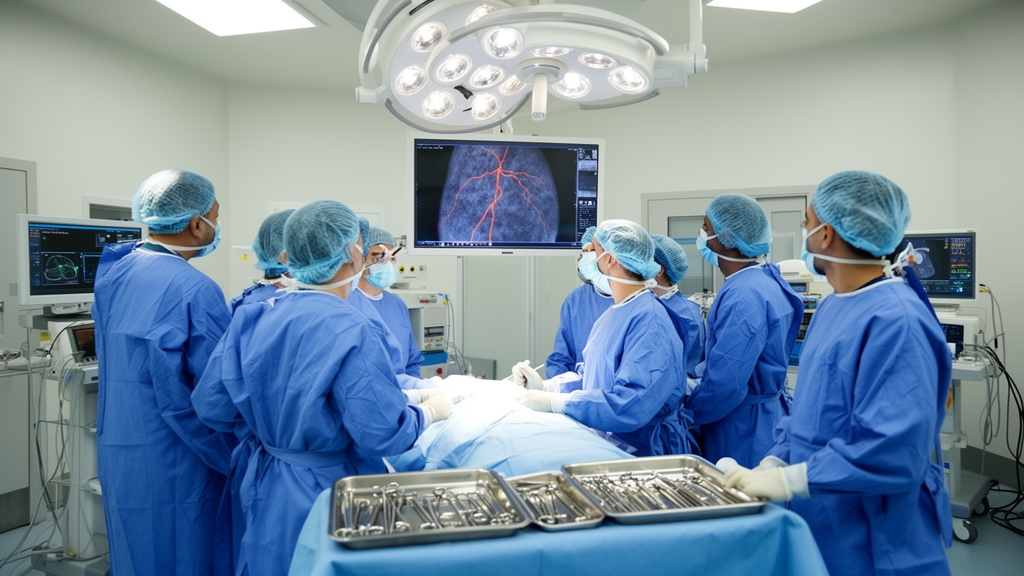
Surgeons in Egypt have reported how fourteen patients with symptomatic nutcracker syndrome fared after surgical or endovascular treatment across four tertiary vascular referral centers, in one of the largest multicenter experiences of surgically managed nutcracker syndrome published from the Middle East. The retrospective case series, conducted between January 2018 and December 2023, found that left renal vein transposition was the dominant treatment and that immediate technical success was achieved in every intervention, with no perioperative mortality or life-threatening complications. Most patients experienced complete or substantial relief of their symptoms during follow-up, although the authors caution that radiological surveillance was incomplete and that two patients developed occlusions of their reconstructed veins, one of whom continued to experience intermittent symptoms.
Nutcracker syndrome is an uncommon vascular compression disorder caused by extrinsic compression of the left renal vein, which produces renal venous hypertension. In its classic anterior form, the vein is squeezed between the superior mesenteric artery and the abdominal aorta. Less frequently, a posterior variant arises when a retro-aortic left renal vein is compressed between the aorta and the vertebral column. The vein can also be doubled in a pre-aortic and retro-aortic fashion, a configuration known as a circum-aortic left renal vein or renal collar, which occurs in an estimated 0.3 to 5.7 percent of people. Although the anatomical phenomenon of renal vein compression is relatively common, only a small proportion of affected individuals develop clinically significant symptoms, which distinguishes the syndrome from the asymptomatic nutcracker phenomenon.
The pathophysiological hallmark of the condition is renal venous hypertension secondary to impaired outflow of the left renal vein. Elevated venous pressure drives the development of collateral pathways through the gonadal, adrenal, lumbar, and pelvic venous systems, producing a wide spectrum of manifestations. Patients commonly present with intermittent or persistent hematuria, orthostatic proteinuria, left flank pain, and fatigue. In males, venous hypertension frequently manifests as left-sided varicocele, whereas females may develop pelvic congestion syndrome characterized by chronic pelvic pain, dyspareunia, dysmenorrhea, and pelvic heaviness. Because these symptoms overlap with urological, gynecological, gastrointestinal, and musculoskeletal disorders, diagnosis is often delayed, and no single investigation is considered diagnostic in isolation.
In the reported cohort, the fourteen consecutive patients comprised nine males, or 64.3 percent, and five females, or 35.7 percent, with ages ranging from 15 to 48 years. Hematuria was the most frequent presenting symptom, occurring either alone or in combination with left flank pain or varicocele. Male patients commonly presented with symptomatic left-sided varicocele, while female patients predominantly reported pelvic congestion symptoms including pelvic heaviness, dyspareunia, dysmenorrhea, and chronic low back pain. One patient presented with concomitant superior mesenteric artery syndrome, manifesting as postprandial abdominal pain, vomiting, fear of eating, and weight loss in addition to intermittent hematuria. Cross-sectional imaging demonstrated anterior nutcracker anatomy in the majority of patients, three patients had posterior compression associated with a retro-aortic left renal vein, and one patient had a circum-aortic left renal vein with anterior compression.
Diagnosis in the series relied on correlating clinical findings with multimodal imaging. Duplex ultrasonography was used for all cases as an initial non-invasive assessment, with an aortomesenteric-to-hilar peak-velocity ratio of approximately five or greater considered supportive of significant compression. Anatomical confirmation was obtained by computed tomography venography or magnetic resonance venography, and an aortomesenteric angle measured on sagittal images of less than 35 degrees was considered supportive of anterior nutcracker anatomy. Selective retrograde venography with measurement of the reno-caval pressure gradient, with a gradient of at least 3 mmHg between the left renal vein and the inferior vena cava considered indicative of renal venous hypertension, was reserved for patients planned for endovascular treatment. In the one stented case, pre-intervention venography demonstrated a gradient of 4.6 mmHg. The authors note that extensive collateral pathways may decompress the renal vein and yield a modest gradient despite clinically significant venous hypertension, so decisions to intervene should integrate clinical presentation with anatomical and imaging findings rather than rely on a single hemodynamic threshold.
Open surgery was the predominant treatment strategy. Left renal vein transposition, performed through a midline transperitoneal approach after systemic heparinization, was carried out in eleven patients, or 78.6 percent, and served as the standard operative procedure for both anterior and selected posterior anatomical variants. The procedure involves detaching the vein from its native insertion and reimplanting it into the inferior vena cava in a tension-free, hand-sewn end-to-side anastomosis, with the gonadal vein routinely ligated when appropriate. In one patient with predominant gonadal venous reflux, marked gonadal vein dilatation of 12 millimeters, and favorable venous anatomy, surgeons instead performed a left gonadal vein transposition, reimplanting the gonadal vein directly into the inferior vena cava. One patient with combined anterior nutcracker syndrome and superior mesenteric artery syndrome underwent simultaneous left renal vein transposition and duodenojejunostomy, while another patient was treated with endovascular stenting using a 14 by 60 millimeter Wallstent deployed after balloon venoplasty.
Immediate technical success, defined as successful decompression with restoration of unobstructed venous flow for open surgery and satisfactory stent deployment with restored renal venous drainage for endovascular procedures, was achieved in all patients. Early postoperative complications were uncommon: three patients developed transient postoperative ileus that resolved with conservative management, and one patient experienced a superficial wound infection treated successfully with antibiotics and local wound care. No perioperative mortality, major hemorrhage, renal failure, or procedure-related vascular injury occurred. Postoperative antithrombotic therapy was not standardized across the participating centers; direct oral anticoagulants were prescribed for periods ranging from six months to lifelong therapy, and in selected patients lifelong aspirin was combined with one year of anticoagulation following venous reconstruction or stenting.
Clinical follow-up was available for thirteen of the fourteen patients, with one patient lost to follow-up. Among those with available follow-up, hematuria resolved completely in nearly all affected patients, and patients presenting with flank pain, varicocele, and pelvic congestion symptoms experienced marked or complete symptom relief. The patient treated for both nutcracker syndrome and superior mesenteric artery syndrome achieved complete resolution of gastrointestinal symptoms together with significant weight gain. No late mortality was documented and no secondary intervention was performed during the recorded follow-up period. However, postoperative cross-sectional imaging was documented in only five of the fourteen patients, because routine surveillance was not standardized. Three of these demonstrated patent venous reconstructions, whereas two demonstrated occlusions, meaning overall anatomical patency for the full cohort could not be determined.
The two occlusions illustrate the complexity of interpreting imaging findings against clinical status. One patient developed left renal vein occlusion six months after transposition and continued to experience intermittent hematuria, flank pain, and persistent varicocele, but judged the residual symptoms moderate and tolerable and preferred conservative management, so reintervention was not considered clinically warranted. The patient who underwent gonadal vein transposition developed occlusion of the transposed gonadal vein at one-year imaging yet remained completely asymptomatic, without recurrent abdominal pain or varicocele. The authors caution that because systematically documented renal function parameters and urinalysis were absent at that time point, persistent subclinical renal venous hypertension or renal consequences cannot be definitively excluded in that case. The stented patient demonstrated sustained symptom resolution without radiological evidence of stent-related complications during follow-up.
The authors emphasize that their study has important limitations. The retrospective design introduces possible selection bias, the small sample size reflects the rarity of symptomatic nutcracker syndrome and limits statistical analysis, treatment strategies were not standardized, and follow-up duration varied among patients. Patients managed conservatively were excluded because complete longitudinal data were not consistently available, so the series represents the more symptomatic, interventionally selected spectrum of the condition and cannot compare intervention against observation. Nevertheless, the multicenter design provides real-world experience from specialized vascular units, and the inclusion of anterior and posterior anatomical variants, multiple operative techniques, and endovascular management offers a broad overview of contemporary practice. The authors conclude that left renal vein transposition remains a durable and effective surgical option, that endovascular stenting is a valuable minimally invasive alternative in carefully selected patients, and that future prospective multicenter studies with standardized follow-up protocols are required to establish evidence-based diagnostic criteria and treatment algorithms.
Subject of Research: Surgical and endovascular management of nutcracker syndrome in Egyptian patients
Article Title: Management of Nutcracker syndrome; a multicentric case series study among Egyptian population
Article References: Naga, A. R., Taha, A. A., Kassem, A. M., Eleshra, A. S., Saad, E. M., Abdelgawad, M. S., Abdelbary, M. S., Moustafa, S., & Shaalan, W. E. (2026). Management of Nutcracker syndrome; a multicentric case series study among Egyptian population. African Journal of Urology, 32(1), Article 74. https://doi.org/10.1186/s12301-026-00624-z
Image Credits: AI Generated
DOI: 10.1186/s12301-026-00624-z
Keywords: nutcracker syndrome, left renal vein compression, renal venous hypertension, left renal vein transposition, endovascular stenting, vascular surgery, hematuria, varicocele, pelvic congestion syndrome, retro-aortic renal vein, multicenter case series, Egypt
News Source: Ophelia Keating. (October 28, 2026). Egyptian surgeons report outcomes in 14 patients treated for nutcracker syndrome. Scienmag.