Restricted military areas inside South Korea’s Gyeryongsan National Park may be doing more than their official duty: according to a new study published in BMC Zoology, zones off-limits to the public appear to function as quiet refuges for some of the region’s most disturbance-sensitive carnivores, including the leopard cat and the yellow-throated marten.
Gyeryongsan National Park offered an ideal natural experiment, because it contains both military zones and non-military zones within a single protected area.
From May to November 2021, the researchers deployed 21 camera traps across the park, six inside the military zone and 15 in the non-military zone. Alongside the photographic records, they compiled 36 environmental variables measured at multiple spatial scales, allowing them to model not just where animals appeared but which landscape features shaped their presence.
The analytical approach combined two methods. Temporal activity patterns were compared between the zones using kernel density estimation, a technique that smooths detection times into continuous daily activity curves and reveals whether species shift their behavior between day and night in different contexts. Spatial habitat use was then assessed with Bayesian single-species occupancy models, which estimate the probability that a species occupies a site even when it is not detected on every visit, while accounting for environmental predictors.
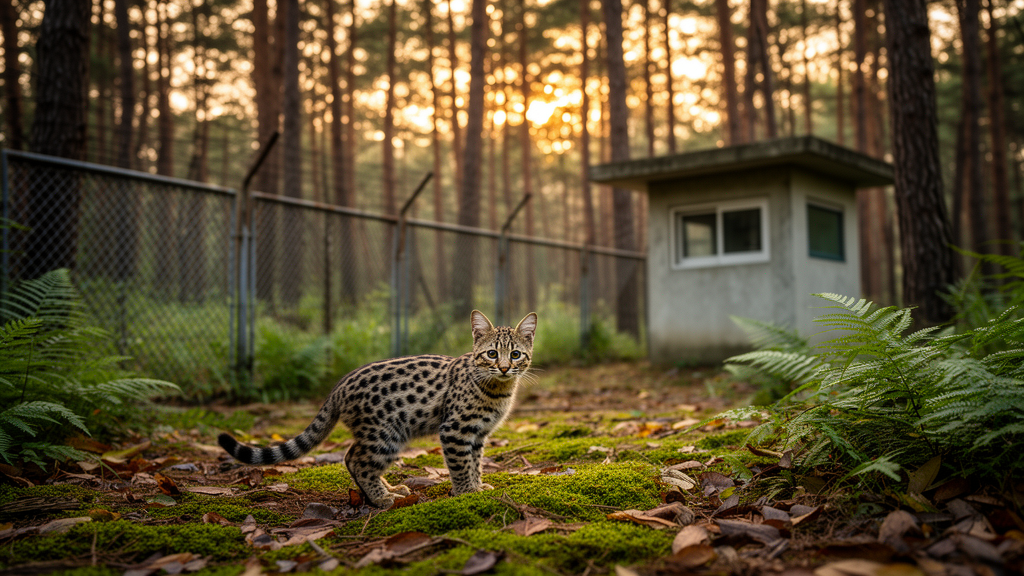
The results were nuanced rather than uniform. Overall community composition was broadly similar between the two zones, meaning most mammals used both areas. But the two carnivores most sensitive to human disturbance stood out. The leopard cat (Prionailurus bengalensis) showed higher estimated occupancy in the military zone, suggesting it favored the quieter, less disturbed side of the park. The yellow-throated marten (Martes flavigula), by contrast, differed in its diel activity patterns between zones, adjusting when it was active rather than simply where.
In a striking reversal, several more disturbance-tolerant or generalist species were actually more strongly associated with the non-military zone. Water deer (Hydropotes inermis), wild boar (Sus scrofa), raccoon dogs (Nyctereutes procyonoides) and Asian badgers (Meles leucurus) all showed stronger links to the publicly accessible part of the park.
Taken together, the authors argue, the findings suggest that military zones can act as low-disturbance refuges for sensitive species and provide conservation value that complements, rather than duplicates, the ordinary protected areas around them.
The study’s design also carries lessons for how conservationists monitor such places.
The researchers are careful about the limits of their work. The survey covered a single park over one season, with only six cameras in the military zone, and the article is an early shared version of the accepted manuscript that is still subject to further edits. The authors explicitly note that long-term, multi-site monitoring is needed to determine whether the refuge effect they observed can be generalized to military zones elsewhere.
Subject of Research: Camera-trap and occupancy modeling study of medium and large mammal distribution and activity inside and outside military zones in Gyeryongsan National Park, South Korea.
Article Title: Assessing mammal diversity in a national park containing a military zone: a case study from Gyeryongsan National Park
Article References: Kim, M., Noe, C., Kim, H. G., Moon, J. C., Kim, E.-K., & Hong, S. (2026). Assessing mammal diversity in a national park containing a military zone: a case study from Gyeryongsan National Park. BMC Zoology. https://doi.org/10.1186/s40850-026-00296-w
Image Credits: AI Generated
DOI: 10.1186/s40850-026-00296-w
Keywords: military zones, Gyeryongsan National Park, leopard cat, yellow-throated marten, camera traps, occupancy models, mammal diversity, biodiversity conservation, South Korea, disturbance-sensitive species, wildlife refuges, BMC Zoology
News Source: Margaret Porter. (October 28, 2026). Military zones may shelter sensitive mammals in South Korean national park. Scienmag.