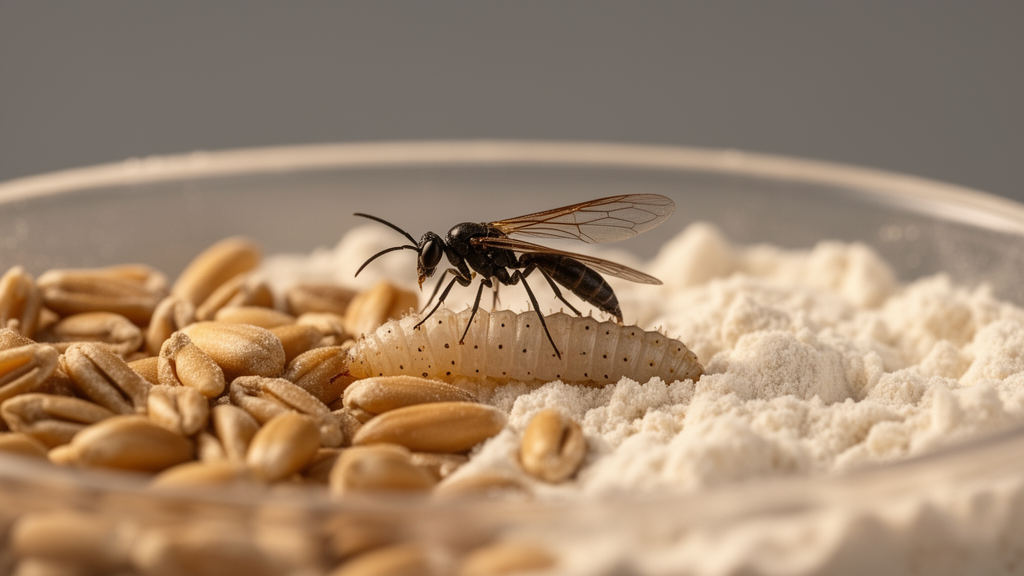
A laboratory study published in the Egyptian Journal of Biological Pest Control reports that the Indianmeal moth, Plodia interpunctella, can serve as a practical alternative host for mass rearing Meteorus pulchricornis, a solitary koinobiont endoparasitoid wasp that attacks a wide range of lepidopteran crop pests. The research, led by Rui Shi and colleagues, compared parasitoids reared on P. interpunctella larvae with those reared on Spodoptera frugiperda, a natural host of the wasp. While the alternative host produced slightly smaller, shorter-lived and less fecund offspring, the key production metrics that matter most in a mass-rearing facility did not differ significantly between the two host species.
Meteorus pulchricornis (Hymenoptera: Braconidae) parasitizes economically important noctuid pests including Spodoptera frugiperda, Spodoptera exigua and Helicoverpa armigera. The species is widely distributed in the Palaearctic Region, and its Asian populations are predominantly thelytokous parthenogenetic, meaning females reproduce without mating, whereas European populations are mostly sexual. The strain used in the study was parthenogenetic, with founding adults originally collected from S. frugiperda larvae in Ningbo, Zhejiang Province, China, in November 2021. Despite its recognized potential as a biological control agent, large-scale application of the wasp has been hindered by the difficulties of rearing it on natural hosts, which carry high maintenance costs and low reproductive efficiency under laboratory conditions.
The Indianmeal moth is a globally distributed stored-product pest that has long been used as a factitious host for other parasitoid species. It offers high fecundity, a short developmental cycle, tolerance of broad environmental conditions, and ease of rearing on artificial diets. Its suitability for supporting the complete development and reproductive performance of M. pulchricornis, however, had remained untested before this study. The authors therefore evaluated parasitism behavior, developmental success and fitness-related traits on P. interpunctella larvae and compared these parameters with those obtained on the conventional host S. frugiperda.
The experimental colony of P. interpunctella was obtained from Zhejiang University and had been reared for more than 30 consecutive generations on an artificial diet of wheat flour, glycerol, honey, yeast powder and propionic acid. The parasitoid colony had been maintained for roughly 50 generations on S. frugiperda and 20 generations on P. interpunctella. Preliminary assays identified early fifth-instar P. interpunctella larvae and early third-instar S. frugiperda larvae, both approximately 10 to 13 millimeters long, as the most suitable stages for parasitism. All experiments were conducted at 26 ± 1 °C, 60 ± 5% relative humidity and a 16-hour light to 8-hour dark photoperiod.
In the host-density experiments, single 7-day-old naïve female wasps were exposed to larvae of either host species at six parasitoid-to-host ratios ranging from 1:5 to 1:30, with each exposure lasting eight hours. The number of parasitized larvae was significantly influenced by host density but not by host species or their interaction. Parasitized numbers increased with density for both hosts, reaching a plateau at 20 to 30 larvae per container for P. interpunctella. Parasitism rates, by contrast, declined significantly with increasing host density, and no significant difference in parasitism rates between the two host species was detected at any density. Cocoon formation and adult emergence rates were unaffected by either host species or density.
A crucial practical discovery concerned silk. P. interpunctella larvae produce dense silken structures during development, and these webs interfered with cocoon formation and adult emergence of the parasitoid. In a supplementary experiment, manually removing the silk with sterile forceps at eight days post-parasitism, the time point identified as optimal, raised cocoon formation rates from 71.67% to 91.25% and adult emergence rates from 73.33% to 93.75%, both statistically significant differences. The authors note that silk removal is performed only once per rearing cycle, takes only a few seconds per larva, and could eventually be mechanized with sieving techniques at industrial scale.
Progeny reared from the two hosts differed in several fitness traits. Wasps from P. interpunctella took longer to develop, 15.27 ± 0.33 days versus 14.73 ± 0.50 days, and lived shorter as adults, 16.63 ± 1.99 days versus 17.73 ± 1.64 days. They were also consistently smaller: mean body length was 3.87 ± 0.23 mm versus 4.60 ± 0.18 mm, forewing length 3.07 ± 0.21 mm versus 3.63 ± 0.19 mm, and hind tibia length 1.35 ± 0.11 mm versus 1.67 ± 0.06 mm, all differences highly significant. The authors attribute these reductions to the host-size principle, since the smaller P. interpunctella larvae presumably offer fewer nutritional resources to the developing parasitoid.
Reproductive output also favored the natural host. When continuously exposed to S. frugiperda larvae, P. interpunctella-reared females produced a total lifetime fecundity of 17.10 ± 4.82 eggs, peaking at 4.10 ± 0.94 eggs per day on day five, while S. frugiperda-reared females produced significantly more eggs over their lifetime, 26.70 ± 4.40, with peak daily oviposition of 6.20 ± 1.72 eggs on day six. Yet the traits most directly tied to production efficiency were statistically indistinguishable between host origins: mean parasitism rates on S. frugiperda were 48.00 ± 19.32% for P. interpunctella-origin wasps versus 50.00 ± 17.00% for S. frugiperda-origin wasps, cocoon formation rates were 90.83 ± 14.93% versus 91.67 ± 18.00%, and adult emergence rates were 93.33 ± 14.05% versus 94.17 ± 12.45%, with none of these differences significant.
The economic analysis strengthened the case for the alternative host. Under laboratory conditions with self-prepared diets, the artificial diet for P. interpunctella cost approximately ¥6.74 (US$0.98) per kilogram, compared with ¥12.12 (US$1.76) per kilogram for S. frugiperda, a difference of roughly 44%. Labor requirements also favored the new host: rearing 1,000 S. frugiperda larvae requires about 80 minutes of daily feeding and maintenance per person, whereas P. interpunctella needs only 15 minutes every five days without silk removal, or about 60 minutes per day with manual silk removal. Even with the extra silk-removal step, the authors conclude that P. interpunctella retains a cost advantage, partly because S. frugiperda is highly mobile and cannibalistic at high densities, forcing frequent container changes and separate rearing.
The authors place their results in context by noting that the Mediterranean flour moth, Ephestia kuehniella, has previously been identified as a potential M. pulchricornis host but achieves only around 80% adult emergence even under optimal conditions, below the rates reported here for P. interpunctella. They suggest that reduced per-capita fecundity could be offset in the field by moderately increasing release densities without expanding the production budget, supported by the high and stable cocoon formation and emergence rates. However, the study has clear limitations that the authors themselves emphasize. Only the F1 generation was assessed, so the long-term effects of continuous rearing on P. interpunctella over multiple generations, including possible fitness declines and impacts on genetic diversity, remain unknown. Field performance also remains unvalidated: smaller body size in parasitoid wasps is typically associated with reduced flight capacity and foraging range, and shortened longevity and fecundity could attenuate pest suppression in open-field settings. The authors propose nutritional fortification of host larvae and nutrient supplementation for adult wasps as optimization strategies, and call for field validation as the critical next step before this laboratory result can translate into operational biological control programs.
Subject of Research: Evaluating the Indianmeal moth as an alternative host for laboratory mass rearing of the parasitoid wasp Meteorus pulchricornis
Article Title: Plodia interpunctella as the suitable alternative host for mass rearing of Meteorus pulchricornis
Article References: Shi, R., Lu, J., Shi, A., Shu, X., Yang, L., Wang, P., Yan, Y., Li, Z., Wu, Q., Wang, Z., Ye, X., Chen, X., & Tang, P. (2026). Plodia interpunctella as the suitable alternative host for mass rearing of Meteorus pulchricornis. Egyptian Journal of Biological Pest Control, 36(1), Article 16. https://doi.org/10.1186/s41938-026-00898-z
Image Credits: AI Generated
DOI: 10.1186/s41938-026-00898-z
Keywords: Meteorus pulchricornis, Plodia interpunctella, Indianmeal moth, parasitoid wasp, biological control, mass rearing, Spodoptera frugiperda, host density, silk removal, artificial diet, augmentative biological control, insect rearing
News Source: Alan Morgan. (October 30, 2026). Indianmeal Moth Proves Efficient Alternative Host for Rearing Parasitoid Wasp. Scienmag.