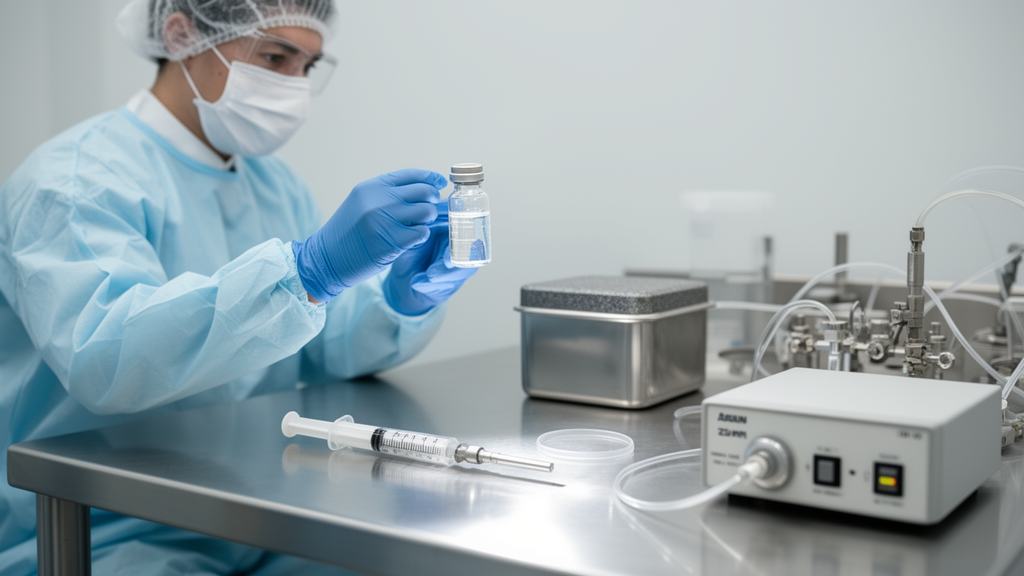
Researchers have developed a good manufacturing practice (GMP) kit that allows hospital radiopharmacies to prepare an injection of zirconium-89 labelled pembrolizumab, a radiopharmaceutical designed to visualise where the checkpoint inhibitor pembrolizumab reaches tumours in patients. The work, published in EJNMMI Radiopharmacy and Chemistry, reports three sequential lots of unit-dose kits together with preclinical imaging, biodistribution, dosimetry and toxicity studies intended to bridge the way to a clinical trial of PET imaging of pembrolizumab delivery to lung cancer brain metastases.
PET with [89Zr]Zr-Bn-DFO-pembrolizumab is described by the authors as a potential imaging biomarker to assess delivery of pembrolizumab to tumours and to predict response to PD-1 checkpoint immunotherapy. Until now, clinical-quality material had been prepared only through multistep radiolabelling processes, and no kit formulation had been reported. Kits simplify production by supplying the antibody conjugate pre-formulated, so that a site need only add the zirconium-89 radionuclide before patient administration.
Each kit contained 2 mg of Bn-DFO-pembrolizumab in 1.0 mL of 0.1 M sodium bicarbonate buffer at pH 7.4. All three sequential lots met the release specifications set for protein concentration (1.8–2.2 mg/mL), pH (7.0–7.5), purity and homogeneity assessed by SDS-PAGE, Bn-DFO conjugation of 3.0 to 6.0 groups per antibody, PD-1 binding affinity with a KD of 1 to 35 pM, and sterility and endotoxin testing according to United States Pharmacopeia methods. Radiolabelling with 37 MBq of zirconium-89 achieved an efficiency of 98.8 to 99.4 percent.
In preclinical imaging, PET specifically visualised PD-1-positive MOLT-4 human T-cell lymphoblastic leukemia tumours in NRG mice at 72 hours after injection of the radiopharmaceutical prepared from the kit. Biodistribution studies in non-tumour bearing BALB/c mice revealed slow elimination from the blood, and the highest normal organ uptake in the lungs, liver, kidneys, spleen and bone. Notably, there was no uptake in the brain, an observation relevant to the planned imaging of brain metastases, since the tracer is expected to reflect pembrolizumab delivery rather than background brain signal.
Dosimetry projections for adult humans injected with 37 MBq of the radiopharmaceutical identified the kidneys, liver, lungs, red marrow, osteogenic cells and spleen as the organs receiving the highest equivalent doses.
Toxicity was assessed by administering multiples of the intended human administered activity and mass per kilogram to healthy BALB/c mice. Over 14 days the animals showed no decrease in body weight or blood cell counts and no increases in liver transaminases or creatinine, indicating no toxicity at the doses tested. The authors caution that these are preclinical findings, and that safety and efficacy in humans remain to be demonstrated in the planned clinical trial.
The study concludes that a kit formulated under GMP conditions can prepare [89Zr]Zr-Bn-DFO-pembrolizumab injection in a quality suitable for patient administration, and that the translational bridge studies predict the radiopharmaceutical would be safe and effective for PET imaging in humans, with a whole-body dose comparable to a standard FDG PET scan.
Subject of Research: Development of a GMP kit for preparing zirconium-89 labelled pembrolizumab for PET imaging of PD-1, with preclinical imaging, biodistribution, dosimetry and toxicity studies.
Article Title: A kit formulated under good manufacturing practices (GMP) for preparing [89Zr]Zr-Bn-DFO-Pembrolizumab injection for human administration and associated preclinical imaging, biodistribution, dosimetry and toxicity studies
Article References: Borlase, S., Chan, C., Cai, Z., & Reilly, R. M. (2026). A kit formulated under good manufacturing practices (GMP) for preparing [89Zr]Zr-Bn-DFO-Pembrolizumab injection for human administration and associated preclinical imaging, biodistribution, dosimetry and toxicity studies. EJNMMI Radiopharmacy and Chemistry. https://doi.org/10.1186/s41181-026-00498-0
Image Credits: AI Generated
DOI: 10.1186/s41181-026-00498-0
Keywords: immunoPET, pembrolizumab, zirconium-89, radiopharmaceutical kit, GMP, PD-1, dosimetry, preclinical imaging, lung cancer brain metastases, PET, formulated, under
News Source: Nathaniel Bowman. (October 29, 2026). GMP kit enables ready-to-use zirconium-89 pembrolizumab PET imaging agent. Scienmag.