


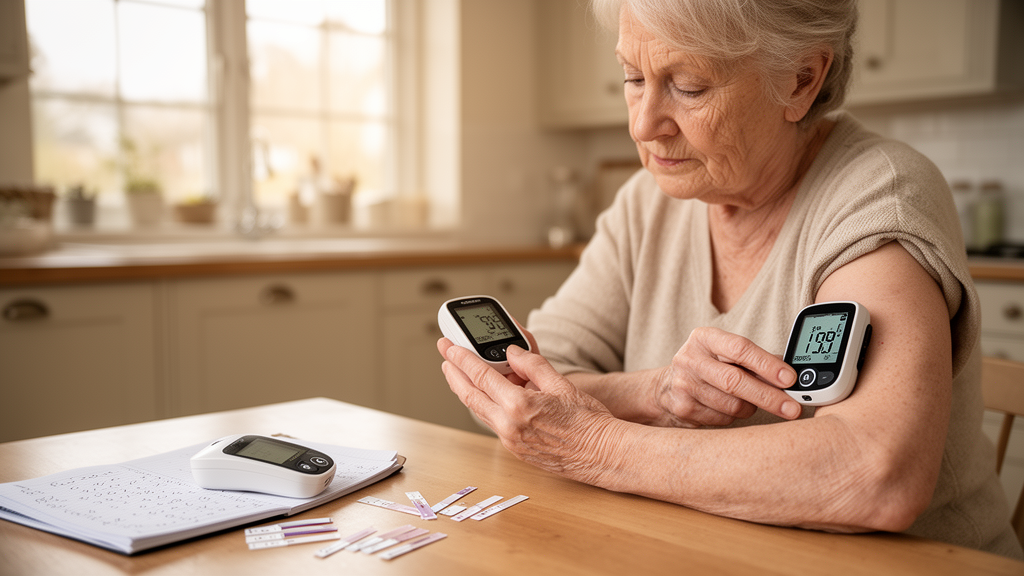
Many older adults living with type 1 diabetes are holding themselves to blood sugar targets designed for much younger patients, and in many cases they are aiming even lower than the goals their own doctors recommend for them. That is the central finding of a new survey study published in the journal Discover Endocrinology and Metabolism, which examined how closely the glycemic goals of adults aged 65 and older with type 1 diabetes match the targets their providers reportedly advise.
According to the paper's methods section, the study recruited 346 adults aged 65 and older with type 1 diabetes from the national T1D Exchange registry and online community between August 27, 2024 and October 9, 2024; the author list includes Anastasia-Stefania Alexopoulos and Anna R. Kahkoska. The methods section states that respondents completed an electronic survey providing demographic and diabetes care data, including their personal and their provider's recommended targets. For each set of targets, respondents reported the low end and high end of the target blood glucose range in milligrams per deciliter, as well as a hemoglobin A1c goal in percent. The authors note that the nature of recruitment made it difficult to estimate how many people received information about the study, so no response rate was calculated.
The cohort had a mean age of 70 years and was predominantly female, at 63 percent, and White, at 96.5 percent. These were experienced and well-equipped patients: 96.9 percent used continuous glucose monitors, and 77.6 percent used insulin pumps. Respondents reported a personal target blood glucose range averaging 79 milligrams per deciliter at the low end to 169 milligrams per deciliter at the high end, with a standard deviation of 14 and 31 respectively, and a personal hemoglobin A1c target of 6.5 percent on average. When asked what their providers recommended, they reported a slightly more relaxed picture: a low end of 79 milligrams per deciliter, a high end of 178 milligrams per deciliter, and a hemoglobin A1c target of 6.8 percent.
To assess agreement between patient and patient-perceived provider glycemic goals, the researchers used concordance correlation coefficients, a statistic ranging from minus 1 to 1. The values pointed to only moderate agreement between what patients wanted for themselves and what they believed their providers wanted for them. The coefficient was 0.63 for the low end of the blood glucose target range, 0.52 for the high end, and 0.52 for hemoglobin A1c, according to the results section of the paper; the figure caption reports closely matching values of 0.62, 0.50, and 0.53 for the same three comparisons. Notably, the coefficient rose to 0.74 when the researchers compared each participant’s personal hemoglobin A1c target with that participant’s most recent self-reported hemoglobin A1c, suggesting patients were largely achieving the strict goals they set for themselves.
The headline finding, as the authors summarize it in their abstract, is that many participants reported hemoglobin A1c goals below 7 percent, targets consistent with early and middle adulthood but not necessarily with older adulthood. Participants also reported stricter targets than their providers, a mismatch the authors say reflects the complexity of modifying glycemic goals in clinical practice. The discordance was concentrated at the upper limit of the glucose range, which the researchers interpret as a sign that patients are less comfortable with hyperglycemia, or high blood sugar, than their providers are. That discomfort, they note, presents a real challenge to shared decision-making in the clinic.
The clinical backdrop explains why this matters. Older adults with diabetes experience more hypoglycemia, dangerously low blood sugar, and worse consequences when it occurs, which is why clinical guidelines suggest individualized relaxation of glycemic goals in this age group. Older adults with type 1 diabetes are at especially high risk because they require intensive insulin regimens, such as multiple daily injections or insulin pump therapy, that leave little margin for error. Among otherwise healthy older adults with type 1 diabetes and few coexisting chronic conditions, the authors note, a hemoglobin A1c target of 7 to 7.5 percent or below is appropriate and aligns with guidelines. But as comorbidity burden grows, or as cognitive and functional deficits accrue, glycemic goals should balance the high risk of hypoglycemia against the less likely benefits of lower targets. For older adults with multiple chronic illnesses and moderate functional impairment, a hemoglobin A1c goal below 8 percent may be appropriate, with less reliance on the measure altogether for those with end-stage disease or severe functional or cognitive impairment.
Context softens the alarm somewhat. Most respondents in this study had a low comorbidity burden and were using continuous glucose monitoring, a technology known to improve safety related to hypoglycemia. As such, the authors write, targeting a hemoglobin A1c below 7 percent may have been appropriate for most respondents. Still, the data suggest potentially missed opportunities to optimize the balance of risk and benefit by aligning more closely with guidelines, for example among the roughly one in four participants with hypoglycemia unawareness, the loss of the warning symptoms that normally precede a dangerous drop in blood sugar, or the one in five with cardiovascular disease. The tendency toward overtreatment in older adults is well documented, though mostly in type 2 diabetes, and the authors call for future studies exploring whether and why it occurs in different contexts. As they point out, it may be reasonable to maintain lower glycemic goals in a functional older adult who uses continuous glucose monitoring and has limited hypoglycemia, yet inappropriate in a similar older adult without such a device who lives alone and reports hypoglycemic episodes.
There is a second, subtler tension in the data. Even the provider-recommended goals, as reported by patients, were more stringent than guideline suggestions: 6.8 percent on average, compared with the less than 7 to 7.5 percent the guidelines recommend for this population. The authors suggest that among older adults who have successfully self-managed their type 1 diabetes for years, there may be a reluctance to relax glycemic goals, and that providers may simply be mirroring the goals of their patients. Patient preferences do legitimately play an important role in individualizing targets. But the authors cite a national survey of more than 800 older adults with diabetes in which beliefs about glycemic goals ran opposite to the guidelines, with older adults feeling that more aggressive targets were merited in the presence of established complications. That makes it essential, they argue, for providers to explain the rationale behind current recommendations, since successful shared decision-making relies on an exchange of information and a mutual understanding of how to move forward.
The authors are candid about the limits of their work. Generalizability is constrained because the cohort was well-resourced, had excellent glycemic management, and was limited in diversity, overwhelmingly White and almost universally equipped with continuous glucose monitors and pumps. The provider goals, moreover, were self-reported by patients rather than confirmed with clinicians, so the study measures perceived provider recommendations as much as actual ones. Even so, the findings offer a clear window into how older adults with type 1 diabetes think about their own control, and how they perceive their goals to align with those of their providers. The authors conclude that additional studies are needed to understand why certain older adults with type 1 diabetes hold stricter goals than their providers, how such discordant goals may affect downstream outcomes, and how these patients actually want to engage in conversations about their glycemic targets.
Subject of Research: Glycemic goal setting and patient-provider agreement in older adults with type 1 diabetes
Article Title: Comparing self-reported personal and provider glycemic goals from older adults with type 1 diabetes
Article References: Alexopoulos, A.-S., DeMonte, J., Sarteau, A. C., Fruik, A., Pilla, S. J., & Kahkoska, A. R. (2026). Comparing self-reported personal and provider glycemic goals from older adults with type 1 diabetes. Discover Endocrinology and Metabolism, 2(1), Article 2. https://doi.org/10.1007/s44417-026-00015-6
Image Credits: AI Generated
DOI: 10.1007/s44417-026-00015-6
Keywords: type 1 diabetes, older adults, glycemic goals, hemoglobin A1c, hypoglycemia, clinical guidelines, continuous glucose monitoring, shared decision-making, survey study, patient-provider discordance, insulin therapy, overtreatment
News Source: Ophelia Keating. (October 29, 2026). Older Adults with Type 1 Diabetes Aim Stricter Than Their Doctors. Scienmag.



