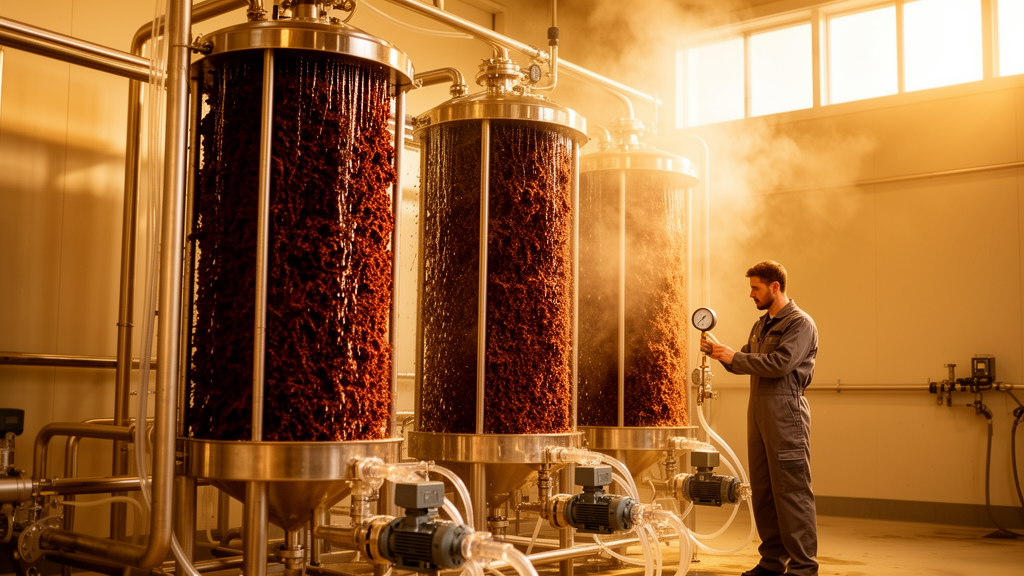
Engineers in New Zealand have kept laboratory-scale biotrickling filters running for roughly 700 days while methane-oxidizing microbes thrived in conditions that would kill most conventional biofilter communities: a scalding 45 degrees Celsius and a corrosive pH between 2.2 and 2.5. The study, published in Frontiers in Bioengineering and Biotechnology, reports the first long-term operation of thermoacidophilic methane-removing biotrickling filters, a class of reactor that until now had never been demonstrated for this purpose.
The team, led by Fletcher Gilbertson, Aaron T. Marshall, Carlo R. Carere and Peter A. Gostomski at the University of Canterbury, built four glass-column reactors packed with rock and fed them methane-laden gas streams. Their goal was to enrich communities of methanotrophs, bacteria that consume methane and convert it to carbon dioxide, from an unlikely starting point: geothermally heated soil collected at Rotokawa, New Zealand. That soil was dominated by acid-loving sulfur oxidizers, with the target methane eaters of the genus Methylacidiphilum making up just 0.54 percent of the initial microbial population.
Despite those long odds, the selection pressure of constant methane supply under extreme conditions worked decisively. After an initial enrichment period of 43 days, Methylacidiphilum species dominated the reactor communities at 47 to 99 percent relative abundance, and they held that dominance throughout two years of continuous operation. These organisms, belonging to the phylum Verrucomicrobiota, are known to grow between 40 and 60 degrees Celsius at pH values from 1 to 6, and they are naturally acclimated to sulfurous geothermal environments where hydrogen sulfide is common.
Performance depended heavily on how much oxygen the reactors received. One reactor operated essentially anaerobically, with less than 500 parts per million oxygen leaking in through diffusion, and removed almost no methane, just 1.17 grams per cubic meter per hour. When the operators switched that reactor to microaerobic conditions with 1 to 3 percent inlet oxygen on day 302, its elimination capacity jumped ninefold within 35 days to 11.1 grams per cubic meter per hour. By day 320 it reached a removal efficiency of 96 percent, and when the methane loading rate was raised to avoid substrate limitation, the reactor sustained an elimination capacity of 41.9, plus or minus 2.6, grams per cubic meter per hour for 33 consecutive days, the largest sustained and stable figure recorded among all four reactors in the study.
The two reactors run under fully aerobic conditions, with 8 to 12 percent inlet oxygen, achieved maximum elimination capacities of 30.7, plus or minus 2.4, and 18.6, plus or minus 3.2, grams per cubic meter per hour, at methane loading rates of 155.1 and 236.3 grams per cubic meter per hour respectively. Those figures are comparable to many mesophilic, non-extreme methane biofilters, though below the best thermophilic systems at neutral pH, which have reported maxima of 75 and 182 grams per cubic meter per hour. Notably, the reactors did not simply plateau at high loading rates as methane biofilters typically do. Instead, their elimination capacities declined when loading exceeded roughly 100 grams per cubic meter per hour.
The reason for that decline points to a metabolic bottleneck. When the oxygen-to-methane ratio in the feed became insufficient for complete oxidation, the reactors accumulated formic acid in their recirculating liquid, reaching concentrations of up to 5.6 millimolar. Methylacidiphilum is reported to be inhibited by formate above 1 millimolar, so the accumulating intermediate likely suppressed methane metabolism even as the microbes kept respiring. Gas measurements backed this up: carbon dioxide recovery exceeded 100 percent of the theoretical yield from methane oxidation, and oxygen consumption stoichiometries climbed above the theoretical two moles of oxygen per mole of methane. The researchers attribute this to the bacteria burning through internal storage polymers such as glycogen, accumulated during earlier periods of unbalanced growth when oxygen or nitrogen was limiting, and possibly to other community members oxidizing excreted metabolites.
The physical side of the reactors proved as important as the biology. Early glass-bead packing failed completely, producing no biofilm and no methane removal over 120 days, likely because the negatively charged cell surfaces of the acidophilic inoculum, dominated by Acidithiobacillus, repelled the positively charged glass surfaces at low pH. Switching to coarse pumice rock solved the problem, with biofilms establishing within 35 days in three reactors. But the thriving biofilms then became their own obstacle: continued growth raised pressure drop across the beds and caused flooding, forcing the operators to periodically invert the columns to dislodge excess biomass. Tracer dye experiments near the end of the run revealed considerable liquid channelling through the beds, and void spaces of one to two centimeters developed after flooding events, both signs that portions of the biofilm were being starved of nutrients and gas contact.
An unexpected chemistry lesson emerged from the reactor hardware itself. Metal support structures rusted within the first 65 days, and analysis of the sump liquid showed soluble iron concentrations climbing to 160 parts per million, eighty times the level in the nutrient medium. The iron dissolution likely had both abiotic and biological origins, and it favored iron-cycling acidophiles: Sulfobacillus and Alicyclobacillus species, both capable of oxidizing or reducing iron, became the second most abundant genera in every reactor. The authors speculate that syntrophic interactions, in which methane oxidizers excrete organic acids that feed metal-dissolving partners, may have contributed, though confirming that would require metatranscriptomic or metabolomic analysis.
Performance rose and fell in visible cycles tied to routine maintenance. In one reactor, elimination capacity, oxygen removal and carbon dioxide production all spiked within one to two days after each medium change, peaked between 40 and 55 grams per cubic meter per hour, then gradually declined until the next nutrient replenishment. Peaks after bed mixing pointed to mass transfer limitation as the underlying cause, a problem well recognized in trickle-bed reactors generally. The authors suggest the columns were likely operated under suboptimal conditions, meaning higher elimination capacities may be achievable with better packing and liquid distribution designs.
The practical appeal of these extremophile reactors lies in the gas streams they could treat. Hot, acidic gases laden with methane arise at landfills, where hydrogen sulfide oxidation alongside methane extraction makes the gas both warm and corrosive, and at geothermal emissions. Conventional mesophilic methanotrophs are inhibited by hydrogen sulfide, whereas Methylacidiphilum tolerates it and can even oxidize it. The authors suggest lower-concentration applications such as mining emissions or cattle barn exhaust may suit these systems, where continued biofilm growth could enhance capacity rather than clog the bed. Whether the community can handle high methane loading without formic acid inhibition remains an open question, and the authors flag that excess biomass production and pressure drop will need engineering solutions before thermoacidophilic biotrickling filters move from the laboratory bench to a smokestack.
Subject of Research: Long-term laboratory operation of thermoacidophilic methane-removing biotrickling filters
Article Title: Long-term performance of thermoacidophilic methanotrophic biotrickling filters
Article References: Gilbertson, F., Marshall, A. T., Carere, C. R., & Gostomski, P. A. (2026). Long-term performance of thermoacidophilic methanotrophic biotrickling filters. Frontiers in Bioengineering and Biotechnology, 14, Article 1954174. https://doi.org/10.3389/fbioe.2026.1954174
Image Credits: AI Generated
DOI: 10.3389/fbioe.2026.1954174
Keywords: methane, biotrickling filter, methanotrophs, Methylacidiphilum, thermoacidophiles, geothermal soil, biofiltration, landfill gas, formic acid, Verrucomicrobiota, mass transfer, iron dissolution
News Source: Gregory Coleman. (October 29, 2026). Acid-loving bacteria strip methane in hot biotrickling filters for 700 days. Scienmag.