When a fighter aircraft yanks itself into a high-angle-of-attack post-stall maneuver, the air flowing over its wings and body does something no steady wind tunnel sweep can fully capture: it separates, forms vortices, reattaches and lags behind the motion of the aircraft itself. The aerodynamic forces at that moment depend not just on the current angle of attack but on the entire history of the maneuver. Reproducing those conditions in a laboratory has long been a bottleneck, because the steel sting supports that hold wind tunnel models are heavy, stiff and dynamically sluggish.
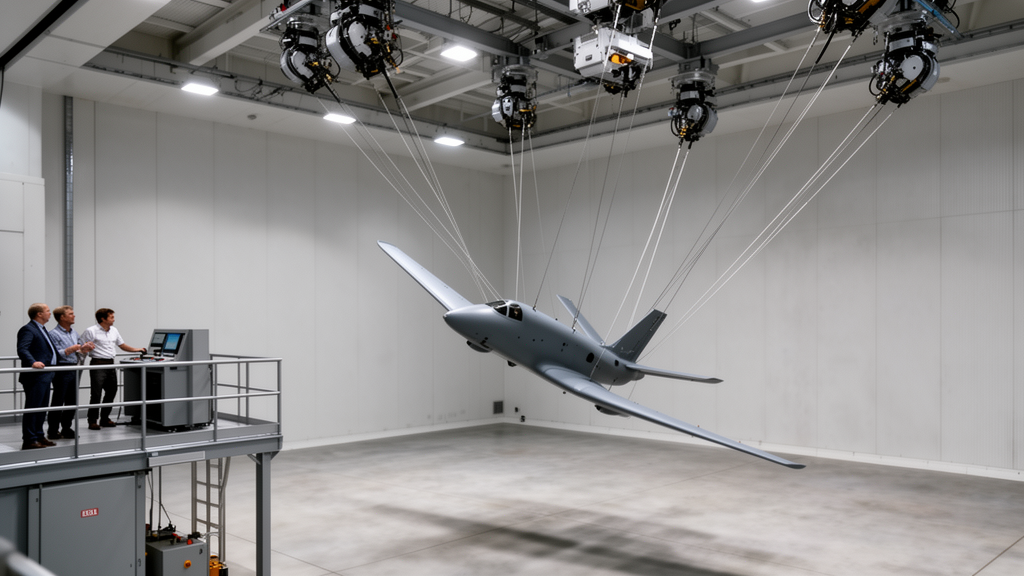
The new system, described in Advances in Aerodynamics, suspends a dynamic standard test model from eight actuated cables, each driven by its own servo motor through a ball-screw linear module. Shortening or lengthening individual cables repositions and reorients the model in all six degrees of freedom. Because the cables are light, the suspended assembly carries far less inertia than a mechanical sting, and because the cables are thin, they interfere minimally with the airflow. The cable attachment points were optimized to give the system an exceptionally large motion range, with angles of attack exceeding 90 degrees, and the team had previously validated the concept with static measurements and high-amplitude oscillations using SDM and F-22-like models in low-speed tunnels.
What distinguishes the present study is the class of motions it generates. In real post-stall maneuvering, the aircraft passes through an initial unstable phase in which both the oscillation frequency and the angular amplitude change continuously with time, before settling into a stable hysteresis phase. Conventional dynamic testing relies on sinusoidal oscillations at fixed amplitude and frequency, which cannot represent that transient. The researchers therefore designed exponential sine sweep commands, in which the instantaneous frequency varies continuously between preset bounds, and built a motion design framework that converts these nonlinear sweep maneuvers into feasible cable-length trajectories through the inverse kinematics of the suspension.
Tracking such commands accurately under aerodynamic load is the hard part. During wind-on tests, unsteady aerodynamic forces act on the model as unpredictable disturbances that would degrade motion precision. The team’s control solution pairs a continuous nonsingular terminal sliding mode controller, chosen for its robustness and for mitigating the chattering that plagues ordinary sliding mode schemes, with an extended state observer that estimates the combined external disturbances and model uncertainties in real time and feeds the estimate back into the control law. In MATLAB simulations of an exponential sweep from 0.5 to 2 Hz at a mean angle of attack of 30 degrees and 20 degrees of amplitude, the pitch angle tracking error stayed below 0.3 degrees, with roll and yaw errors even smaller.
The experimental campaign took place in the FL-5 low-speed wind tunnel, an open-circuit facility with a 1.5-meter-diameter test section inlet. All tests ran at a constant freestream velocity of 30 meters per second, corresponding to a Reynolds number of 1.1268 million. The test model weighed 2.476 kilograms, spanned 0.5 meters, and had a wing reference area of 0.1064 square meters. An inertial measurement unit recorded attitude, motor encoders measured cable lengths with an accuracy of 0.036 degrees or better at the servo rear end, tension sensors monitored cable forces to prevent slack, and a custom six-component strain-gauge balance mounted inside the model cavity measured the aerodynamic loads. Data were sampled at 100 Hz and the balance signals were filtered with a 6 Hz low-pass digital filter.
Extracting clean aerodynamic signals from a moving, cable-suspended model demanded careful data processing. Identical motion profiles were executed with the wind off and on, and the wind-off recordings, which contain gravitational and inertial contributions, were subtracted from the wind-on data. Because any timing mismatch between the two runs would corrupt the subtraction, the team synchronized the signals in the frequency domain, applying a calculated phase shift via forward and inverse fast Fourier transforms to eliminate time delays. The processed forces were then converted into dimensionless coefficients using the model’s wing area, mean aerodynamic chord and the measured dynamic pressure, and final results were averaged over ten consecutive motion cycles.
Before trusting the new rig, the researchers benchmarked it against tradition. Static lift coefficient measurements and single-degree-of-freedom pitch oscillation tests were performed with both the cable system and a conventional tail support, and the results agreed closely, confirming that the suspension does not distort force measurement. With that validation in hand, they launched a test matrix of unstable maneuvers: constant-amplitude frequency sweeps from 0.1 to 2 Hz with amplitudes of 2 to 10 degrees, constant-frequency amplitude sweeps from 0.2 to 1 Hz with amplitudes of 1 to 25 degrees, and coupled amplitude-frequency sweeps from 0.1 to 3 Hz with amplitudes of 1 to 20 degrees. The reduced frequency reached 0.075, confirming that genuinely unsteady aerodynamic effects were in play. During a representative sweep from 0.1 to 0.5 Hz at 5 degrees amplitude, tracking errors remained within plus or minus 0.3 degrees.
The aerodynamic results are the paper’s centerpiece. In constant-amplitude frequency sweeps at 30 degrees initial angle of attack, the lift coefficient hysteresis loops evolved dramatically as frequency rose. The first cycle showed a wide counterclockwise loop; by the third cycle the loop tilted and its phase lag grew; at the fifth cycle it inverted into an S-shaped curve; the sixth cycle showed complete directional reversal; and the loop area peaked at the eighth cycle before settling into a reversed, stable pattern by the ninth. Complementary unsteady CFD simulations of the F22 model, using improved delayed detached eddy simulation with a sliding mesh, offered a physical interpretation: at the same angle of attack on the ascending and descending branches of a cycle, the instantaneous vortex structures near the leading edge differ markedly, with coherent vortices sustaining suction on the way up and a post-stall recovery lag depressing lift on the way down. The authors caution that the simulations are sensitive to flow-development history and serve as auxiliary interpretation rather than a cycle-by-cycle reproduction of the experiments.
Amplitude sweeps told a complementary story. At a fixed 0.5 Hz, with amplitude growing from 1 to 25 degrees, the hysteresis loop area expanded monotonically, with each new loop fully enclosing the trajectories of earlier, smaller-amplitude cycles, evidence of amplitude-scaling in the flow’s unsteady memory. Specific extremes emerged: the lift coefficient bottomed at 1.012 at 33.82 degrees angle of attack during the roughly 6-degree-amplitude cycle and peaked at 1.795 at 20.94 degrees during the roughly 9-degree-amplitude cycle, while the drag coefficient ranged from a minimum of 0.448 to a maximum of 0.878. The coupled amplitude-frequency sweep, with frequency rising from 1 to 2 Hz as amplitude fell from 20 to 1 degree, produced the most complex response of all, with multi-lobed, heavily distorted loops signaling interactions between different time scales of the flow. Below reduced frequencies of about 0.05 at 10 degrees amplitude, the behavior reverted to quasi-steady, consistent with classical theory.
For aerodynamicists, the significance is methodological as much as physical. The measured hysteresis loops under swept motions are substantially richer than anything obtainable from traditional sinusoidal testing, and they expose the path-dependent nature of flow separation and reattachment that reduced-order aerodynamic models, typically trained on fixed-frequency data, struggle to capture. The team notes that existing computational studies often rely on prescribed stable motions, potentially limiting how well their models generalize to genuinely unstable transients. Future work, the authors write, will correlate the force measurements with detailed flow-field visualization and deploy unsteady surface pressure sensors for data-assimilation studies of dynamic stall, aiming to support aerodynamic configuration optimization and active flow control for highly maneuverable aircraft.
Subject of Research: Development and wind tunnel validation of a cable-driven parallel suspension system for simulating unstable aircraft motions and measuring unsteady aerodynamic forces
Article Title: Simulation of aircraft unstable motions and unsteady aerodynamic testing with cable-driven parallel suspension system
Article References: Wang, X., Liu, X., Han, D., Zheng, F., & Lin, Q. (2026). Simulation of aircraft unstable motions and unsteady aerodynamic testing with cable-driven parallel suspension system. Advances in Aerodynamics, 8(1), Article 24. https://doi.org/10.1186/s42774-026-00268-1
Image Credits: AI Generated
DOI: 10.1186/s42774-026-00268-1
Keywords: aerodynamics, wind tunnel testing, cable-driven parallel robot, post-stall flight, unsteady aerodynamics, dynamic stall, hysteresis loops, sliding mode control, angle of attack, flight dynamics, CFD, aircraft model
News Source: Denise Maddox. (October 28, 2026). Cable-driven robot suspends aircraft model to test wild post-stall maneuvers. Scienmag.