


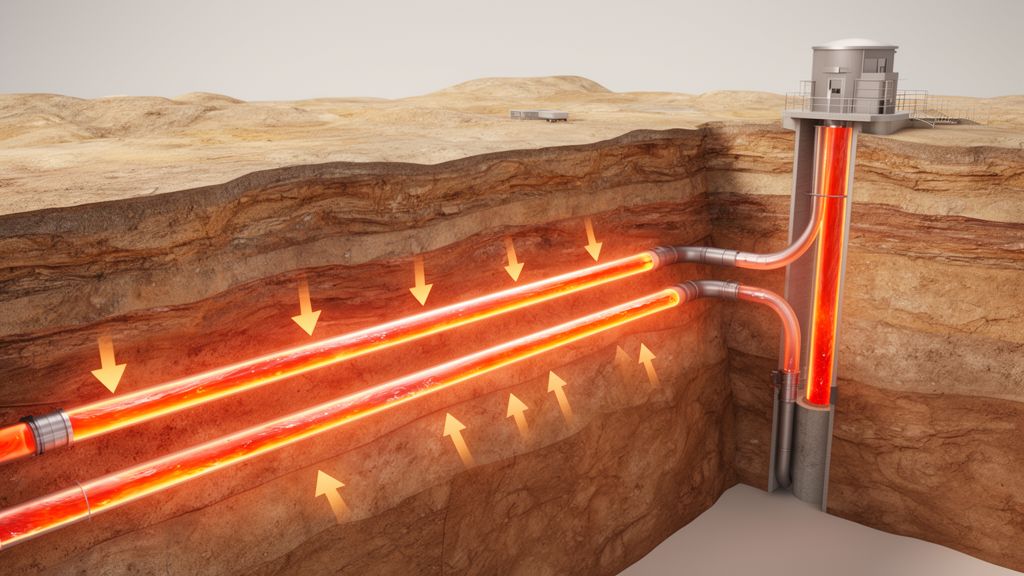
Geothermal energy has long promised a steady, always-on counterweight to the flickering output of wind turbines and solar farms. Yet turning that promise into dependable heat for homes and industry has been held back by a stubborn engineering problem: the wells that pull warmth from the Earth often do so too slowly, and they exhaust the warmth around them too quickly. A new numerical study published in Geothermal Energy examines how the shape of the well itself—straight down, bent sideways, or branching like an upside-down letter T—changes how much heat a closed-loop geothermal system can bank and later release, and how long the underground reservoir stays useful.
The research, led by Wenbin Han and colleagues including Xianbiao Bu, focuses on the coaxial closed-loop geothermal system, or CCLGS. Unlike conventional geothermal schemes that pump groundwater to the surface, exchange its heat, and reinject it, a coaxial closed loop seals its working fluid inside a pair of concentric pipes. Cold water descends through the outer casing, absorbs heat from the surrounding rock, and rises through the inner pipe without ever touching groundwater. This ‘take heat without taking water’ design avoids the scaling, clogging, and groundwater depletion that plague open systems. The trade-off is modest heat output: at the same well depth, a closed loop typically delivers 20 to 25 percent less extraction power than a water-withdrawal scheme.
To close that gap, the team modelled three well geometries at the same 2,000-metre depth. The vertical well is the simplest—a straight coaxial pipe. The L-shaped well adds a 500-metre horizontal side section, extending total wellbore length to 2,500 metres. The inverted T-shaped well branches into horizontal sections on both sides, reaching 3,000 metres in total. More horizontal length means more contact area between the circulating water and warm rock, and the simulations showed that this translates directly into stronger performance: after 120 days of operation, the inverted T-shaped well’s outlet temperature was significantly higher than the other two configurations, because its lateral branches expose a larger volume of rock to the working fluid over a longer flow path.
The study also introduced a second variable: how the system is operated. Mode 1 is a full-release mode in which the system extracts heat continuously. Mode 2 is a storage-release cycle in which the system extracts heat for six hours, stores heat for twelve hours, then resumes extraction for another six hours. During the storage phase, an electric heater—conceptually powered by surplus renewable electricity that would otherwise be curtailed—warms the circulating water before it is injected into the formation, deliberately banking thermal energy in the rock around the borehole. This approach links the geothermal system to the wider problem of renewable curtailment, where wind and solar output exceeds grid demand and the excess energy is simply wasted.
The simulation results, validated against experimental data from the HGP-A well in Hawaii with errors between 0.03 and 1.89 kelvin, quantified the benefits of both design choices. Compared with continuous operation, the storage-release mode raised outlet temperatures of the three well types by 16.21 K, 14.99 K, and 10.05 K respectively, and extended the period over which outlet temperature remained in a stable plateau. Average heat extraction power over the heating season reached roughly 7.70 megawatts for the vertical well, 10.71 megawatts for the L-shaped well (about 28 percent higher), and 13.77 megawatts for the inverted T-shaped well (about 44 percent higher than vertical). The storage-release mode itself boosted extraction power by 44.78 percent for vertical wells, 30.37 percent for L-shaped wells, and 20.30 percent for inverted T-shaped wells relative to continuous operation.
An intriguing asymmetry emerged when the team examined the storage phase in isolation. The inverted T-shaped well, despite its superior extraction performance, stored the least heat during the charging period, while the vertical well stored the most. The researchers attribute this to temperature: because horizontal side wells keep the surrounding rock warmer, the temperature difference between injected water and formation is smaller, so less heat flows into the rock. In the inverted T-shaped well’s lateral sections, the fluid may actually be extracting heat even during the nominal storage period. This means the geometry that excels at delivering heat is the same one that resists recharging it—a trade-off that operators would need to weigh against their priorities.
The storage cycle also proved gentler on the reservoir itself. In continuous operation, extraction power declined by 39.55 percent, 34.33 percent, and 19.49 percent from the first month to the last for the three well types. Under the storage-release mode, those declines shrank to 18.84 percent, 16.78 percent, and 11.98 percent respectively. Formation temperature at the end of the season was higher with storage included, rising by 7.80 K for the vertical well, 7.23 K for the L-shaped well, and 6.16 K for the inverted T-shaped well compared with full-release operation. Because rock temperature governs how much heat remains available in future years, the authors conclude that incorporating storage extends the service life of the geothermal reservoir while improving short-term output.
The team extended the analysis to economics and carbon accounting, using heating-cost benchmarks from Tianjin, China, where public buildings pay 40 yuan per square metre and residential buildings 25 yuan per square metre for geothermal heat. Taking an average revenue of 32.5 yuan per square metre and subtracting electricity, resource tax, and maintenance costs of 11 yuan per square metre—plus 1.5 yuan per square metre for the electric heater in the storage mode—they estimated total revenue for a four-month heating season. The inverted T-shaped well delivered the highest absolute heating area and revenue, but the vertical well showed the largest proportional improvement between operating modes, with revenue growing 39.09 percent when storage was added. Carbon reduction scaled with total heat extracted, and while the electric heater in Mode 2 raised the system’s own emissions share from roughly 23.6 percent to 28.5 percent of the CO2 avoided, net environmental benefits still favoured the storage-release mode.
Several caveats frame these findings. The study is entirely numerical, resting on a transient heat-transfer model that assumes isotropic rock properties, constant thermal parameters independent of temperature and pressure, purely conductive heat exchange between casing and formation, and a perfectly sealed loop with no fluid leakage. Real geological formations rarely behave so neatly, and field-scale heterogeneity, groundwater movement, and long-term material degradation could all shift results. The economic estimates also depend on local heating tariffs and electricity prices that vary widely by region. Nevertheless, the model was calibrated against mesh-independence and time-step tests, and its validation against the Hawaiian field data lends credibility to the heat-transfer physics.
The practical message is that geothermal system design is not a single decision but a coupled one: well geometry, operating schedule, and reservoir longevity interact in ways that simple intuition can miss. Horizontal side wells reliably raise output and stabilise it across a heating season. Intermittent storage powered by surplus renewable electricity raises output further, steadies reservoir temperature, and turns wasted wind and solar generation into useful heat. But the geometry best suited to extraction is not the best suited to recharging, so operators targeting long service life or maximal carbon displacement may favour different configurations than those chasing peak power. As grids absorb more variable renewable generation, closed-loop geothermal systems that can absorb surplus electricity as stored heat—and release it on demand—offer one more route to turning curtailment from a liability into an asset.
Subject of Research: Numerical comparison of thermal storage and heat release performance in coaxial closed-loop geothermal systems with vertical, L-shaped, and inverted T-shaped well configurations.
Article Title: Performance comparison of thermal storage and release of coaxial closed-loop geothermal system with different well configurations
Article References: Han, W., Lei, Y., Chen, W., Gao, X., Ma, B., Lv, J., & Bu, X. (2026). Performance comparison of thermal storage and release of coaxial closed-loop geothermal system with different well configurations. Geothermal Energy, 14(1), Article 22. https://doi.org/10.1186/s40517-026-00394-5
Image Credits: AI Generated
DOI: 10.1186/s40517-026-00394-5
Keywords: geothermal energy, coaxial closed-loop system, well configuration, thermal energy storage, heat extraction, renewable energy curtailment, numerical simulation, formation temperature, carbon reduction, heating economics, Performance, comparison
News Source: Violet Maxwell. (October 30, 2026). Horizontal Wells and Smart Cycling Boost Geothermal Heat Storage Performance. Scienmag.



