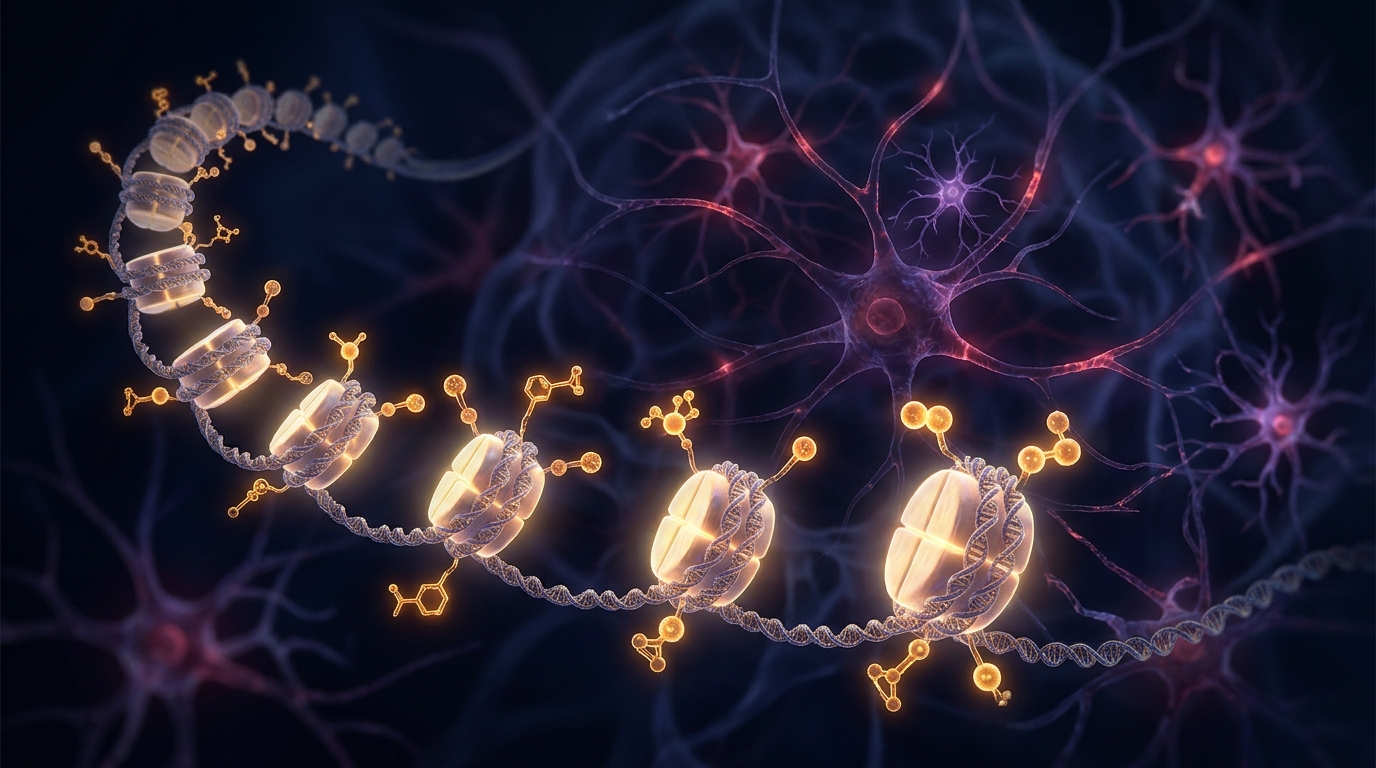
A new review published in Cellular and Molecular Neurobiology argues that histone post-translational modifications, the chemical tags placed on the protein spools around which DNA winds, may explain why neuroinflammation in Alzheimer’s disease does not simply fade when the initial insult passes. The authors, led by Junyi Liang, Huawen Cao and Weiming Zhao, propose that these chromatin marks act as integrators of inflammatory, metabolic and proteotoxic signals, converting transient pathological events into sustained transcriptional programmes that keep immune cells locked in an activated state.
The central problem the review addresses is persistence. Microglia and astrocytes, the brain’s resident immune and support cells, respond to amyloid-β and tau pathology with inflammatory gene expression, yet the mechanisms by which short-lived stimuli become long-lasting immune states have remained unclear. The authors synthesize evidence that histone marks regulate chromatin accessibility, enhancer activity and transcription factor recruitment, thereby shaping the magnitude, duration and reversibility of neuroimmune responses across microglia, astrocytes and neurons.
At the molecular level, histone post-translational modifications include acetylation, methylation and a growing family of acylation pathways. Acetylation of specific lysine residues generally loosens the chromatin fibre, making regulatory DNA more accessible to transcription factors, while methylation can either activate or repress depending on which residue carries which number of methyl groups. The review emphasizes that these marks do not act uniformly across the genome. Instead, they operate in a gene-locus- and cell-type-specific manner, meaning the same modification can sustain an inflammatory programme in one cell type while leaving another untouched.
The authors describe this locus-specific encoding as a form of pathological neuroimmune memory. Rather than a metaphorical analogy to neuronal memory, the term refers to the biochemical retention of transcriptional states through chromatin changes that outlast the original stimulus. In this model, amyloid-β accumulation, tau pathology, metabolic dysfunction, cellular senescence and innate immune signalling converge on chromatin remodelling machinery, each leaving marks that reinforce the others. The result is a self-sustaining inflammatory programme whose strength and reversibility depend on which marks have accumulated and where.
This framework may account for the heterogeneity of inflammation observed across disease stages. Because different histone marks establish and maintain transcriptional programmes with different kinetics, the inflammatory profile of a brain region could shift as the disease progresses, with some marks conferring reversible states and others more entrenched ones. The review suggests that understanding the establishment, maintenance and reversibility of these epigenetic states could identify therapeutic windows for targeted epigenetic interventions, timed to periods when chromatin-based programmes remain plastic enough to redirect.
The convergence of metabolic and proteotoxic stress on chromatin is a key structural element of the argument. Histone acylation pathways, which attach acyl groups derived from cellular metabolites to histone tails, provide a direct biochemical route by which metabolic state can be written into chromatin. When mitochondrial function or nutrient sensing is disturbed, as occurs in Alzheimer’s disease, the availability of these acyl donors changes, potentially altering the histone modification landscape and thereby the transcriptional output of immune genes.
It is important to note what this review is and is not. It is a synthesis of existing literature, not a report of new experimental data, and its claims about histone marks sustaining neuroinflammation are presented as a model supported by accumulating evidence rather than as a demonstrated causal mechanism in patients. The authors themselves frame the work as an examination of how histone PTMs establish sustained transcriptional programmes, with the memory model offered as a unifying interpretation of observations across cell types and disease stages.
The therapeutic implication, if the model holds, is that epigenetic interventions might need to be locus- and cell-type-specific rather than broad. Global inhibition of histone deacetylases, for example, would affect every cell and every gene, whereas the review’s framework suggests that the pathological programme resides in particular marks at particular enhancers in particular glial populations. Identifying which marks define the persistent state, and at which genomic loci, would be a prerequisite for designing interventions that reverse the programme without disrupting normal chromatin function elsewhere.
As an open-access review, the article consolidates a rapidly expanding literature at the interface of metabolism and chromatin biology in neurodegeneration. Its value lies less in any single finding than in the integrative model it offers: that the persistence and heterogeneity of neuroinflammation in Alzheimer’s disease may be encoded, in part, in the histone modification landscape itself, and that reading that landscape carefully could reveal when and how the inflammatory programme becomes reversible.
Subject of Research: Histone post-translational modifications as chromatin-based integrators of inflammatory, metabolic and proteotoxic signals in Alzheimer's disease neuroinflammation
Article Title: Histone Post-Translational Modifications at the Metabolism–Chromatin Interface: Reprogramming of Neuroinflammation in Alzheimer’s Disease
Article References: Liang, J., Cao, H., Ren, X., Sha, N., Han, X., Jiang, L., Liu, B., & Zhao, W. (2026). Histone Post-Translational Modifications at the Metabolism–Chromatin Interface: Reprogramming of Neuroinflammation in Alzheimer’s Disease. Cellular and Molecular Neurobiology. https://doi.org/10.1007/s10571-026-01828-1
Image Credits: AI Generated
DOI: 10.1007/s10571-026-01828-1
Keywords: Alzheimer's disease, neuroinflammation, histone modifications, chromatin, epigenetics, microglia, astrocytes, amyloid-beta, tau pathology, metabolic dysfunction, senescence, acylation
News Source: Cassandra Pierce. (November 4, 2026). Histone Marks May Hold Alzheimer’s Inflammation in a Persistent State. Scienmag.