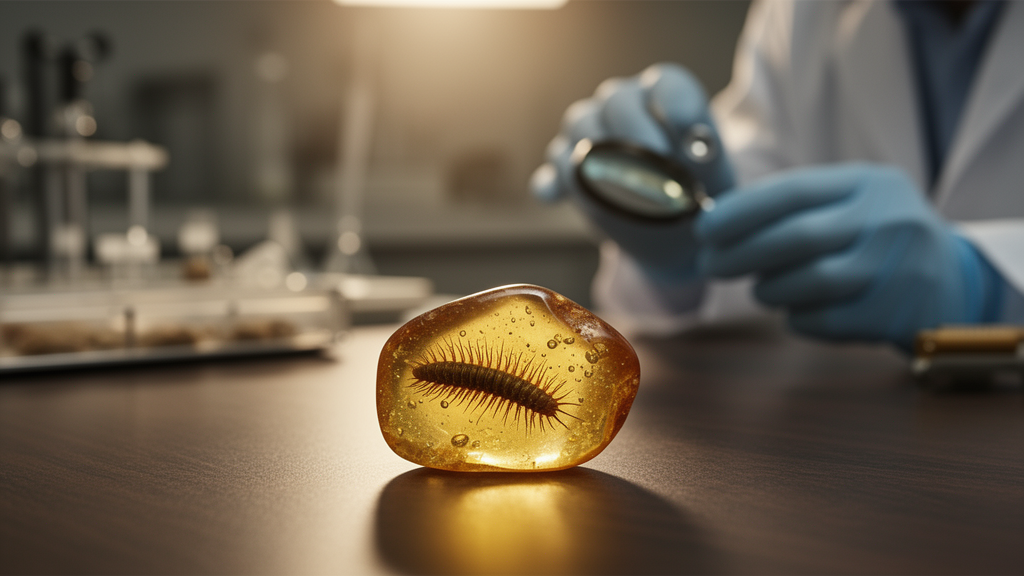
A new deep-time analysis of hundreds of specimens preserved in amber turns that expectation on its head. Instead of a steady decline in size from the Carboniferous to the present, the study finds that Cretaceous bristly millipedes were markedly smaller than their Eocene relatives, with modern species falling in between. The work, published as an open-access research article in June 2026, represents the first attempt to investigate morphological change in this understudied group beyond a purely taxonomic frame.
The research team, led by Jéhan Le Cadre and Joachim T. Haug of Ludwig-Maximilians-Universität München with colleagues from Germany, China and Ukraine, examined 287 amber pieces containing bristly millipedes, drawing on both previously published material and newly investigated specimens from eight institutional and private collections. The fossil assemblage spans three time slices: Cretaceous Kachin amber from Myanmar at roughly 100 million years ago, Eocene ambers from Europe, including Baltic, Bitterfeld and Rovno deposits, at about 35 million years ago, and Miocene Dominican amber at around 20 million years ago. To place the fossils in context, the authors also documented 378 extant specimens, mostly Polyxenidae from Europe and China and Synxenidae from Australia and Namibia.
Bristly millipedes are notoriously difficult to fossilise. Their bodies are soft and uncalcified, and they live in concealed habitats such as tree bark, leaf litter and even empty snail shells, so their remains are essentially limited to amber. Yet within resin they are surprisingly common, likely because they spend so much time on tree bark, the very source of the resin itself. The amber record of Polyxenida is rich enough to cover nearly the complete post-embryonic development of both major ingroups, Polyxenidae, with roughly 100 formally described living species, and Synxenidae, with eight. A third group, Lophoproctidae, has never been reported in amber and was excluded from the analysis.
Part of what makes the group so tractable for evolutionary study is its anamorphic development. Bristly millipedes hatch with only a few segments and add more at each moult until adulthood, after which moulting continues without adding segments. Because each developmental stage can be identified from the number of leg-bearing segments, immature fossils can be assigned to specific stages, allowing the researchers to compare like with like across tens of millions of years. The team measured ten distances on each specimen where preservation allowed, including body lengths, trunk widths at three positions and the lengths of the first, median and last pairs of legs, and complemented these measurements with Elliptic Fourier analyses of body outlines drawn from sharp panoramic images taken with a digital microscope.
The shape analysis confirmed that the method works even on such soft-bodied animals. The first principal component of the overall morphospace, covering 79.3 percent of the variation, was dominated by ontogeny and relative body slenderness, with rounder shapes at one extreme and slenderer shapes at the other. Synxenidae emerged as distinctly more slender than Polyxenidae, a difference most pronounced in late-stage specimens. Most fossil and modern specimens overlapped in the central region of the morphospace, underscoring the striking morphological stability of the group, which has changed little in form and behaviour over vast stretches of time. A handful of atypical fossils, however, plotted at the extremes of the morphospace, hinting at morphotypes not seen in the modern fauna.
The morphometric measurements delivered the study’s central surprise. For both Polyxenidae and Synxenidae, Cretaceous specimens were consistently and significantly smaller than extant representatives in later developmental stages, in body lengths, trunk widths and, in Synxenidae, leg lengths. Eocene fossils, by contrast, were often the largest of all, in some measurements significantly exceeding both Cretaceous and modern specimens. In Polyxenidae, for example, Eocene stage 4 immatures were significantly longer and wider than Cretaceous counterparts, and Eocene adults were significantly wider than Cretaceous adults. In Synxenidae, Cretaceous fossils in stages 5 through 10 were repeatedly significantly smaller than Eocene or extant specimens. Early developmental stages generally showed no significant differences through time, likely reflecting small sample sizes.
This pattern directly contradicts the long-standing narrative of miniaturisation. If bristly millipedes were truly the dwarf progeny of the Carboniferous giants, Cretaceous fossils should be the largest in the record, with Eocene and Miocene forms successively smaller and modern species the smallest of all. Instead, the data show reduced sizes in the Cretaceous, a sharp increase into the Eocene, and a subsequent decrease toward the present that never returns to Cretaceous dimensions. The authors note that the observed trends hardly support miniaturisation since the Cretaceous; rather, the changes may reflect particularities of the Kachin deposit and the environmental conditions under which each amber formed.
Several possible explanations are weighed in the study, each with caveats. All Cretaceous ambers in the sample come from a single deposit, Kachin, on the Burma Terrane, an isolated island near the equator at the time of fossilisation, carrying tropical rainforests and a highly diverse Gondwanan fauna. Island dwarfism is one candidate explanation, but the authors point out two problems: island gigantism also exists, making the island argument adaptable to any outcome, and bristly millipedes are poor dispersers whose patchy bark-dwelling habitat is effectively an island in itself regardless of the larger landmass. A diverse predator assemblage in Kachin amber could alternatively have pressured prey animals to remain small, an idea echoing earlier suggestions about defensive size reduction. The inherent entrapment bias of resin, which more easily captures small organisms, was also considered but deemed unlikely to explain the pattern, since some Eocene fossils exceed both Cretaceous and extant specimens in length, and the longest bristly millipedes fall well below the roughly ten-millimetre threshold above which amber rarely fully entraps organisms.
The explanation the authors favour involves climate. The Temperature-Size Rule describes how ectotherms reared in warmer conditions often develop faster and mature at smaller sizes, with growth not fully compensating for accelerated development. The Cretaceous was a period of high atmospheric carbon dioxide, an intensified greenhouse effect and elevated temperatures, and the Burma Terrane lay close to the equator under tropical rainforest. The Eocene ambers, by contrast, formed during a cooling interval in warm-temperate, equable European climates, which under the Temperature-Size Rule would favour larger bodies, a pattern also invoked for the famous Eocene giant ants. Why modern millipedes are smaller than their Eocene counterparts remains unresolved, and the authors flag additional untested factors, including sexual dimorphism, since female bristly millipedes are reported to be larger than males, and reproductive mode, as some populations reproduce asexually.
The study’s conclusions are deliberately measured. Drawing definitive conclusions is challenging because the Mesozoic sample is restricted to a single deposit, and the authors stress that this first exploration of morphological change in bristly millipedes may suggest, rather than prove, the influence of environment on the group’s evolutionary trajectory. Taxonomically and behaviourally stable for hundreds of millions of years, these tiny animals have nonetheless repeatedly changed in body size, growing from Cretaceous dwarfs into Eocene giants and settling back to intermediate dimensions today, a quiet record of deep-time environmental pressure written in amber.
Subject of Research: Evolutionary changes in body size and shape of bristly millipedes preserved in Cretaceous, Eocene and Miocene amber
Article Title: Past “giants” and extant dwarfs, more like the opposite: deep-time investigation of bristly millipedes reveals reduced sizes during the Cretaceous
Article References: Le Cadre, J., Gietl, D., Dupuis, A., Rappsilber, I., Strom, A., Melzer, R. R., Huang, D., Perkovsky, E. E., Haug, C., & Haug, J. T. (2026). Past “giants” and extant dwarfs, more like the opposite: deep-time investigation of bristly millipedes reveals reduced sizes during the Cretaceous. Developmental Biology Advances, 17(1), Article 14. https://doi.org/10.1186/s13227-026-00269-7
Image Credits: AI Generated
DOI: 10.1186/s13227-026-00269-7
Keywords: bristly millipedes, Polyxenida, amber fossils, Kachin amber, Baltic amber, Bitterfeld amber, morphometrics, Elliptic Fourier analysis, Temperature-Size Rule, Burma Terrane, Cretaceous, Eocene
News Source: Gavin Prescott. (October 29, 2026). Cretaceous Amber Reveals Tiny Bristly Millipedes That Grew Into Eocene Giants. Scienmag.