


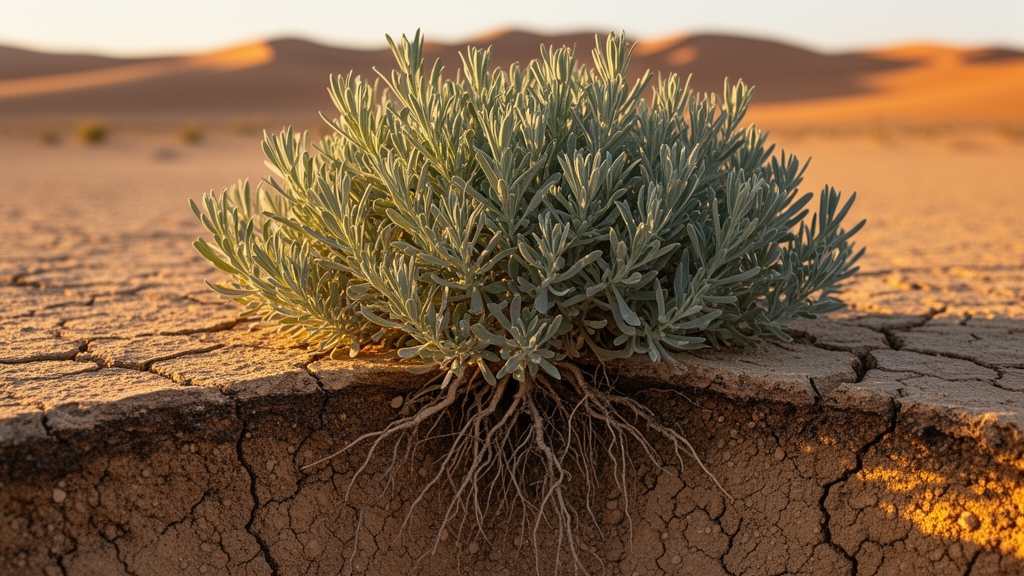
Scientists have assembled the first telomere-to-telomere genome of Prunus pedunculata, a desert shrub endemic to the Mongolian Plateau, revealing a dodecaploid plant with twelve copies of its basic chromosome set (2n = 12x = 96) — the highest ploidy level reported among sequenced woody perennials. The 1.38-gigabase-pair genome was resolved into 48 chromosomes, with telomeric repeats detected on each one.
The study, published open access in Genome Biology, addresses a notable gap. The authors note that geographical imbalance in extremophile plant genomics has left the Mongolian Plateau underexplored, and that this arid-adapted shrub offers an ideal system for understanding how woody plants survive extreme drought.
Evolutionary analysis confirmed an autopolyploid origin, meaning all twelve chromosome sets derive from a single ancestral species rather than from hybridization between different species. The assembly showed more than 80 percent subgenome consistency and no evidence of hybridization.
Dating analysis placed the most recent whole-genome duplication at approximately 3.49 million years ago, a period coinciding with the uplift of the Tibetan Plateau and the intensification of Asian interior aridity. The researchers suggest this timing links the polyploidization event to the aridification of the region the shrub inhabits.
To trace the plant’s genomic history, the team reconstructed ancestral karyotypes using six Prunus species spanning diploid to dodecaploid genomes and three inflorescence types. The reconstruction points to an ancestor with eight chromosomes, followed by chromosomal rearrangements after the polyploidization events.
The functional side of the study relied on organ-specific transcriptomics under progressive drought conditions. This uncovered a coordinated division of labor among organs that integrates several signaling modules — abscisic acid (ABA), CLE25, BES1/BIN2, and auxin — to orchestrate growth cessation and stress survival as water becomes scarce.
A key finding concerns gene duplication. Drought-induced genes significantly overlapped with expanded gene families, which the authors interpret as functional recruitment of polyploidy-derived redundancy. In other words, the extra gene copies created by whole-genome duplication appear to have been repurposed for drought stress responses.
The authors conclude that duplicated genes have been repurposed for drought stress, and that a multi-component signaling network coordinates organ responses and enhances survival under water scarcity. They suggest these findings could offer leads for crop improvement, although such applications remain prospective rather than demonstrated in this study.
As with any genome assembly and transcriptomic analysis of a single species, the work describes genomic architecture and signaling associations in one desert shrub; the proposed links between polyploidization timing and regional aridification rest on coincidence in dating rather than direct causal demonstration. The findings nonetheless provide a reference genome for a previously unsequenced, high-ploidy woody perennial from an underexplored arid region.
Subject of Research: Telomere-to-telomere genome assembly and drought adaptation of a dodecaploid desert shrub
Article Title: Telomere-to-telomere genome of a dodecaploid desert shrub Prunus pedunculata reveals polyploidy-driven arid adaptation
Article References: Yang, Q., Ma, J., Wang, J., Yang, X., Xie, S., Wang, L., Fei, W., Yang, W., Huang, M., & Zhao, L. (2026). Telomere-to-telomere genome of a dodecaploid desert shrub Prunus pedunculata reveals polyploidy-driven arid adaptation. Genome Biology. https://doi.org/10.1186/s13059-026-04317-2
Image Credits: AI Generated
DOI: 10.1186/s13059-026-04317-2
Keywords: Prunus pedunculata, telomere-to-telomere genome, dodecaploid, polyploidy, autopolyploid, whole-genome duplication, drought adaptation, Mongolian Plateau, transcriptomics, ABA signaling, gene family expansion, Genome Biology
News Source: Juliet Wilcox. (October 29, 2026). Dodecaploid Desert Shrub Genome Reveals Polyploidy-Driven Arid Adaptation. Scienmag.



