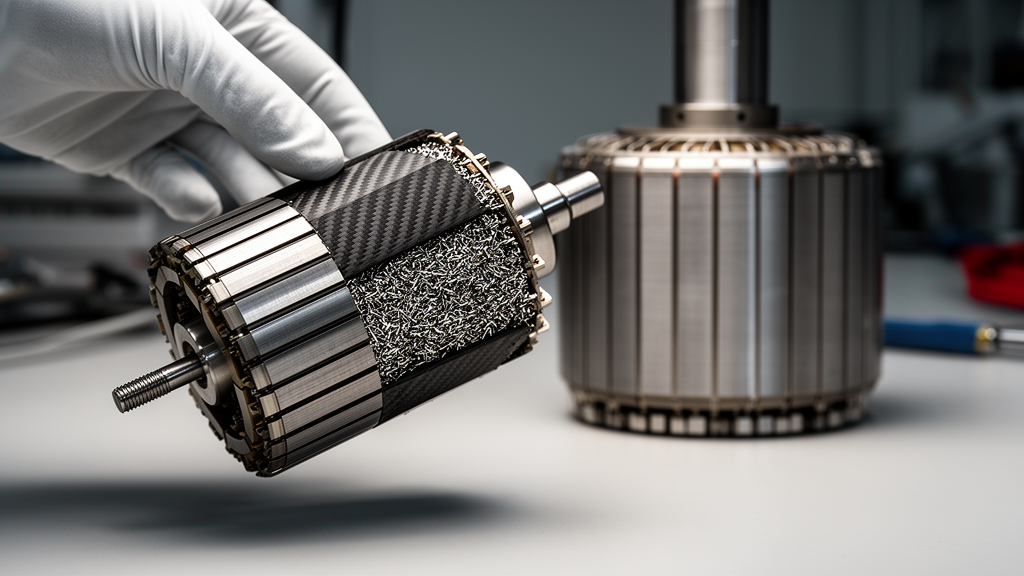
Researchers have developed a carbon fiber-reinforced polymer composite rotor infused with soft magnetic Fe₃Si microparticles that cuts rotor weight and rotational inertia by 38.12% compared with conventional electrical steel cores, according to a study published in Advanced Composites and Hybrid Materials. The optimized composite reached a density of 4857.95 kg/m³, substantially lower than electrical steel, while maintaining structural integrity for high-speed synchronous reluctance motor applications.
The team, led by Anand Prakash Jaiswal and Minkook Kim, targeted the growing demand for lightweight, energy-efficient electric motors in electric vehicles, aerospace, and industrial systems. The composite rotor was designed as an alternative to conventional electrical steel rotor cores, which the study identifies as the benchmark material for comparison.
To build the composite, the researchers uniformly integrated Fe₃Si microparticles into the carbon fiber-reinforced polymer matrix using a hand lay-up method with dry particle deposition. This approach enhanced the material's magnetic permeability while reducing its electrical conductivity.
The reduced electrical conductivity stems from the discontinuous conductive network of the polymer matrix. Because the conductive pathways are broken up by insulating polymer, eddy currents and associated core heating are suppressed, addressing a key loss mechanism in high-speed machines.
A central challenge was that the composite’s intrinsic magnetic permeability remains lower than that of electrical steel. The researchers compensated by strategically reducing the rotor magnetic pole arc angle from 145° to 130°, a design adjustment that restored electromagnetic performance despite the material’s lower permeability.
Electromagnetic simulations of the optimized Fe₃Si-enhanced composite rotor showed a peak efficiency of 94.0%, closely matching the benchmark electrical steel rotor at 95.4%. These are simulation-based predictions rather than measurements from a physical prototype, so experimental validation remains a future step.
The combination of lower density, reduced rotational inertia, and suppressed eddy current losses suggests the composite could serve as a lightweight core material for next-generation electric machinery.
The study is published open access and was shared early as a peer-reviewed, accepted version of record subject to further edits. The authors note that the results highlight the potential of Fe₃Si-carbon fiber composites, though translating the simulated gains into real motor performance will require subsequent testing.
Subject of Research: Fe₃Si-enhanced carbon fiber polymer composites for lightweight synchronous reluctance motor rotors
Article Title: Enhancing electrical and magnetic performance of carbon fiber polymer composites with Fe₃Si for lightweight, high-efficiency synchronous reluctance motor rotors
Article References: Jaiswal, A. P., Ho-Nguyen-Tan, T., Hong, G., Ahn, D., Yoon, S. H., & Kim, M. (2026). Enhancing electrical and magnetic performance of carbon fiber polymer composites with Fe₃Si for lightweight, high-efficiency synchronous reluctance motor rotors. Advanced Composites and Hybrid Materials. https://doi.org/10.1007/s42114-026-02133-7
Image Credits: AI Generated
DOI: 10.1007/s42114-026-02133-7
Keywords: carbon fiber composites, Fe3Si, synchronous reluctance motor, electrical steel, rotor design, magnetic permeability, eddy currents, electric vehicles, lightweight materials, electromagnetic simulation, Enhancing, electrical
News Source: Denise Maddox. (October 29, 2026). Fe₃Si-Enhanced Carbon Fiber Composite Lightens Synchronous Reluctance Motor Rotors. Scienmag.