


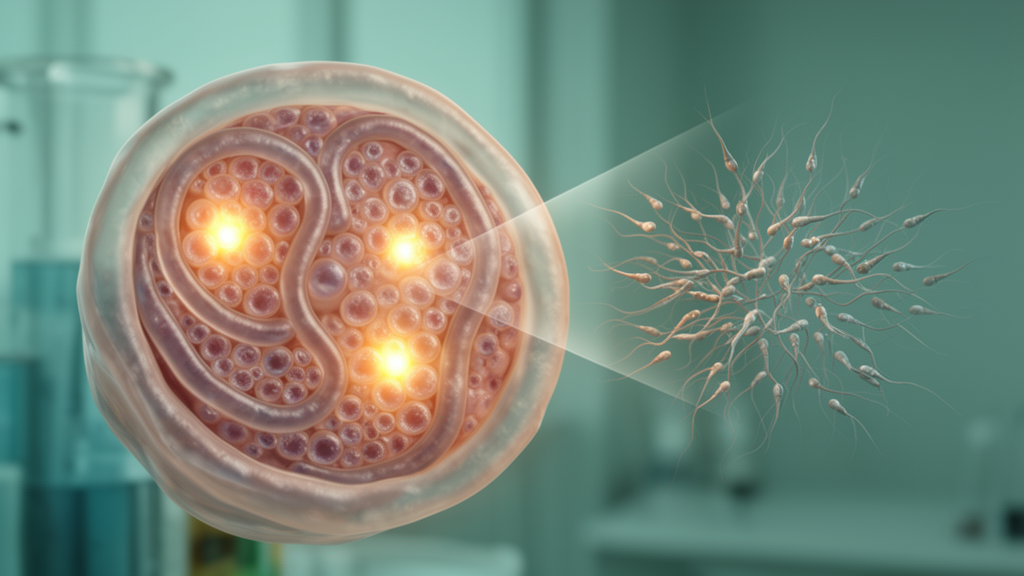
Non-obstructive azoospermia (NOA) is one of the most severe forms of male infertility, arising when the testes fail to produce mature spermatozoa despite no physical blockage in the reproductive tract. Among azoospermia cases, NOA accounts for up to 70 percent, and in the majority of patients the underlying cause remains unknown. While testicular sperm extraction combined with intracytoplasmic sperm injection allows some affected men to achieve fertility, there is still no effective treatment for those who completely lack mature sperm within the testis. A new integrative study, published in Frontiers in Genetics, has combined human bulk transcriptomic datasets with single-cell RNA sequencing from a genetically engineered mouse model to map the molecular and cellular landscape of this disorder, and to identify two genes that may serve as candidate diagnostic biomarkers.
The research team, led by investigators at Ningxia Medical University in Yinchuan, China, focused on UTF1, a transcriptional regulator highly expressed in pluripotent stem cells and primarily localized in undifferentiated spermatogonia within testicular tissue. UTF1 is considered one of the key marker molecules for early undifferentiated spermatogonia and spermatogonial stem cells in humans, and previous studies suggest its deficiency or dysregulated expression may affect the maintenance of spermatogonia, transitions between differentiation states, and subsequent spermatogenesis. In patients with NOA, UTF1 expression has been reported as dysregulated and accompanied by altered spatial localization. Because global knockout of Utf1 results in embryonic lethality, the researchers generated a testis-specific conditional knockout mouse model, crossing Utf1fl/fl mice with Vasa-Cre tool mice to produce Utf1cKO animals in which the gene is deleted in germ cells.
On the human side, the team drew on two public datasets from the Gene Expression Omnibus. The training cohort, GSE145467, contained testicular transcriptomic profiles from 10 NOA patients and 10 fertile controls, while the independent validation cohort, GSE45887, comprised 16 NOA and 4 control samples. Differential expression analysis of the training cohort uncovered 4,688 differentially expressed genes, of which 1,550 were upregulated and 3,138 downregulated in NOA. The single-cell sequencing of mouse testicular tissue covered three wild-type controls and three Utf1-knockout samples, ultimately profiling 49,901 cells and 26,608 genes. This resolved eight major cell populations, including spermatogonia, spermatids, Sertoli cells, Leydig cells, endothelial cells, macrophages, and peritubular cells, from which spermatogonia, Sertoli cells, and spermatids were selected for weighted gene co-expression network analysis to extract spermatogenesis-related genes.
From this pipeline, 300 key module-related genes were identified, and 240 human one-to-one orthologs were mapped for downstream analysis. Intersecting these with the human differentially expressed genes yielded 73 candidate genes, which were strongly enriched in biological processes such as spermatid differentiation, sperm motility, flagellum assembly, sperm DNA condensation, and the acrosome reaction. Pathway analysis also highlighted glutathione metabolism, reactive oxygen species response, glycolysis, and fatty acid degradation. Three machine learning algorithms—support vector machine-recursive feature elimination, random forest, and the Boruta algorithm—were then applied to narrow the field, and their intersection produced two candidate biomarkers: ACTRT2 and AKAP4. Both genes were significantly downregulated in NOA samples compared with controls in both the training and validation datasets.
The two biomarkers showed distinct chromosomal locations, with ACTRT2 on chromosome 1 and AKAP4 on chromosome X, but overlapping subcellular distributions and functional pathways. ACTRT2 was predicted to reside predominantly in the cytoskeleton and cytoplasm, and its enriched pathways were mainly involved in microtubule dynamics and cytoskeleton remodeling. AKAP4, primarily localized to the nucleus, showed enrichment in pathways focused on flagellum assembly and meiotic spindle regulation. Fifty-one pathways were commonly shared between the two genes, including core modules governing microtubule nucleation, depolymerization, and kinetochore-microtubule attachment. The authors suggest this pairing captures a continuous pathological axis in NOA, from early spermatogonial dysregulation to late-stage sperm structural failure, though they emphasize the relationship remains correlative rather than causally established.
A nomogram was constructed to predict NOA risk based on the expression levels of the two genes, and the Hosmer-Lemeshow goodness-of-fit test indicated adequate model fit in the training cohort, with a P value of 0.911. However, the authors are candid about the limits of the predictive models. When the three machine-learning classifiers built in the training cohort were applied to the independent validation cohort, performance dropped sharply—Boruta and random forest reached an area under the curve of 0.750, while SVM-RFE fell to 0.125—and the models tended to classify all validation samples as controls. The team attributes this to the small sample size and marked class imbalance of the validation cohort, with 16 NOA cases against only 4 controls, as well as cross-platform and cross-cohort batch effects. They conclude the predictive models should be considered exploratory, with clinical utility requiring validation in larger and more balanced cohorts.
The study also documented substantial immune microenvironmental changes. Profiling 28 immune cell subsets revealed significant infiltration differences in 23 populations between NOA and control samples, with 22 subsets elevated in NOA—prominently macrophages, regulatory T cells, myeloid-derived suppressor cells, and mast cells—while memory B cells were the sole population markedly reduced. Both ACTRT2 and AKAP4 showed significant inverse associations with the majority of T-cell subsets, NK cells, MDSCs, macrophages, mast cells, and monocytes, alongside positive associations with memory B cells. Cell-cell communication analysis in the mouse model revealed that the Utf1cKO group exhibited a marked increase in both the number and strength of intercellular interactions compared with controls, with sperm cells initiating distinct signaling programs, including de novo interactions mediated by ligand-receptor pairs such as Dll3-Notch1/3 and Grn-Sort1. The authors interpret these signaling changes as likely compensatory or pathological rewiring within a damaged microenvironment rather than effective homeostatic maintenance.
The experimental work in mice provided phenotypic evidence that Utf1 deficiency impairs testicular development and spermatogenesis. At 35 days postpartum, Utf1cKO mice showed a significantly reduced testis-to-body weight ratio, decreased sperm count and motility in the cauda epididymis, and significantly lower serum testosterone levels compared with littermate controls. Mating experiments at 60 days postpartum showed that Utf1cKO males produced a significantly lower average litter size than wild-type or heterozygous control males. Histological analysis revealed a reduction in spermatogonia as early as 10 days postpartum, followed by depletion of spermatocytes and round spermatids, disorganized cellular layering within seminiferous tubules, and ultimately the absence of mature spermatozoa in the lumina. Immunohistochemistry showed decreased expression of the proliferation markers PCNA and MKi67, while TUNEL staining demonstrated significantly increased germ cell apoptosis, indicating that both reduced proliferation and enhanced apoptosis contributed to germ cell loss.
Pseudotime trajectory analysis added a dynamic dimension, showing that the Utf1cKO group exhibited fewer early-stage and more late-stage differentiated sperm cells compared with controls, a pattern the authors interpret as compromised differentiation initiation alongside a paradoxically advanced but arrested differentiation program. ACTRT2 expression along the pseudotime axis was upregulated in the early differentiation stage, peaked at mid-stage, and then declined, while AKAP4 expression rose slowly to a peak in the early-to-mid stage before a sustained gradual decrease. The authors stress several limitations: the relatively small sample size, potential cross-species integration bias, a lack of causal validation, and the absence of rescue experiments, meaning the association between UTF1 and ACTRT2/AKAP4 remains correlative. Exploratory correlations between gene expression and clinical parameters such as serum FSH, Johnsen score, and testicular volume revealed only non-significant trends. The findings, derived primarily from experimental models and integrative analyses, will require validation in larger, well-characterized patient cohorts before any clinical application in disease stratification or sperm retrieval prediction can be considered.
Subject of Research: Candidate biomarkers and spermatogenic dysfunction in non-obstructive azoospermia identified through integrated human and mouse transcriptomic analysis
Article Title: Integrated single-cell and bulk transcriptomic analyses reveal UTF1-associated spermatogenic dysfunction and identify ACTRT2 and AKAP4 as biomarkers in non-obstructive azoospermia
Article References: Yu, J., Li, M., Zhou, Y., Liu, H., Pei, C., & Ma, L. (2026). Integrated single-cell and bulk transcriptomic analyses reveal UTF1-associated spermatogenic dysfunction and identify ACTRT2 and AKAP4 as biomarkers in non-obstructive azoospermia. Frontiers in Genetics, 17, Article 1975399. https://doi.org/10.3389/fgene.2026.1975399
Image Credits: AI Generated
DOI: 10.3389/fgene.2026.1975399
Keywords: non-obstructive azoospermia, male infertility, UTF1, ACTRT2, AKAP4, spermatogenesis, single-cell RNA sequencing, biomarkers, conditional knockout mice, immune infiltration, cell-cell communication, transcriptomics
News Source: Juliet Wilcox. (October 29, 2026). Two Gene Biomarkers Linked to Sperm Production Failure in Infertility Study. Scienmag.



