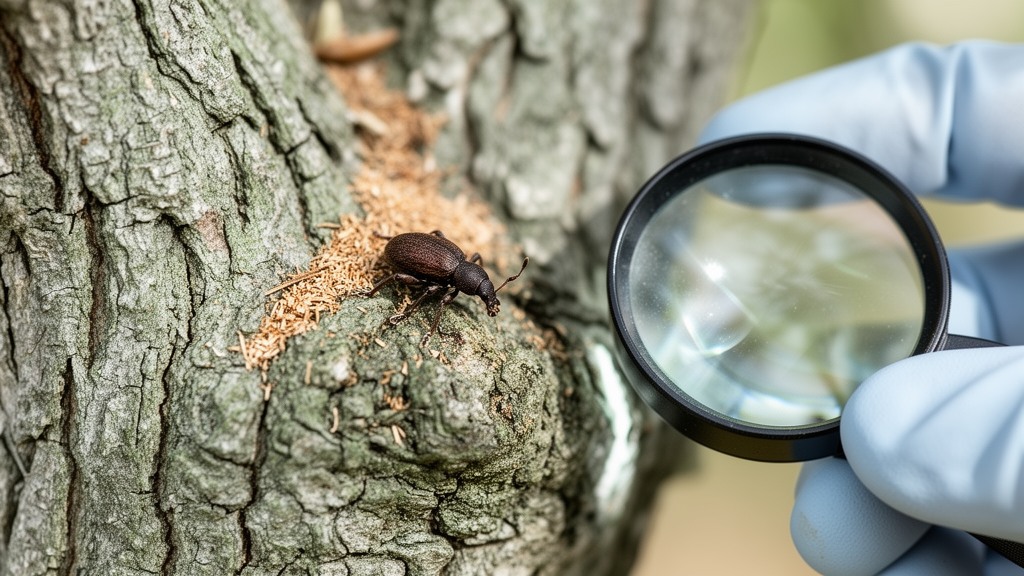
The olive bark beetle Phloeotribus scarabaeoides, a species native to the entire Mediterranean region of Southern Europe, North Africa and the Middle East, has been recorded for the first time in the Czech Republic. In April 2023, small stems of Olea europaea infested with the beetle were found in the town of Ždánice in South Moravia. By June 2023, 253 specimens had emerged in the laboratory from 80-centimetre-long stems with a diameter of 8 centimetres, a yield the researchers estimate corresponds to a population of roughly 320 individuals per 80-centimetre trunk with a diameter of 7 to 8 centimetres. The case report, published in the Annals of Forest Science, classifies the record to date as an accidental introduction rather than an established population.
Only isolated cases of introduction without further establishment are known from northern European countries, including Great Britain, Hungary and Austria. In the Czech case, the beetles arrived on imported olive trees, a commodity that has become increasingly popular in parts of South Moravia, where individual trees can reach prices of up to 4,000 euros and where residents commonly buy potted olives for summer gardens and move them to insulated spaces during winter. The authors suggest this growing trade may contribute to the potential spread of non-native bark beetle species.
The studied gallery systems consisted of two transverse, or slightly inclined to the longitudinal axis of the stem, opposing egg galleries originating from a very short mating chamber. The egg galleries measured 6 to 28 millimetres in length, with a mean of 19.38 plus or minus 6.75 millimetres, and 0.9 to 1.6 millimetres in width, with a mean of 1.23 plus or minus 0.27 millimetres. The larval passages, which were longitudinal and only those ending with a pupal cradle were measured, ran straight or only slightly curved, with a length of 26 to 40 millimetres and a mean of 32.61 plus or minus 5.05 millimetres.
Larval galleries were very densely distributed along the egg galleries, at approximately 9 to 12 galleries per side of each egg gallery, and the density of exit holes reached 42 per 10 square centimetres of trunk surface.
Following the discovery, the researchers carried out a detailed survey of olive trees in the vicinity of the find, as well as an investigation of related tree species, specifically Fraxinus and Syringa. The species was not detected on other Olea europaea trees at the import facility, nor on surrounding trees in the built-up areas of the nearest municipalities, a total of ten sites within a 20-kilometre radius, including the town of Ždánice and the villages of Uhřice and Žarošice. No spread to or infestation of other host plants, specifically Fraxinus or Syringa species, was revealed by the survey of trees and parks surrounding the site of discovery.
On the basis of these surveys, the record is classified as an accidental introduction, and the species is not yet permanently established in the country. The authors nevertheless note that, given the number of olive trees sold annually in the region, which they put at up to several dozen, future permanent establishment cannot be ruled out. For owners of Olea europaea trees, they identify monitoring of tree health as crucial, especially after successful overwintering, together with the removal of any dead branches and twigs that could attract the beetle. These are precautionary measures grounded in the finding itself rather than evidence of an established infestation.
The concern behind the monitoring advice lies in the beetle’s potential host range. P. scarabaeoides has the potential to attack native species in the region, acting, for example, as a pest of ash trees, and the authors describe it as a potential threat to native Fraxinus excelsior and Fraxinus angustifolia in the floodplain forests of the southeastern Czech Republic, as well as to Syringa vulgaris in parks. No such host shift has been observed; the surrounding surveys found no infestation of ash or lilac. The risk assessment is therefore prospective, resting on the beetle’s known biology and on the abundance of potential hosts near the discovery site.
That abundance is considerable. Fraxinus excelsior is an important tree species in the hilly areas of the Czech Republic, accounting for 4.6 percent of the total tree biomass volume according to forest management plans. It is particularly vital in Natural Forest Area No. 35, the Jihomoravské úvaly, where F. excelsior and F. angustifolia occur with varying abundance across approximately 16,000 hectares, and in Natural Forest Area No. 36, the Středomoravské Karpaty mountains, where the discovery site is located and F. excelsior covers approximately 400 hectares. The study area has in recent years been heavily affected by ash dieback, and the authors note that native bark beetles, namely Hylesinus varius and Hylesinus crenatus, play a significant, albeit secondary, role in that decline, which has severely weakened ash stands in the region.
The context of the introduction is itself part of the finding. Olive trees are non-native to the Czech Republic and are grown only in the warmest regions of the country, with frost as the primary stressor they cannot tolerate. However, as a result of climate change, the authors report that the trees’ chances of survival have significantly increased, particularly in the warmest areas where winter snowfall is now rare and temperatures often remain above freezing. Olive has become a common ornamental tree in parts of South Moravia, planted year-round in gardens as well as kept in pots. The beetle’s own history in Europe shows how such trade moves it: an infested tree was imported to Halifax in Great Britain from France in a record dating to 1870, and the species was introduced to Innsbruck in Austria via beetle-infested olive branches, in both cases without subsequent establishment.
The Czech authors place their case report in a wider pattern of non-native tree imports carrying their associated bark beetles into new territory. Increased imports of the non-native Austrian pine, Pinus nigra, have previously facilitated the introduction of its associated bark beetles Pityogenes bistridentatus and Orthotomicus robustus, and the authors conclude that continued increases in the import of non-native tree species may lead to more frequent introductions of non-native bark beetles. The potential spread of P. scarabaeoides across the wider South Moravia region is, in their assessment, of particular concern because of the possible host shift to native Fraxinus species. Whether the beetle returns with future olive shipments, and whether it could ever establish and shift to ash, remains an open question that the authors’ monitoring recommendations are designed to answer.
Subject of Research: First record of the olive bark beetle Phloeotribus scarabaeoides in the Czech Republic, detected in imported olive trees and classified as an accidental introduction.
Article Title: First report: Phloeotribus scarabaeoides (Bernard, 1788) in the Czech Republic—could the new lifestyle of the population cause the spread of a new bark beetle to Central Europe?
Article References: Holuša, O., Fiala, T., & Holušová, K. (2026). First report: Phloeotribus scarabaeoides (Bernard, 1788) in the Czech Republic—could the new lifestyle of the population cause the spread of a new bark beetle to Central Europe?. Annals of Forest Science, 83(1), Article 41. https://doi.org/10.1186/s13595-026-01360-8
Image Credits: AI Generated
DOI: 10.1186/s13595-026-01360-8
Keywords: Phloeotribus scarabaeoides, olive bark beetle, Czech Republic, South Moravia, Olea europaea, invasive species, bark beetles, Fraxinus excelsior, accidental introduction, ornamental tree trade, gallery morphology, ash dieback
News Source: Alan Morgan. (October 29, 2026). Olive Bark Beetle Discovered in Czech Republic Raises Fears of a Central European Spread. Scienmag.