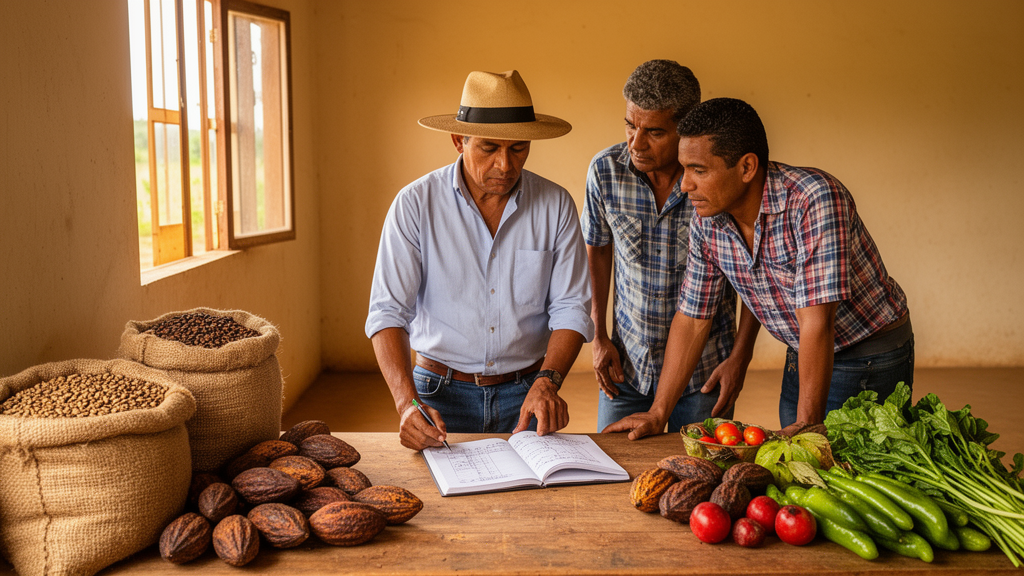
Financial education tailored to the cultural and productive context of each community strengthened the internal governance of short food supply chains in vulnerable rural communities of Ecuador, Peru and Colombia, according to a qualitative study published in Agricultural and Food Economics. Based on in-depth interviews with 23 producer leaders conducted in October and November 2024, the research examined cocoa cooperatives in Esmeraldas, Ecuador; banana by-product ventures in Condorcanqui, Peru; and blackberry producers of the Nasa Indigenous community in Cauca, Colombia. The authors report that training in budgeting, cost control, credit use and financial planning helped producers organize collectively, make more informed decisions and reduce their dependence on intermediaries.
The study defines internal governance as the coordination and cooperation mechanisms among the actors directly involved in a chain, including internal decision-making processes, rules for resource allocation and benefit sharing, and management practices related to financial administration, transparency and collective action. This contrasts with broader governance, which covers external regulatory frameworks, certification schemes and the influence of public authorities and buyers. The researchers argue that while external structures set the conditions under which short food supply chains operate, internal governance determines their operational capacity, equity and resilience, and that financial literacy has been an underexamined dimension of it.
All three cases emerged from the financial education strategy of the CODESPA Foundation, a Spanish development NGO with long-standing field programs in the region. The cases were selected purposively rather than randomly, based on criteria including the presence of organized producer groups engaged in short food supply chains, the implementation of financial education as a cross-cutting component, documented improvements in market access or income, and the availability of primary data. The authors caution that this selection strategy, together with the qualitative design and limited sample, means the findings are indicative rather than generalizable.
The Ecuadorian case involves small-scale cocoa producers, mostly of African descent, in the Quinindé Canton of Esmeraldas, a province where more than 80 percent of the rural population lives in poverty. Producers deliver fermented and dried beans to REDESCOCPE, a cooperative network that handles marketing and export, eliminating the conventional intermediary who typically captures a large share of added value. Producer organizations there implemented a financial education program of five training modules covering family budgeting, savings, credit use, equity and financial well-being, delivered over two days. According to project documentation, 2,175 producers, 54 percent of them women, have been trained, and productivity increased by 70 percent over the past decade, figures the article attributes to the NGO’s program reports rather than to independent measurement.
The cooperatives also adopted practical measures to meet the European Union’s Deforestation Regulation, including a digital administrative and accounting system for recording transactions, parcel geo-referencing to verify non-deforested origins, decentralized collection centres and cloud-based purchase management platforms. The study reports that these measures enhanced traceability, compliance and market access, positioning the groups for better pricing opportunities in European markets. Good Agroecological Practices certification serves a dual role, supporting environmental conservation and communicating verifiable information about origin and production methods to consumers.
The Peruvian case is described as the most significant of the three because producers created an entirely new short chain from waste. In Condorcanqui, Awajún communities grow bananas conventionally under global long-chain schemes, where nearly 50 percent of production is discarded, 20 percent through quality rejections and 30 percent as agricultural residue such as stems and leaves, and bananas reaching the market sell for about USD 0.02. Working with the National University of San Marcos, which developed dehydration technology in 2021, and later with the National University of Jaén on biofiber extraction, the NUGKUY enterprise of the Chapi community began converting surplus bananas into dehydrated flakes sold to food companies at USD 2.81 per unit and pseudo-stems into biofiber used by artisans and design companies. The article reports the project created 28 jobs, increased women’s participation in the family economy by 40 percent and raised producers’ average income by 15 percent.
In Colombia, 49 families from the Nasa community in the La Cilia–La Calera Indigenous Reserve, 35 percent of them women leaders, shifted from a region marked by illicit coca cultivation to blackberry farming. The association KWE’SX KIWE EWA – ASKEWA was created in 2023, and nearly 40 people participated in 60 hours of financial education sessions between 2023 and 2024 covering personal finance, budgeting, credit access, savings and investment, and financial statement analysis. With support from the sugar mill Ingenio del Cauca and the NGO, an inclusive business was established in which the company Nutrium buys the blackberries, processes them and supplies the juice producer Postobón. Project figures cited in the study indicate average production of five tons of blackberries per month, a 142 percent increase in production and a 200 percent rise in family income, with 97 percent of participating families above the monetary poverty line by 2024, compared with an average monthly family income of 66.66 euros in 2022.
The interview analysis, coded manually through open, axial and selective coding grounded in constant comparison, produced four meta-categories: short food supply chains, financial health, organization and environment, and quality of life of families and communities. Producers reported that they previously did not keep accounts or calculate costs systematically. One participant said, “Before, we did not keep accounts; we did not know exactly how much we were spending or earning,” while another explained, “Before, we were afraid of loans because we did not understand them; now we know how to use them and how to pay them back.” Others described prioritizing productive investments, saving toward longer-term goals, and using better record-keeping to access formal credit and reduce reliance on informal lenders.
The authors interpret these accounts carefully, noting that they reflect perceived changes rather than quantitatively measured outcomes. They argue that financial education operates not merely as individual capacity building but as a facilitating component of internal governance, strengthening producers’ ability to engage in collective planning, allocate resources more transparently and comply with external requirements such as traceability standards. The cases also show that short and conventional chains coexist in hybrid configurations: Ecuadorian cocoa still reaches global markets, Peruvian banana by-products depend on conventional banana production, and Colombian blackberries are split between national agroindustry, which takes 80 percent of output, and the local market. Financial literacy appeared to help producers navigate both channels more deliberately, although the study does not measure price margins, contract conditions or shifts in bargaining power.
The study is explicit about limits. Structural constraints, including regulatory barriers, infrastructure gaps, insufficient government support and broader market power asymmetries, remain largely outside producers’ control, and financial education does not eliminate these vulnerabilities. Strengthened internal governance, the authors conclude, appears to be a necessary but not sufficient condition for consolidating short food supply chains in vulnerable territories, and interventions are likely to work best when accompanied by enabling institutional frameworks, infrastructure investment and regulatory support. They call for comparative, longitudinal or mixed-methods research to assess the durability and scale of the governance changes associated with financial education, and for further work on how internal governance mechanisms interact with external governance structures across different institutional contexts in Latin America.
Subject of Research: Financial education as a component of internal governance in short food supply chains in vulnerable rural communities of Ecuador, Peru and Colombia
Article Title: Financial education and internal governance on short food supply chains: evidence from vulnerable rural communities in Latin America
Article References: Galbán-Lozano, S. E., Velázquez-Salazar, M., Martínez-García, E., & Peñuela-Díaz, X. (2026). Financial education and internal governance on short food supply chains: evidence from vulnerable rural communities in Latin America. Agricultural and Food Economics, 14(1), Article 63. https://doi.org/10.1186/s40100-026-00505-7
Image Credits: AI Generated
DOI: 10.1186/s40100-026-00505-7
Keywords: financial education, short food supply chains, internal governance, smallholder farmers, Ecuador, Peru, Colombia, cocoa, banana by-products, blackberries, rural development, qualitative research
News Source: Courtney Benton. (October 30, 2026). Financial Education Strengthens Small Farmer Governance in Three Latin American Food Chains. Scienmag.