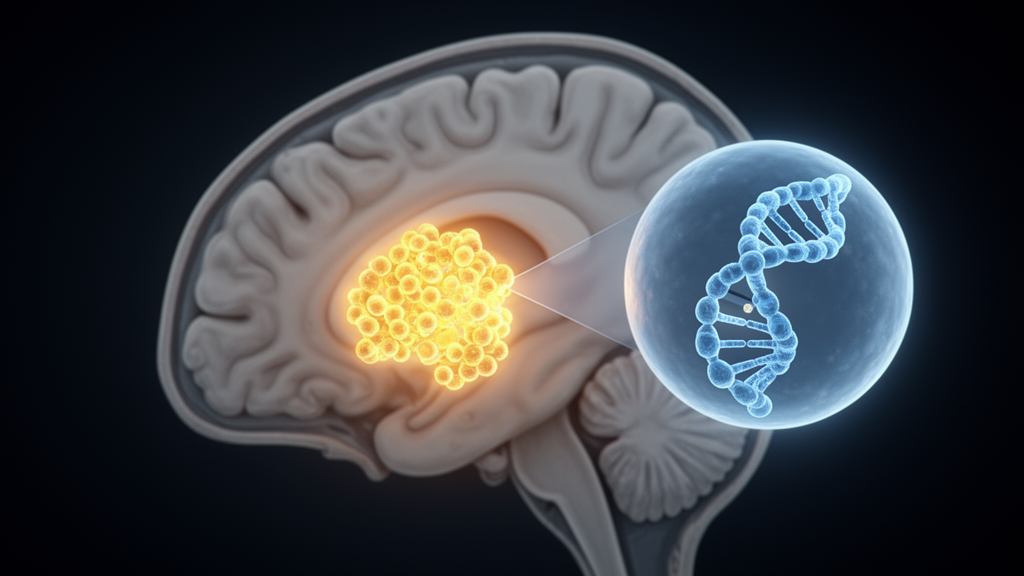
A tumour long thought to be almost exclusively the work of one mutated gene has now been shown to arise through a completely different route. In a study published in EMBO Molecular Medicine, researchers report that disrupting the tumour suppressor gene Apc in mouse pituitary stem cells is sufficient to drive adamantinomatous craniopharyngioma, a rare but devastating brain tumour, without any mutation in the β-catenin gene CTNNB1 that is normally blamed for the disease. The finding establishes APC disruption as a causal mechanism of this tumour and identifies a distinct genetic subtype that had previously gone unrecognised.
Adamantinomatous craniopharyngiomas, or aCPs, are complex intracranial neoplasms that arise in the sellar and suprasellar region of the brain, pressing on the pituitary gland, hypothalamus and optic pathways. Although the World Health Organisation classifies them as grade 1 benign epithelial tumours, their location makes complete surgical removal extremely difficult, leading to high rates of recurrence and severe endocrine and neurological sequelae. They account for around 90 percent of all craniopharyngiomas, with an incidence of roughly 1.7 per million people, and represent the most common suprasellar, non-neuroepithelial intracranial tumour of childhood. Most cases are driven by somatic mutations in CTNNB1, the gene encoding β-catenin, but a small fraction of tumours remain genetically unresolved, and the drivers behind those cases have been an open question.
The new work, led by researchers including James Blackburn, James G Nicholson and senior author Carles Gaston-Massuet, attacked that question with genetically engineered mouse models. The team used a conditional allele in which exon 15 of Apc, a large exon containing the domain responsible for β-catenin degradation, is flanked by LoxP sites. When they deleted this exon using the Prop1:Cre driver, which is active in embryonic pituitary progenitors from day 10 of gestation, the resulting homozygous mutant embryos developed large pituitary tumours that were almost devoid of hormone-producing cells. None of the mutant pups survived beyond the first postnatal week, and abnormal pituitary enlargement was detectable as early as embryonic day 11, worsening throughout gestation alongside a statistically significant increase in mitotic index.
Crucially, the embryonic tumours displayed the classic histopathological hallmarks of human aCPs. These included whorl-like clusters of cells accumulating β-catenin in both nucleus and cytoplasm, a diagnostic feature of the disease, as well as palisading epithelium forming finger-like protrusions. The β-catenin-accumulating clusters expressed the pituitary stem cell marker Sox2, showed low proliferative capacity themselves, and were surrounded by dividing cells and Sox9-positive cells, mirroring what has been described in tumours driven directly by oncogenic β-catenin. When the researchers compared their Apc-driven tumours with murine Ctnnb1-driven tumours and with human CTNNB1-positive aCP samples, the shared histological features were striking.
Because full deletion of Apc proved lethal before birth, the team engineered a milder, hypomorphic configuration by combining two different floxed Apc alleles. The resulting compound mutants, in which a small amount of wild-type Apc messenger RNA, roughly 7.5 percent of normal levels, was still produced, survived to adulthood and every single one developed large pituitary tumours after birth. These postnatal tumours contained cysts, stellate reticulum-like cells, large foci of wet keratin and nucleo-cytoplasmic β-catenin clusters, all diagnostic features of human aCPs, and notably included wet keratin deposits that had been absent from previously published murine models of the disease. From four months of age, all mutant animals became obese, a co-morbidity thought to reflect hypothalamic involvement and one of the most burdensome complications in aCP patients, and one that earlier β-catenin-driven mouse models had failed to reproduce. Survival was markedly shortened, with a gender difference: males had a 50 percent probability of survival at around 180 days, while females survived to roughly 320 days.
To pinpoint the cell of origin, the researchers used an inducible Sox2CreERT2 system to delete Apc exon 15 specifically in Sox2-positive pituitary stem cells. When deletion was induced embryonically, the embryos developed anterior pituitary hyperplasia with clusters of accumulating β-catenin that expressed Axin2, a canonical Wnt pathway target, and the senescence marker p21. When deletion was induced in newborn pups, tumours were present in the anterior pituitary lobe by ten weeks of age. Together, these experiments demonstrate that bi-allelic loss of Apc in Sox2-positive pituitary stem cells is sufficient to initiate aCP formation both during development and in adulthood, cementing the causal role of the tumour suppressor.
The mechanistic heart of the paper lies in what those tumour-initiating clusters actually do. Using a fluorescent Wnt-reporter line to isolate the β-catenin-accumulating cells by flow cytometry, the team profiled their transcriptome. The clusters showed strong activation of the canonical Wnt pathway, with upregulation of Axin2, Lef1, Sp5 and multiple Wnt ligands, but also secreted a remarkable cocktail of inflammatory and developmental factors: fibroblast growth factors, bone morphogenetic proteins, Sonic hedgehog, numerous keratins, a broad array of interleukins including Il6, and chemokines such as Ccl2, Ccl3 and Cxcl family members. Gene set enrichment analyses confirmed upregulation of IL2-Stat5, IL6-Jak-Stat3 and TNF-alpha signalling, pathways central to inflammation, immunomodulation and angiogenesis. This is the signature of the senescence-associated secretory phenotype, or SASP, in which senescent cells flood their surroundings with pro-inflammatory mediators that reshape the tumour microenvironment.
Notably, the senescence programme in the Apc-driven clusters ran through p21, encoded by Cdkn1a, rather than p16, which is upregulated in some human and murine β-catenin-mutated aCP clusters. The clusters expressed high levels of p21 protein, along with the DNA-damage marker γ-H2AX, the inflammatory regulator NF-κB and its downstream mediator pSTAT3, but were negative for p16. Across the team’s three allelic series, p21 levels rose with phenotypic severity, and the size of the β-catenin clusters tracked with it, supporting the idea that the strength of this senescence-associated inflammatory output, rather than the specific initiating mutation, determines whether hyperplasia progresses to frank tumour formation. This may also explain why an earlier study, which deleted a different Apc exon in pituitary progenitors and produced only small clusters with attenuated SASP, concluded that Apc deletion was not tumorigenic.
The study went further, asking whether the murine tumours recapitulate the epigenetic landscape of human disease. DNA methylation profiling showed that both Apc-driven and Ctnnb1-driven mouse tumours clustered alongside human aCP samples rather than with control pituitary tissue, and both showed significantly higher Pearson correlations with human aCP references than wild-type murine pituitary did. Differential methylation analysis revealed substantial shared epigenetic alterations between the two mouse models: 106 of 122 differentially methylated region-linked genes detected in Apc-driven tumours, 86.8 percent, were also detected in the β-catenin-driven tumours. Among the shared hypomethylated genes were Il6, a canonical SASP cytokine, Parp1, linked to DNA damage response and senescence, Tlr4, a mediator of NF-κB signalling, and Igfbp4. Gene ontology analysis of the shared genes pointed to inflammatory pathways including nitric oxide biosynthesis and IL-1β, IL-6 and TNF-α production. Compared with the recently described human methylation subtypes ACP-1 and ACP-2, the Ctnnb1-driven mouse tumours correlated more strongly, particularly with the CTNNB1-enriched ACP-2 subtype, as expected given the shared driver.
The authors caution that whether the transcriptional and epigenetic features they describe characterise all APC-mutated human tumours will require larger patient cohorts. Nevertheless, the practical implications are clear. Previous whole-exome sequencing studies had identified three aCP cases harbouring germline APC mutations in patients with familial adenomatous polyposis, and further reports have linked aCPs with Gardner and Turcot syndromes, but causality had never been established. The new mouse data close that gap, supporting APC genetic testing in patients with aCP, particularly those lacking CTNNB1 mutations, and arguing for early surveillance for aCP development in individuals with FAP and other germline APC-associated syndromes. Equally, patients who develop aCPs without β-catenin mutations should be considered for testing for underlying APC mutations. The hypomorphic mouse model, faithfully reproducing tumour-induced obesity and other clinical features, now offers researchers a robust genetic tool for studying one of paediatric neuro-oncology’s most troublesome tumours, and for testing interventions aimed at the senescence-driven inflammation that fuels it.
Subject of Research: Apc tumour suppressor loss as a causal, CTNNB1-independent driver of adamantinomatous craniopharyngioma in mouse models
Article Title: Apc-deficient pituitary stem cells drive adamantinomatous craniopharyngioma through senescence-associated inflammation
Article References: Blackburn, J., Nicholson, J. G., Gomez-Corral, L., Xue, J., Rai, A., Finn, B. P., Tan, R. J. L., Chakravarthi, K. C., Gualtieri, A., Hall, C. L., Czibik, G., Dutta, P., Korbonits, M., Roncaroli, F., Davis, S. W., & Gaston-Massuet, C. (2026). Apc-deficient pituitary stem cells drive adamantinomatous craniopharyngioma through senescence-associated inflammation. EMBO Molecular Medicine. https://doi.org/10.1038/s44321-026-00525-2
Image Credits: AI Generated
DOI: 10.1038/s44321-026-00525-2
Keywords: adamantinomatous craniopharyngioma, APC, β-catenin, pituitary stem cells, Wnt signalling, senescence, SASP, p21, DNA methylation, familial adenomatous polyposis, mouse models, brain tumour
News Source: Juliet Wilcox. (October 29, 2026). Tumour suppressor gene loss sparks childhood brain tumour in mice, revealing hidden driver. Scienmag.