


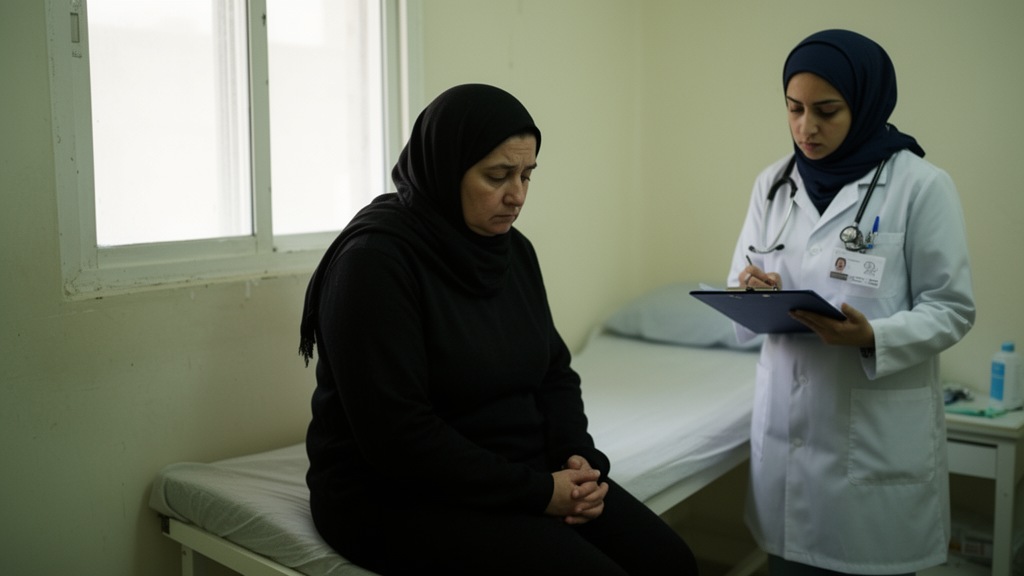
An online survey of 500 Palestinian women has linked a greater number of partner-perpetrated adverse tactics to less favorable scores on a reproductive health questionnaire, while war and adversity exposure showed no independent association after statistical adjustment. The cross-sectional study, published in Conflict and Health, also found that older age was associated with lower scores and higher monthly income with higher scores.
The researchers used an online cross-sectional convenience survey, meaning participants were recruited through accessible channels rather than random sampling, so the sample may not represent all Palestinian women. The questionnaire, termed the RHN-VW, comprises 39 items scored from 1 to 5, yielding a possible total score of 39 to 195 across four domains: men’s participation, self-care, support and health services, and sexual and marital relationships.
The mean total score was 153.89, with a standard deviation of 23.83. Domain means were 51.95 for men’s participation, 53.04 for self-care, 20.18 for support and health services, and 28.73 for sexual and marital relationships. The authors note that the support and health-services domain showed the least favorable score after accounting for differences in the possible ranges of each domain.
To examine which factors were associated with scores, the team used nonparametric tests for group comparisons and a multivariable linear regression with HC3 heteroscedasticity-robust standard errors. The model included age, education, marital status, monthly income, smoking, partner adverse tactics, and war and adversity exposure as covariates. Unstandardized coefficients in the model represent adjusted point differences in the RHN-VW score.
The adjusted model explained 23.9 percent of the variance in scores. Older age was associated with lower scores, with an unstandardized coefficient of −0.530 (95 percent confidence interval −0.740 to −0.320) per unit increase. A higher past-year partner adverse-tactics count in the primary model was associated with lower scores (B = −3.666, 95 percent CI −4.938 to −2.394). By contrast, monthly income above 4000 Israeli shekels, compared with income below 2000 shekels, was associated with a higher score (B = 11.098, 95 percent CI 5.825 to 16.371).
A sensitivity analysis indicated some nonlinearity in the partner adverse-tactics association, with a quadratic term reaching statistical significance (p = .009). War and adversity exposure, however, was not independently associated with scores once other factors were taken into account. This distinction matters because the study was conducted in a conflict-affected setting, yet the adjusted analysis did not identify war exposure itself as an independent correlate of the measured outcomes.
Exploratory analyses added further detail. Partner adverse tactics were inversely associated with all four RHN-VW domains. The association remained present for a combined self-care and support-and-health-services score even after partner- and relationship-focused domains were excluded, and the authors report that this persistence suggests the finding was not attributable solely to husband- and relationship-focused items in the instrument.
The authors are careful to frame what the study does and does not show. These findings identify priorities for further assessment and evaluation rather than demonstrating service unavailability, unmet clinical need, causal effects, or the effectiveness of a specific intervention. Because the design is cross-sectional, the associations cannot establish direction of causality, and the convenience sampling further limits generalizability.
The study, published open access on 22 September 2026 and shared early as a citable accepted manuscript subject to further edits, was led by Eman Alshawish and colleagues including Loai M. Zabin and Mohammed Hayek. Its stated aim was to examine selected reproductive health-related practices, partner involvement and support experiences, perceived health-service responsiveness, and sexual and marital relationship experiences among Palestinian women, and to assess their associations with partner-perpetrated adverse tactics and war-related adversity. The authors describe the background as one in which women’s reproductive health-related practices and support experiences in conflict-affected settings are shaped by gendered power relations, partner violence, service disruption, and constraints on safe access to care. Within that framing, the reported findings point to partner behavior, age, and household income as statistical correlates of the measured reproductive health scores, while leaving questions of causation and intervention effectiveness to future research.
Subject of Research: Associations between partner adverse tactics, war-related adversity, and reproductive health-related practices among Palestinian women
Article Title: Selected reproductive health-related practices, support experiences, and relationship factors among Palestinian women in conflict-affected Palestine: associations with partner adverse tactics and war-related adversity
Article References: Alshawish, E., Zabin, L. M., Zaid, E., Abuhejleh, D., Salah, I., Bouzia, A., Marabeh, O., Saabi, Z., & Hayek, M. (2026). Selected reproductive health-related practices, support experiences, and relationship factors among Palestinian women in conflict-affected Palestine: associations with partner adverse tactics and war-related adversity. Conflict and Health. https://doi.org/10.1186/s13031-026-00846-6
Image Credits: AI Generated
DOI: 10.1186/s13031-026-00846-6
Keywords: Palestinian women, reproductive health, cross-sectional survey, partner adverse tactics, war-related adversity, Conflict and Health, RHN-VW questionnaire, health services, linear regression, conflict-affected settings, Selected, reproductive
News Source: Courtney Benton. (October 30, 2026). Partner Adverse Tactics Linked to Lower Reproductive Health Scores Among Palestinian Women. Scienmag.



