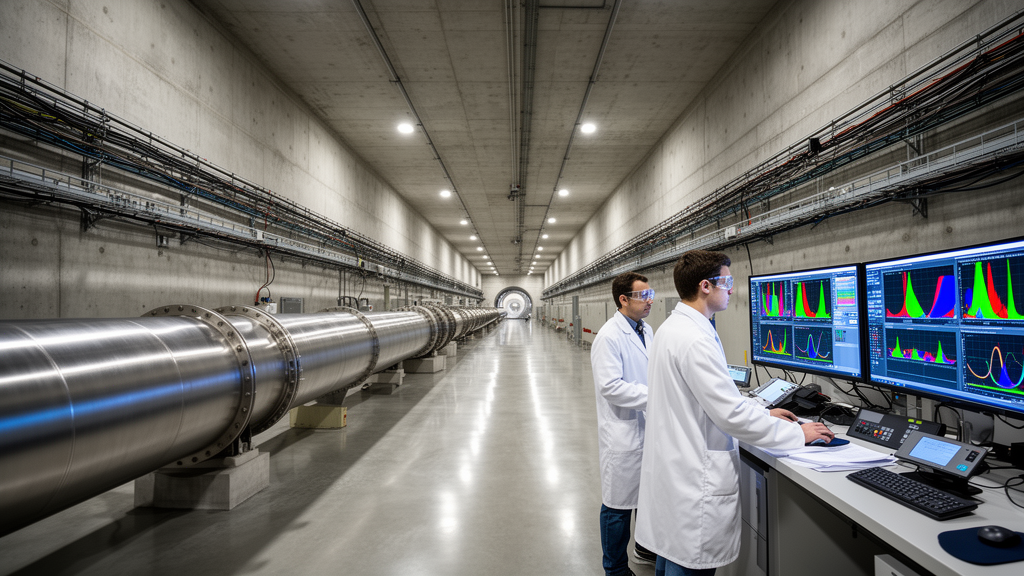
The European Spallation Source in Lund, Sweden, is a multidisciplinary neutron research facility currently under commissioning, driven by a superconducting proton linear accelerator that its operators see as fertile ground for artificial intelligence and machine learning. A new review published in EPJ Research Infrastructures lays out the facility’s overall strategy for deploying AI and machine learning techniques during both the commissioning phase and steady-state operation, identifying the use cases most aligned with the facility’s high-level goals and describing pilot projects already under development or being tested offline and on the accelerator itself.
The ESS linac is designed to be the driver of what is intended to be the brightest neutron source in the world, based on a 5 MW proton beam. The accelerator is roughly 600 meters long and combines normal-conducting and superconducting sections to accelerate protons to 2 GeV. In the initial phase of user operation, the linac is planned to run at a reduced power of 2 MW with a beam energy of 800 MeV, with some cryomodules unavailable in that configuration. Because the machine is designed as a high-power, high-reliability facility that must deliver uninterrupted neutrons to users, its team argues it can benefit substantially from AI and machine learning methods that have become increasingly prominent in modern accelerators.
The strategy is anchored in three high-level goals: reliable operation with minimum downtime, operation with minimal beam losses and activation of the beamline, and sustainable operation. As a user facility, ESS aims to maximize available beam time, which translates into a demanding requirement of 95 percent availability for the accelerator. Given the multi-megawatt beam power, uncontrolled beam loss must not exceed an average of 1 W/m along the linac so that hands-on maintenance remains possible. These targets define the paradigm for which AI tools are prioritized, with the main focus on projects that maximize machine availability and minimize beam loss while energy-consumption applications are investigated in parallel.
Anomaly detection and fault prediction are central to the reliability goal. Faults in high voltage converter modulators, for example, have been reported elsewhere as a major cause of accelerator downtime, and similar models can be applied to electrical and radio-frequency systems as well as vacuum and cryogenics. Detecting anomalies in beam behavior is another key strand: by using historical data from beam position, current and loss monitors during and before beam trips, the team aims to identify and classify these events, enabling prediction and possibly prevention of trips during online operation. Early detection of beam deviations from nominal parameters would not only reduce downtime but could allow beam production to be stopped before a beam loss event occurs, reducing dose rates and activation along the linac.
AI-based tuning routines are expected to automate machine setup and optimization in the longitudinal and transverse planes, reducing startup and recovery times after long shutdowns and trips. Large language models trained on equipment-specific documentation are planned to help on-call experts troubleshoot issues more efficiently. On the sustainability front, ESS already transports heat generated from equipment cooling to the local heating network that helps warm the city of Lund, and AI-aided routines for optimizing heat transport and energy consumption are being explored, with pilot projects under evaluation and stakeholders being identified.
The facility is still defining the scope and roadmap of its AI activities, with a preliminary roadmap projected until 2030. In the first phase, pilot projects will be consolidated under a single framework to improve coordination, and a core task force within the Accelerator Division, comprising AI experts and representatives of different teams, will identify needs and coordinate efforts while communicating with other ESS units such as Controls, IT infrastructure, Engineering, Target and Neutron Science. High-priority projects will receive more resources and, where applicable, beam time for online testing during commissioning. In-house development is encouraged to build and retain expertise, complemented by collaboration with national and international facilities and industry partners. Through its Integrated Control System Division, ESS is already a core partner of the Wallenberg AI, Autonomous Systems and Software Program, contributing to its research arena for operational data, and student projects have spanned topics from ML-driven dynamic modeling to causal analysis of alarm cascades.
A substantial preparatory effort concerns data infrastructure. The ESS control system, built on the EPICS framework, currently handles around 11 million process variables and growing. The Control System Machine Learning project, initiated in 2019, explores whether machine learning can contribute to higher availability and operational efficiency, deeper process understanding, and reduced commissioning and maintenance costs. A central lesson from its early phases is that data collection, cleaning and pre-processing take more effort than model development itself, so the focus has shifted to data-centric workflows and machine learning operations. A core component is the csml_data library, which provides schema-driven conversion between EPICS control system data and the Python data science ecosystem, preserving metadata such as alarm states, timestamps and control constraints, so that pipelines can train on archived data and run inference on live data without schema translation. Trained models are being integrated into the live control system by publishing predictions as EPICS process variables through Input/Output Controllers, allowing outputs to feed existing operator interfaces, alarm systems and control logic without architectural changes. A dedicated study on data quality and quantity for machine learning has proposed remedies including standardized metadata policies, adaptive archiving strategies and improved retrieval tooling, and ESS has made some control system datasets publicly available to facilitate external collaboration.
Among the pilot projects, one targets the high-power klystrons that deliver radio-frequency power to the accelerating cavities. These complex vacuum devices degrade gradually and can fail unexpectedly, causing significant beam downtime, while existing hardware interlocks respond reactively once signals exceed predefined thresholds and cannot distinguish a stable signal near a limit from one drifting toward it. The proposed framework adds two complementary LSTM-based models trained on slow-control diagnostic data. The first, an LSTM autoencoder trained exclusively on nominal operating data, flags multivariate signal windows whose shape, variance or cross-channel structure deviates from the learned baseline, catching oscillatory anomalies regardless of absolute signal level. The second, a sequence-to-sequence regressor, forecasts the near-future trajectory of key diagnostics, with signal-dependent horizons of roughly 5 to 15 minutes for electrical quantities such as solenoid and filament currents and 30 to 90 minutes for thermal signals, generating early warnings with an estimated time-to-breach when a signal is projected to cross an interlock limit. Both models have been trained on 365 days of archived data from an operational ESS klystron and are currently running live in advisory mode, publishing EPICS alarms in real time, while full control authority remains with the established hardware protection systems. Future work includes validation using leave-one-fault-out cross-validation on historical interlock event logs and extension to additional RF subsystems.
A second pilot addresses fast anomaly detection for beam protection. Non-invasive diagnostics including beam current, position and loss monitors produce aggregate data rates of several gigabytes per second, and conventional protection based on localized diagnostics and fixed thresholds cannot capture complex correlations across systems. A centralized machine learning protection concept under development aggregates high-bandwidth diagnostic data into a centralized FPGA-based inference platform built on a Xilinx Versal Adaptive Compute Acceleration Platform. A hybrid CNN-GRU model implemented with the hls4ml tool flow aims at deterministic real-time processing with end-to-end inference latency below 50 microseconds, with scalability of the model on the FPGA currently the main challenge. An alternative approach running a pure CNN on the Versal’s Deep Processing Unit and AI Engines targets latency below 5 milliseconds; preliminary tests on beam position monitor classifications demonstrated processing times of 2.5 milliseconds. The ultimate goal is anomaly detection on the timescale of a single ESS proton pulse, which lasts 2.86 milliseconds.
Two further pilots round out the portfolio. A trajectory correction project trains a deep residual neural network on about 100,000 simulated beam trajectories generated with OpenXAL, taking 309 magnet settings as input and outputting 86 beam position monitor values per plane, with the aim of correcting slow trajectory drifts to within 1 millimeter; the model is currently being tested on simulation data and has demonstrated feasibility of correcting beam offsets below 1 mm within a few iterations, with testing on the real linac planned later. Meanwhile, a local AI helper for the Proton Beam Instrumentation group is being evaluated to assist on-call personnel in finding system information and troubleshooting guidance grounded in a curated document set, with every answer required to include references to its underlying sources so users can verify the information. The longer-term plan is to extend the approach to other accelerator domains such as RF and vacuum, ultimately aiming at a combined accelerator AI helper that supports operations across the division.
Subject of Research: Strategy and pilot projects for applying AI and machine learning at the European Spallation Source proton linac
Article Title: Strategy of AI Application and Current Activities at European Spallation Source Proton Linac
Article References: Gorgisyan, I., Shea, T., Eshraqi, M., Rathsman, K., Montano, R., Mohammednezhad, M., Kocevar, H., Arnold, P., Danared, H., Juni Ferreira, M., Pierini, P., Rostrup Forup Jensen, M., Weisend, J. G., II, Gustafsson, K., Perák, G., Cvenkel, D., Berkolds, K., Grzegrzółka, M., & Plostinar, C. (2026). Strategy of AI Application and Current Activities at European Spallation Source Proton Linac. EPJ Research Infrastructures, 10(1), Article 28. https://doi.org/10.1007/s41781-026-00182-7
Image Credits: AI Generated
DOI: 10.1007/s41781-026-00182-7
Keywords: European Spallation Source, proton linac, machine learning, artificial intelligence, anomaly detection, klystron, FPGA, beam trajectory correction, MLOps, large language models, neutron source, Lund
News Source: Blake Davidson. (October 28, 2026). AI Takes Aim at Beam Losses and Downtime at Europe’s Spallation Source. Scienmag.