A city logistics pilot in Budapest now has its two anchor sites. Using an Analytic Hierarchy Process framework built specifically for the Hungarian capital, researchers ranked a set of candidate locations for micro-consolidation centers and selected the Március 15 Square parking area, scoring 75.9 percent, and the Ferenciek Square underpass, scoring 73.5 percent, as the best places to establish the new hubs. The work, published in European Transport Research Review, forms part of the LIFE IP HungAIRy project, a European Commission LIFE Programme initiative titled “Improving air quality at eight Hungarian regions through the implementation of air quality plan measures,” which aims to tackle environmental problems and improve air quality in ten Hungarian municipalities.
The Budapest pilot is being developed with support from the BKK Centre for Budapest Transport, which assisted the Municipality of Budapest in cooperation with the City Logistics Research Group of the Budapest University of Technology and Economics. Within the pilot, the defined tasks include designing a loading area reservation system as a webpage or mobile application, creating micro-consolidation centers, and developing the basis of a certified transportation system, alongside selecting surrounding loading areas where the reservation system can be tested. The main expected result is a more efficient use of freight transport capacities so that fewer freight vehicles circulate in the city, decreasing emissions from urban freight transport and improving air quality in the city center.
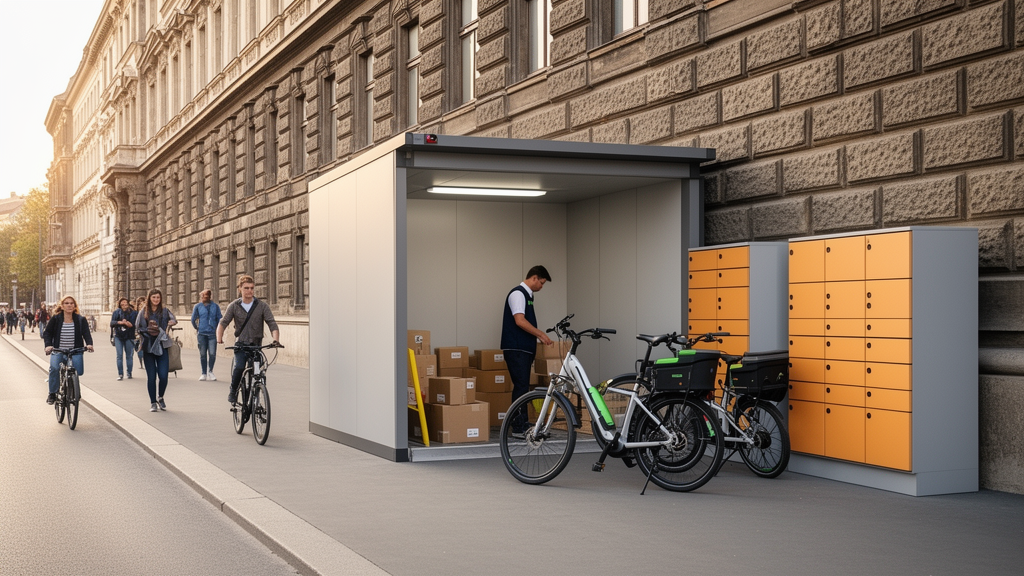
Micro-consolidation centers are urban logistics facilities that enable cross-docking, consolidation, and transshipment between middle-mile delivery, for example between a logistics service provider’s logistics center and the hub, and first- or last-mile delivery, such as parcel delivery from the hub to homes or parcel lockers. Unlike traditional consolidation centers, which are usually located in outer-urban areas, micro-consolidation centers sit close to the city center so they can be served by logistics providers, and last-mile deliveries from them typically use environmentally friendly freight vehicles such as cargo bikes or electric vans. The study distinguishes three types: traditional micro-consolidation centers, called MicroHUBs, which have fixed locations with static infrastructure and support short-term storage and transshipment, for example between vans and cargo bikes; mobile micro-consolidation centers, or MobileHUBs, which have no fixed location and can be dynamically deployed using intermodal units such as containers, as demonstrated by UPS in Hamburg, Dublin, and Leuven and in a Brussels pilot; and small-scale parcel consolidation hubs, or ParcelHUBs, which handle parcels only and are equipped with parcel lockers without warehouse infrastructure, as seen in Madrid and Bologna.
First- and last-mile delivery tasks are currently the most critical issues in city logistics, being the most expensive parts of city logistics systems and causing significant disruption in urban transportation, particularly because of the rapid expansion of the e-commerce sector in recent years. Many small freight vehicles are needed to serve urban delivery locations such as retailers and restaurants or to handle home delivery in residential areas, and these vehicles play a significant role in city-center congestion and contribute a significant part of urban emissions. The research team notes that a range of innovations are now being implemented to address these problems, including cargo bikes, trikes and cubicycles, delivery robots, drones, parcel lockers, and better-organized logistics systems, with loading zones remaining crucial infrastructure for efficient and regular loading next to delivery locations.
The location selection framework was built from a review of comparable projects worldwide. In Barcelona, more than 1,000 potential locations were examined using an Iterated Local Search strategy for a location routing problem, while Madrid applied mixed-integer linear programming to model micro-hub locations, capacities, and fleet assignments. Pardubice in the Czech Republic used the WASPAS method with the Best-Worst Method and CRITIC to rank alternatives under uncertainty, and Izmir in Turkey combined the Analytic Hierarchy Process with TOPSIS to score urban districts. Vienna developed an AHP-based decision support tool involving municipalities, logistics companies, and citizens, Stuttgart paired AHP with the PROMETHEE method, Volos used weighted sum multi-criteria analysis, and Belgrade relied on fuzzy AHP and fuzzy TOPSIS. Portsmouth applied a Red/Amber/Green Rating filtering process with 28 subcriteria, Sydney tackled an incapacitated single allocation hub covering problem with the Floyd-Warshall and Teitz and Bart algorithms, and New York City optimized micro-consolidation center locations with a heuristic model to reduce the social costs of last-mile deliveries.
According to the literature review, these published projects varied widely in their goals and criteria. In Bologna the focus was on preserving the historical city core, in Madrid on using under-used garages, and in Prague on operating during cold and snowy winter periods. In most cases, delivery costs and distances, emission-related aspects, operational costs, proximity to local demand, and capacity limitations were considered, but criteria such as weather resilience, digital user experience, marketing aspects, compliance, the 15-minute-city concept, and historic preservation appeared only in single papers. No presented solution is standard, and none defined a general framework for any city. The review also found that only a few studies examined post-socialist Central European cities, and none included criteria addressing two-tier municipal structures. Budapest’s districts have relatively broad powers by international standards, with their own budgets, institutions, and significant local decision-making authorities, a situation shared by cities such as Brussels and Berlin but absent from the related literature.
For the Budapest application, the study focused on four areas: the Váci Street shopping area and its surroundings, the Corvin District, an area along Bartók Béla Road in District XI, and Nyugati Square. Researchers identified five potential locations in the Váci Street area, five in the Corvin District, one along Bartók Béla Road, and one at Nyugati Square, all places where at least one type of micro-consolidation center can be implemented and, in some areas, two or all three options are feasible. Areas currently being developed within other city logistics projects were excluded, and a manual inspection of all potential locations was conducted with a special focus on areas identified by the Municipality of Budapest as most problematic for city logistics, such as areas with strict access regulations, pedestrian zones, limited loading capacity, and no available transshipment possibilities.
The researchers defined 24 subcriteria across three main categories: technical, demand-side, and operational and network design criteria. The technical criteria cover total available floor area, access and exit options for transport modes, technological height and width for entry, entry restrictions, weight limits, physical condition, renovation needs, obstructions, utility supply, and current area coverage. The demand-side criteria include the planned coverage area, the number and density of delivery locations, annual freight demand, population, employment, and relevance for logistics service providers. The operational and network design criteria address the ownership of the area, the willingness of the owner municipality or company to support the development, zoning according to the current network planning framework, the nature of surrounding areas, the number of curbside functions to be eliminated, and the current gross-weight-based access restriction system. Greater emphasis was placed on demand potential, network design, and institutional feasibility than in previously published related papers, and the ownership criterion was specifically designed for Budapest’s two-level municipality structure with a central municipality and district municipalities.
Four experts, two from the City Logistics Research Group of the Budapest University of Technology and Economics representing academia and two from the BKK Centre for Budapest Transport representing the municipal side, evaluated the importance of the criteria and subcriteria. Consistency ratios of at most 0.1 were obtained in all cases, so the pairwise comparisons were considered consistent. The evaluation ranked technical criteria as the most important, followed by the equally important demand-side criteria and the operational and network design criteria. The most important subcriterion within each category was total available floor area among the technical criteria, freight demand in the planned coverage area among the demand-side criteria, and the area’s owner among the operational and network design criteria. Data were collected from public and municipal databases, previous research data, personal site visits, observations of surrounding areas and logistics processes, and measurements of physical parameters during visits.
The ranking placed the Március 15 Square parking area first, where 476 square meters would be available for development with very good transport connections for all possible delivery modes, no significant physical restrictions, good condition, and no significant obstructions or renovation needs identified. A nearly 0.5 square kilometer area around the Váci Street shopping area could be served from this location, with more than 500 delivery locations, more than 350,000 parcels per year of freight demand, more than 5,000 residents, and more than 32,000 employees, and the area is highly relevant for logistics service providers because of the pedestrian zones around Váci Street. The area is owned by the municipality, but its main disadvantage is that it is currently used for parking and many parking spaces would need to be eliminated. The Ferenciek Square underpass followed with 73.5 percent, a difference of only 2.4 percent that the authors consider not significant for practical purposes. This underground area is only suitable for a ParcelHUB, has less space with good surface access, is in good condition after recent metro renovations, is owned by a company of the municipality, and requires no curbside functions to be eliminated because only currently empty store locations would be used. They were followed by the Aranykéz Street Garage with 68.8 percent, the Nyugati Square parking area with 67.5 percent, and the Vörösmarty Garage with 67.2 percent, while the parking area at Gárdonyi Square, the only designated area completely suitable for a MobileHUB, performed poorly at 50.1 percent. Because establishing two micro-consolidation centers was necessary in each pilot scenario, three combinations were suggested, and the Municipality of Budapest selected the first: a MicroHUB at Március 15 Square and a ParcelHUB in the Ferenciek Square underpass. Procurement for the pilot began in 2025, with implementation, the addition of a new pilot area at Göncz Árpád City Center, and monitoring and analysis of operations in later phases.
According to scenario-based models of the Municipality of Budapest, developing these micro-consolidation centers could lead to a 20 to 80 percent reduction in freight traffic in the examined area, with a 0.2 to 0.9 microgram per cubic meter reduction in NO2 emissions on an annual basis, representing a 1.9 to 2.9 percent reduction, plus a minor reduction of less than 0.1 micrograms per cubic meter in PM10 and PM2.5 concentrations. The authors stress that the final reduction depends on logistics provider companies actually using the new infrastructure, the types of vehicles they apply, and the final number of parcels delivered through the new centers. The team also acknowledges limitations: the methodology was applied only to selected urban locations rather than the entire central area of Budapest, yearly parcel demands were considered despite the market being highly seasonal with very different summer holiday and end-of-year periods such as Black Friday and Christmas, only four experts evaluated the criteria, which may cause subjectivity, and local building codes on whether logistics infrastructure can be set up in an area must be examined in future evaluations. The authors nevertheless consider the framework applicable to other post-socialist Central European cities and other environments after local adaptation, and believe the pilot will enable testing different micro-consolidation center technologies that can later be extended to other areas of Budapest, with consolidation, IT applications, and dynamic daily operational planning based on real-time data as possible next steps.
Subject of Research: Location selection for micro-consolidation centers in a Budapest city logistics pilot using an AHP-based ranking framework
Article Title: Selection of the best locations for micro-consolidation centers for a city logistics pilot in Budapest
Article References: Lőcsei-Tóth, K., Vass, G., Sárdi, D. L., Bóna, K., Büki, A., Strang, T., Uglik, Z. T., & Herbert, B. (2026). Selection of the best locations for micro-consolidation centers for a city logistics pilot in Budapest. European Transport Research Review, 18(1), Article 92. https://doi.org/10.1186/s12544-026-00849-7
Image Credits: AI Generated
DOI: 10.1186/s12544-026-00849-7
Keywords: city logistics, micro-consolidation centers, Budapest, Analytic Hierarchy Process, last-mile delivery, freight traffic, NO2 emissions, LIFE IP HungAIRy, urban logistics, parcel lockers, multi-criteria decision analysis, Selection
News Source: Denise Maddox. (October 29, 2026). Budapest Picks Two Spots for City Logistics Micro-Hubs. Scienmag.