


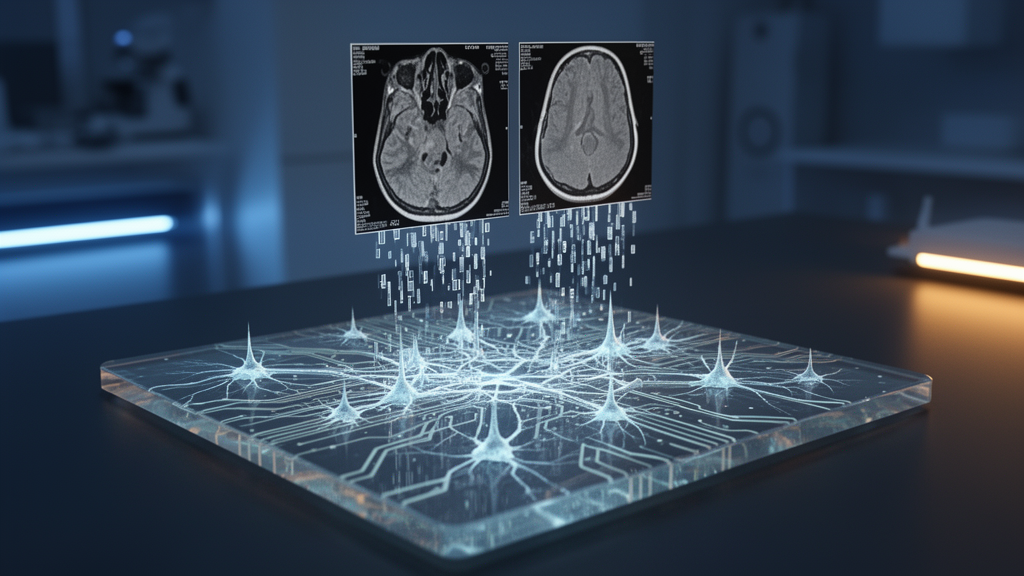
Researchers present a bio-inspired computing scheme that reduces halftone binary images by up to 75 percent while enabling lossless reconstruction of every original pixel, integrated into a reversible data-hiding workflow for DICOM medical images. The work, published in the journal Cluster Computing, centers on a Spiking Neural P (SN P) circuit whose design borrows its core mathematical operation from discrete convolution, the same kernel-based computation that underlies convolutional neural networks.
In their experiments, every restored halftone image produced a peak signal-to-noise ratio of infinity and a bit error rate of exactly zero, the mathematical signatures of perfect recovery.
The mechanism is disarmingly simple once unpacked. The circuit takes a binary image and divides it into non-overlapping blocks of two-by-two pixels. Each block contains four bits, so there are exactly 16 possible configurations. Four input connections to a single neuron, called dendrites in the SN P literature, carry synaptic weights of 1, 2, 4 and 8, successive powers of two. The weighted sum of the four pixel values therefore yields a unique integer between 0 and 15 for every possible block, with no two different blocks ever colliding on the same value. That integer indexes one of 16 colored spikes, the output symbols of the circuit.
Because the mapping from block to spike is a bijection, a one-to-one and onto correspondence, the process runs in reverse without ambiguity. The authors formalize this in a theorem proving that the encoding function is injective and that the sizes of the input and output sets match, which together establish bijectivity. The inverse mapping simply decomposes each encoded value back into its four-bit binary word, recovering the original pixel block exactly. Replacing each two-by-two block with a single encoded value cuts the image to one quarter of its original pixel count, the source of the 75 percent reduction in spatial dimensions.
The convolution connection is more than cosmetic. The researchers note that the weighted aggregation performed by the neuron is mathematically equivalent to the kernel-input dot product that constitutes the fundamental operation of discrete convolution. Their circuit processes each block with a fixed kernel of weights arranged as 1, 2, 4, 8, using a stride of 2, producing a reduced representation half the width and half the height of the input. Unlike conventional convolutional layers, whose kernels are tuned during training to extract discriminative features, this kernel is fixed by design and implements a deterministic positional binary encoding. The scalar output is not interpreted as a feature activation but as the index of a colored spike, a combination the authors describe as the convolution-inspired nature of the circuit.
The choice of weights matters enormously. The authors demonstrate that consecutive weights such as 1, 2, 3 and 4 would cause collisions: the block configuration with white pixels at positions one and four, and the configuration with white pixels at positions two and three, would both sum to 5, making unique reconstruction impossible. Powers of two eliminate this problem entirely, since every integer from 0 to 15 has exactly one four-bit binary representation. The design also offers flexibility: firing rules can be adapted so that different spike trains represent the same image, and block sizes could in principle extend to three-by-three or four-by-four, increasing the diversity of colored spikes at the cost of more firing rules.
Computational complexity analysis in the paper shows both encoding and decoding scale linearly with the total number of pixels, O(MN) for an image of height M and width N, or quadratic in the side length of a square image but linear in pixel count. Each block requires only a constant number of operations: four comparisons and a weighted sum. The authors contrast this with a conventional two-dimensional convolution using a k-by-k kernel, which would require O(MNk squared) operations, and with FFT-based convolution, which achieves O(MN log MN) but carries higher constant factors and implementation overhead. Memory usage is likewise O(MN), with the reduced image occupying one quarter of the original size.
The SN P circuit does not operate alone. The full workflow begins with an ownership logo transformed into a binary halftone image through error-diffusion halftoning, a technique that converts continuous-tone images into two-level representations of black and white pixels arranged in dot patterns. A secret message of 1,040 bits containing sensitive patient information is then embedded into the halftone logo using a binary data-hiding method that divides the image into two-by-two mini-blocks and applies adaptive rules based on the Human Visual System, avoiding modifications to uniform blocks and favoring diagonal changes where the eye is less sensitive. The marked halftone image then passes through the SN P circuit, and the resulting colored-spike representation is compressed with lossless JPEG 2000, which employs a reversible integer-approximated wavelet transform.
Experimental validation used 40 DICOM images across four modalities: computed radiography, radiofluoroscopy, computed tomography and magnetic resonance imaging, with grayscale depths of 12 and 10 bits. Objective quality metrics applied to the final marked DICOM images showed peak signal-to-noise ratios well above the 30 dB threshold commonly regarded as nearly imperceptible, while structural similarity and universal quality indices remained close to 1. A committee of three healthcare specialists, one general practitioner and two radiologists, scored the processed images on a five-point mean opinion scale, and the quantitative results are reported in the paper’s tables.
The authors are candid about limitations. The SN P circuit has been validated only on binary images; extending it to grayscale or color medical images would require new synaptic weights and a considerably larger set of firing rules to preserve collision-free, fully reversible encoding, substantially increasing both mathematical formulation and computational complexity. They also note that the reversible data-hiding scheme they adopted, based on multirange-level histogram shifting, is not robust against geometric or statistical attacks, since even minor pixel alterations destroy the histogram alignment needed for reversibility; its role in this work is a proof of concept for structural compatibility rather than a robustness claim. Future work, they write, will target grayscale and color extensions, larger block sizes and adaptive synaptic weight configurations. For now, the study demonstrates that a neuron with four weighted dendrites and sixteen colored spikes can perform a fixed, deterministic convolution-like encoding of binary images while enabling lossless reconstruction of the original data.
Subject of Research: A convolution-inspired spiking neural P circuit for lossless binary image resizing within a reversible data-hiding framework for DICOM medical images.
Article Title: Convolution-inspired spiking neural P circuits for lossless image resizing embedded in a reversible data-hiding framework for DICOM medical images
Article References: Valerio-Trigueros, K. A., Olvera-Martinez, L., Cedillo-Hernandez, M., Diaz-Rodriguez, C., Fragoso-Navarro, E., & Sanchez-Garcia, J. C. (2026). Convolution-inspired spiking neural P circuits for lossless image resizing embedded in a reversible data-hiding framework for DICOM medical images. Cluster Computing, 29(15), Article 873. https://doi.org/10.1007/s10586-026-06708-3
Image Credits: AI Generated
DOI: 10.1007/s10586-026-06708-3
Keywords: spiking neural P systems, DICOM, reversible data hiding, lossless image compression, convolution, medical imaging, JPEG 2000, halftoning, colored spikes, bio-inspired computing, image authentication, data security
News Source: Cassandra Pierce. (October 29, 2026). Convolution-Inspired Spiking Neural P Circuit Achieves Lossless 75 Percent Image Resizing in Reversible Data-Hiding Framework for DICOM Medical Images. Scienmag.



