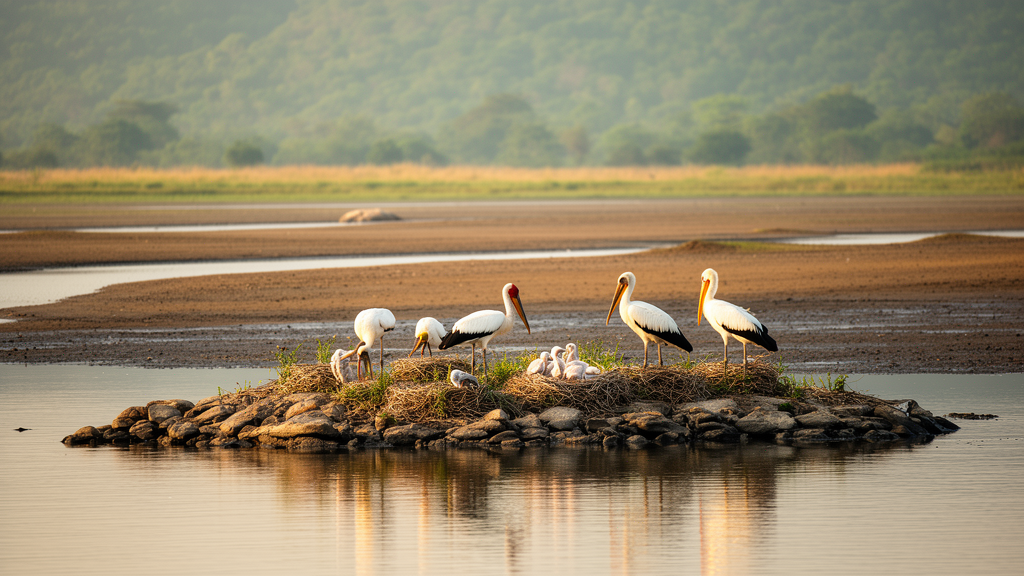
Across nine wetlands in the southern Indian state of Tamil Nadu, the single factor that best explains whether colonial waterbirds arrive, how many birds settle, and how many species breed is not rainfall or temperature but the sheer extent of water visible on the wetland surface. A three-year field study combining monthly bird counts, satellite-derived inundation maps and reanalysis climate data found that wetland water extent was the strongest predictor of nesting arrival, colony abundance and species richness, while climatic variables played a clearly secondary role. The findings, published in Ecology and Evolution, come from one of the first quantitative multi-site assessments of short-term environmental drivers of colonial waterbird breeding in monsoon-dependent wetlands of southern India.
The research team surveyed nine wetlands over three consecutive breeding seasons, from 2022–2023 to 2024–2025. Eight of the nine sites are Ramsar-designated wetlands of international importance, and all are artificial water bodies originally built for irrigation and water storage, ranging from small marshes of about 29 hectares to the 453-hectare Karaivetti Bird Sanctuary. Colonial nesting waterbirds, a guild that includes herons, egrets, cormorants, darters, ibises, storks and spoonbills, breed in dense groups in trees and plants standing in or beside water, so their reproduction is tightly coupled to the flooding conditions of the wetlands they occupy.
Surveys were conducted at roughly monthly intervals during each breeding season, always between 7 and 8 a.m. from fixed vantage points such as watchtowers, after roosting birds had departed so that only breeding individuals were counted. A single trained observer carried out all counts to keep detection and counting procedures consistent across sites and years. In total, 16 colonial nesting species were recorded across the nine wetlands during the study period. Nesting occurred at every site in at least one season, and six of the nine wetlands supported nesting in all three years, but three sites, Koonthankulam, Therthangal and Vettangudi, recorded complete breeding failures in at least one season, with no active colonies at all.
To quantify hydrological conditions, the researchers used Sentinel-2 satellite imagery at 10-metre resolution, generating a composite image from all cloud-free observations in the 15 days before each survey. Surface water was classified using the Modified Normalised Difference Water Index, with thresholds calibrated separately for each wetland against true-colour imagery and repeated field observations, because water colour, turbidity and aquatic vegetation differ from site to site. Climate data came from the ERA5 reanalysis dataset, providing daily maximum temperature, cumulative precipitation and mean wind speed for each site. These variables were summarised over 30-, 60- and 90-day windows preceding each survey, and model comparison showed that the 30-day window received the strongest support for all three breeding responses, indicating that the birds respond primarily to recent environmental conditions in the month before a survey.
The statistical analysis used generalised linear mixed models, with wetland identity and breeding season as random intercepts to account for repeated observations at the same sites and years. For nesting arrival, modelled as a binary presence-or-absence response, water extent had a strong positive effect, with an estimate of 1.732. In practical terms, the odds of colony establishment increased roughly 5.7-fold for each one-standard-deviation increase in water extent. Model predictions showed nesting probability rising from about 0.55 under very low inundation to nearly 1.0 when wetlands were highly inundated. Maximum temperature, precipitation and wind speed showed no significant associations with whether colonies formed at all.
Once colonies were established, however, climatic conditions began to matter. Colony abundance, analysed with a negative binomial model to handle overdispersed count data, increased significantly with water extent but declined significantly with rising 30-day maximum temperature and, somewhat counterintuitively, with higher cumulative precipitation. Wind speed showed only a weak, non-significant negative effect. Species richness followed a similar pattern: it rose strongly with water extent and fell with both maximum temperature and precipitation, while wind speed again had no detectable effect. In the richness model, water extent showed the largest standardised effect of any predictor, underlining how strongly the diversity of breeding species tracks the amount of open water available.
Model comparisons confirmed the hierarchy of drivers. For nesting arrival, a model containing water extent alone performed nearly as well as the full model including all climatic variables, with a difference in AIC of only 1.15, meaning inundation alone captured almost all of the explanatory power for whether colonies formed. For colony abundance, adding temperature to the water-only model improved fit substantially, showing that thermal conditions carry explanatory weight beyond hydrology once breeding is under way. Taken together, the authors conclude that wetland inundation acts as the primary ecological filter governing colony establishment and persistence, while temperature shapes colony size and species composition after breeding has begun.
Why would rainfall, the intuitive driver of wetland flooding in a monsoon-dependent landscape, show weak and even negative associations with breeding? The answer lies in the plumbing of Tamil Nadu’s wetlands. All nine study sites receive water from reservoirs, irrigation systems, canal networks and runoff from distant catchments, so local rainfall at the wetland does not necessarily reflect the water actually present. Similar decoupling has been reported elsewhere: studies in Argentina and Australia found waterbird breeding responded more strongly to water levels than to local rainfall when hydrology was controlled by processes elsewhere in the watershed. Water extent, by contrast, integrates the cumulative effects of rainfall, catchment processes, water management and evaporation, making it a more biologically meaningful measure of breeding habitat suitability than precipitation alone.
The negative temperature effects align with a broader literature on thermal stress in waterbirds. Elevated temperatures increase evaporative water loss and the energetic costs of thermoregulation, and heat-stressed birds spend more time panting, wing-spreading and seeking shade at the expense of foraging and parental care. High temperatures have been shown in experimental and observational studies to reduce foraging efficiency, adult body condition, chick provisioning rates and breeding success. Notably, temperature did not affect whether colonies formed, only how large and diverse they were, suggesting that habitat availability gates the decision to breed while thermal conditions influence performance afterwards.
The study’s authors are careful about its limits. Climate data at roughly 31-kilometre resolution cannot capture colony-scale microclimates created by canopy cover and wetland morphology; all counts came from one observer, so inter-observer reliability could not be assessed; satellite-derived water masks were calibrated visually rather than against an independent accuracy dataset; and water extent is only a surrogate that does not capture water depth, hydroperiod, prey availability or water quality. Unmeasured factors clearly matter too: the marked decline in species richness at Vellode Bird Sanctuary, from 10 species in 2022–2023 to 5 by 2024–2025, coincided with deteriorating nesting habitat, including dying nesting trees smothered by climbing vegetation. Because colonial waterbirds are highly mobile and redistribute among wetlands, temporary breeding failures at individual sites may reflect movement within a wider wetland network rather than population decline. For conservation, the message is direct: maintaining adequate water levels during the breeding season, through landscape-scale management of reservoirs, canals and irrigation systems, together with protecting nesting trees and controlling invasive vegetation, is fundamental to sustaining these heronries under increasing climatic variability.
Subject of Research: Environmental drivers of colonial waterbird breeding in monsoon-dependent wetlands of Tamil Nadu, southern India
Article Title: Hydrological Conditions Drive Colonial Waterbird Breeding Dynamics in Monsoon‐Dependent Wetlands of Southern India
Article References: Jacob, A., & Gopi, G. V. (2026). Hydrological Conditions Drive Colonial Waterbird Breeding Dynamics in Monsoon‐Dependent Wetlands of Southern India. Ecology and Evolution, 16(10), Article e74567. https://doi.org/10.1002/ece3.74567
Image Credits: AI Generated
DOI: 10.1002/ece3.74567
Keywords: colonial waterbirds, wetlands, Tamil Nadu, hydrology, monsoon, nesting colonies, species richness, satellite remote sensing, ERA5 climate data, water extent, thermal stress, heronries
News Source: Drew Townsend. (October 29, 2026). Water Levels, Not Rainfall, Decide Where Colonial Waterbirds Nest in Southern India. Scienmag.