


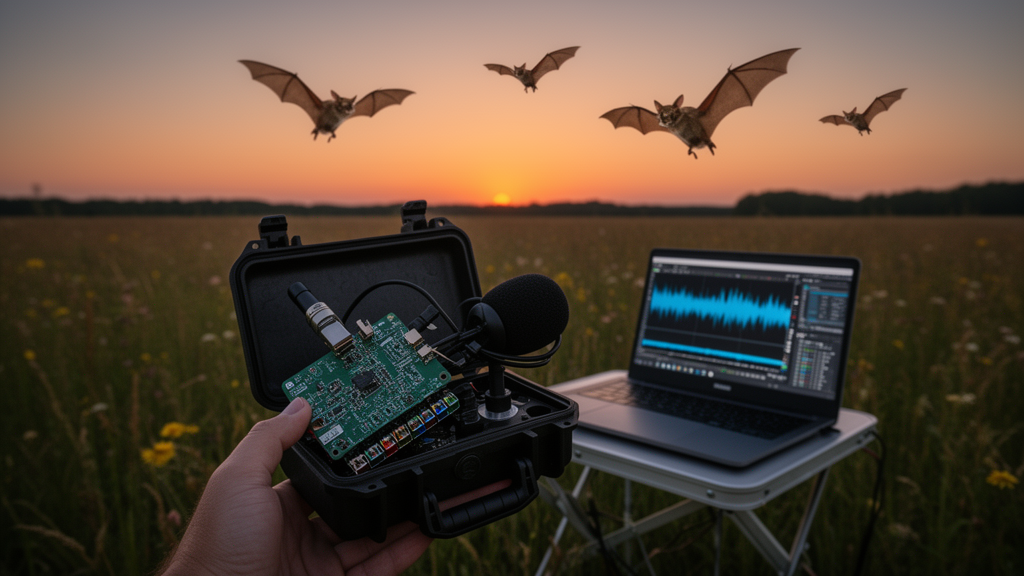
A new open-source device promises to make one of the trickier corners of bat research far more accessible. Batsy4-Pro, described in BMC Ecology and Evolution, is a four-channel ultrasonic recorder built around a Teensy 4.1 microcontroller that captures synchronised full-spectrum audio at 192 kHz straight to a microSD card. The recorder weighs under 150 grams, runs from a standard 5 V USB power bank, and, together with its four-microphone array, can be assembled for roughly 200 euros—a fraction of the several thousand euros that conventional multichannel field systems can cost.
The motivation behind the device is a stubborn geographic imbalance. Tropical and subtropical regions harbour much of the world’s bat diversity, yet remain underrepresented in experimental behavioural bioacoustics. Of the more than 1,300 known species of echolocating bats, fewer than 30 have been studied in experimental behavioural contexts. The author, Ravi Umadi, notes that instrumentation is only one contributor to this disparity, alongside funding, institutional capacity, training and field logistics—but argues that a compact, affordable, openly documented platform can remove at least one practical barrier.
Conventional setups for behavioural experiments on echolocating bats typically require professional audio interfaces, external preamplifiers, laptop computers and stable AC power. Ultrasonic microphones with flat frequency responses beyond 100 kHz add further cost. Batsy4-Pro consolidates analogue-to-digital conversion, processing, storage and real-time monitoring into a single device. Two WM8782 stereo analogue-to-digital converters feed four Knowles MEMS microphones, digitising 16-bit audio at 192 kHz per channel, with data saved as timestamped WAV files. The theoretical Nyquist frequency is 96 kHz, with the usable bandwidth further determined by microphone response and analogue filtering.
A distinguishing feature is the dual recording-mode architecture. A continuously running ring buffer in external PSRAM memory stores the most recent five seconds of audio from all four channels—a window occupying 7.68 megabytes. One button triggers retrospective capture of that buffer, allowing researchers to save brief or unexpected acoustic events that occurred before they pressed anything. A second button starts forward recording that begins with the five-second buffered history and appends up to ten seconds of live audio, preserving behavioural context while capturing ongoing activity. The five-second window was chosen to encompass the brief terminal approach and interception sequences analysed in representative bat-prey studies.
The device also integrates real-time monitoring, something passive acoustic loggers generally lack. A rotary encoder lets the operator select any of the four channels or a combined mix, routed either through tunable heterodyne conversion between 10 and 85 kHz or through direct passthrough of audible-frequency signals to headphones. The default carrier is 45 kHz. Monitoring runs continuously during recording and does not alter the stored full-spectrum data, enabling manual triggering from observed call patterns without a separate detector or spectrogram display.
To evaluate the system, the author deployed it in August 2025 along the river Isar in Freising, Germany, at the edge of a riparian forest known for consistent bat foraging activity. The four microphones were mounted on one-metre aluminium arms arranged in a three-dimensional cross configuration, with each microphone 0.99 metres from the hub centre. Approximately 30 foraging sequences were recorded; 21 sequences meeting quality criteria were retained, and 368 of 440 calls—83.6 percent—passed screening for quantitative analysis. Median call duration was 4.51 milliseconds.
Signal quality held up well against professional equipment. Across the 368 field-recorded calls, the median maximum-channel signal-to-noise ratio was 27.3 dB. A comparison dataset of 500 calls recorded with a Behringer U-PHORIA UMC404HD professional audio interface, from a separate experiment using a similarly sized array with the same MEMS microphones, yielded a nearly identical median of 27.4 dB. The author concludes that variability in signal-to-noise ratio is dominated by differences in call amplitude rather than recorder noise, and that the field performance of Batsy4-Pro approaches that of a professional soundcard-based system.
The synchronised four-channel recordings also supported three-dimensional localisation of calling bats via time-difference-of-arrival analysis, and the recorded trajectories suggested bats actively approaching the array. Because the intended applications involve moving animals, the author ran grid-based Monte Carlo simulations to characterise the usable localisation volume of the deployed geometry. Within four metres of the reference microphone, 71.0 percent of grid points achieved median localisation errors of 50 centimetres or less, and 84.7 percent achieved 100 centimetres or less. Performance was strongest within two metres, where 94.4 percent of positions met the 50-centimetre criterion, and declined sharply with range in a spatially anisotropic pattern shaped by the array geometry rather than distance alone.
The simulations also tested sensitivity to source motion, approximated through Doppler resampling and a first-order delay correction at fixed grid coordinates. Median trial-wise error rose from 2.18 centimetres in the stationary condition to 55.28 centimetres at a simulated speed of 10 metres per second, and the fraction of trials exceeding the 50-centimetre threshold climbed from 15.0 to 52.5 percent. The author is careful to frame these velocity results as a model-sensitivity assessment: motion was not propagated explicitly through time-resolved trajectories, so the analysis establishes sensitivity of the implementation to the velocity parameter but does not quantify the accuracy expected for real moving animals. Empirical validation with calibrated sources at surveyed positions remains essential, and the modular array is designed to facilitate such testing.
All hardware designs, circuit schematics, firmware source code and assembly documentation are released under permissive open-source licences—the CERN Open Hardware Licence v2, GPLv3 and CC-BY-SA-4.0—that explicitly permit commercial production without royalty obligations, opening the door to local manufacturing and institutional workshop projects. Datasets, analysis code and firmware are available in a Zenodo repository, and the hardware carries Open Source Hardware certification. The author positions the platform as an enabling component rather than a complete solution to geographic disparity, but one that can expand the taxonomic and geographic scope of experimental bat bioacoustics, strengthen local capacity for ecological monitoring, and support comparative study of echolocation under natural conditions.
Subject of Research: An open-source four-channel ultrasonic recorder for field bioacoustics and bat echolocation research
Article Title: BATSY4-PRO: an open-source multichannel ultrasound recorder for field bioacoustics
Article References: Umadi, R. (2026). BATSY4-PRO: an open-source multichannel ultrasound recorder for field bioacoustics. BMC Ecology and Evolution, 26(1), Article 85. https://doi.org/10.1186/s12862-026-02592-y
Image Credits: AI Generated
DOI: 10.1186/s12862-026-02592-y
Keywords: bioacoustics, bats, echolocation, open-source hardware, ultrasound recording, microphone array, acoustic localisation, field research, Teensy microcontroller, conservation technology, BATSY4-PRO, open-source
News Source: Drew Townsend. (October 29, 2026). Open-Source 200-Euro Recorder Brings Multichannel Bat Ultrasound to the Field. Scienmag.



