


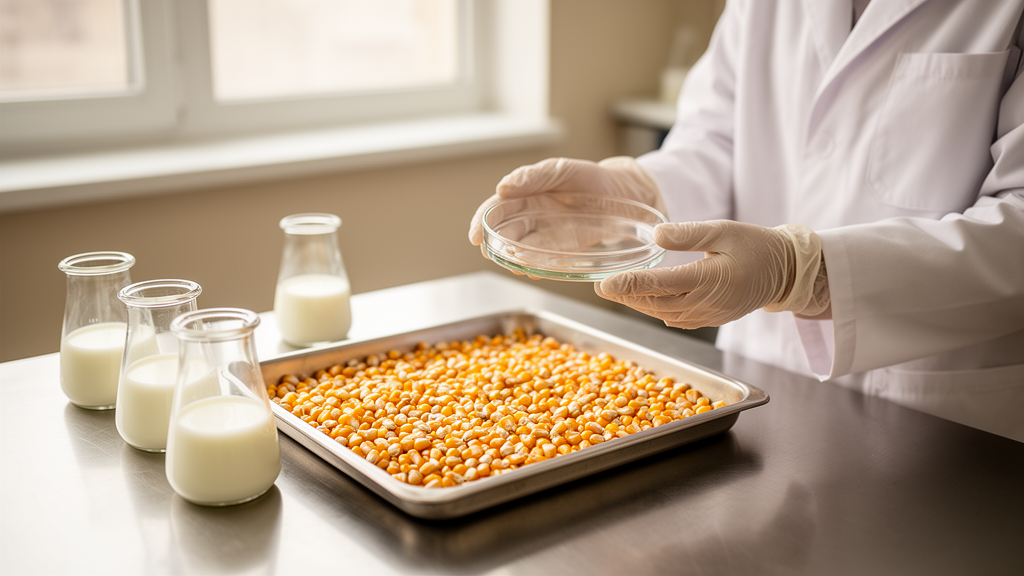
Two strains of Bacillus subtilis originally isolated from commercial yoghurt suppressed the growth of mycotoxin-producing Fusarium species in laboratory assays and lowered levels of the toxin deoxynivalenol in artificially inoculated maize kernels, according to a study published in the Egyptian Journal of Biological Pest Control. The strains, designated RYPB1 and MYPB1, had previously been recovered from fermented milk and shown activity against the grey mould pathogen Botrytis cinerea.
The context for the work is the sheer scale of mycotoxin contamination. An estimated 25 to 50 percent of the world’s annual crop production is affected by these fungal toxins, which are produced mainly by moulds in the genera Fusarium, Aspergillus, Alternaria and Penicillium. Cereal grains are particularly vulnerable to Fusarium infection, and the fungi produce several major mycotoxins during crop development and storage, including fumonisins, trichothecenes such as deoxynivalenol, and the estrogenic compound zearalenone. Deoxynivalenol, also known as vomitoxin, is classified as non-carcinogenic by the International Agency for Research on Cancer but can cause vomiting, digestive problems, oxidative stress and reproductive disorders in humans and animals. Fumonisins, produced mainly by Fusarium proliferatum and F. verticillioides, are classified as possibly carcinogenic to humans and are linked to neural tube defects, esophageal cancer and, in animals, conditions such as leukoencephalomalacia in horses and pulmonary edema in pigs.
The experimental bacteria were obtained from the researchers’ earlier work, in which B. subtilis strains MYPB1, with GenBank accession PQ056998, and RYPB1, with accession PQ056997, were isolated from commercial yogurts. B. subtilis is generally recognized as safe for consumption by the United States Food and Drug Administration and is widely used in the food industry, which made yoghurt a plausible source of strains suitable for food-related applications. The study had three objectives: to evaluate in vitro antagonism against mycotoxigenic Fusarium species isolated from contaminated cereal grains, to assess suppression of fungal growth and toxin production in maize kernels, and to test removal of zearalenone in liquid medium.
In dual-culture assays on agar, the two strains inhibited mycelial growth of 19 Fusarium isolates to varying degrees. RYPB1 reduced growth by between 22.7 and 61.1 percent, with its strongest effect against Fusarium sp. FOFMC-26 at 61.1 percent, followed by Fusarium sp. FOFMC-27 at 57.1 percent and F. verticillioides FQD-13 at 55.9 percent. MYPB1 inhibited growth by 23.0 to 64.0 percent, performing best against F. verticillioides FQD-21 at 64.0 percent and F. verticillioides FQD-10 at 56.4 percent. Analysis of variance confirmed that inhibition differed significantly among the fungal isolates for both bacterial strains. Scanning electron microscopy of hyphae taken from the inhibition zones revealed distortion, shrinkage and loss of turgidity in treated cultures, while control hyphae showed normal morphology with smooth wall surfaces, a pattern the authors attribute to agar-diffusible bacterial metabolites disrupting fungal cell membranes.
The strains also emitted antifungal volatile organic compounds. In sealed two-plate assays, in which bacterial and fungal cultures shared a headspace but never touched, volatiles from RYPB1 suppressed F. verticillioides FQD-16 by 51.5 percent, with inhibition against other isolates ranging from 0.6 to 35.8 percent and no effect against FQD-23. Volatiles from MYPB1 inhibited FQD-16 by 48.2 percent, with other responses between 3.7 and 27.6 percent and no inhibition against two isolates. Headspace solid-phase microextraction coupled with gas chromatography-mass spectrometry putatively annotated nine volatile compounds for RYPB1 and four for MYPB1. The dominant compound in both profiles was 1-cyclohexylethanamine, accounting for 84.4 percent of RYPB1 volatiles and 87.0 percent of MYPB1 volatiles. Crucially, the identification is only putative, based on a library match quality score of 91 percent and a retention index, because authentic analytical standards were not run, and no purified-compound bioassays were performed, so any antifungal role for this compound remains hypothetical.
The zearalenone experiments produced some of the study’s most nuanced results. In Luria-Bertani broth spiked with the toxin, live MYPB1 cells removed 63.3 percent of measurable parent zearalenone after 48 hours at 30 degrees Celsius, compared with 30.5 percent for live RYPB1 cells. Cell-free culture supernatants removed 44.0 percent for MYPB1 and 21.9 percent for RYPB1. Heat-killed cells retained partial activity, removing 31.6 percent for MYPB1 and 11.8 percent for RYPB1, and heat-denatured supernatants lost much of their activity. The authors interpret this pattern as consistent with contributions from both cell-associated binding and heat-sensitive extracellular factors, but they are explicit that the mechanism remains unresolved. The liquid chromatography-mass spectrometry method quantified only residual parent zearalenone in the liquid fraction; the toxin was not recovered from bacterial pellets, no mass-balance analysis was performed, and no transformation products or toxicity assessments were carried out. Adsorption therefore cannot be distinguished from cellular uptake or enzymatic breakdown.
The maize kernel assay delivered a more mixed picture. Kernels confirmed free of the target toxins were sterilized, treated with bacterial suspension and inoculated with a standardized mycelial plug of F. verticillioides FQD-20, then incubated for 21 days. Neither bacterial strain visibly reduced mycelial growth intensity, a discrepancy the authors attribute to the differences between homogeneous nutrient-rich agar and the heterogeneous kernel surface, where moisture distribution, nutrient availability and metabolite diffusion are all restricted. Water activity was not measured during incubation, and bacterial survival or colonization was not quantified, both of which limit interpretation. However, both strains significantly reduced conidial production, by 57 percent for RYPB1 and 44 percent for MYPB1, indicating an effect on sporulation even without reduced visible colonization.
Mycotoxin measurements in the kernels showed that the fumonisin response was modest despite statistical significance. RYPB1 produced only about a 0.7 percent difference from the control, which the authors describe as having no biologically meaningful effect, while MYPB1 achieved a statistically detectable but modest 9 percent reduction. Deoxynivalenol, by contrast, was reduced substantially: 51 percent with RYPB1 and 72 percent with MYPB1. Zearalenone was not detected in any kernel treatment. The authors caution that matrix-specific recovery efficiency for the ELISA kits was not independently validated with spiked maize samples, so relative differences among treatments are more reliable than the absolute toxin concentrations. They also note that the apparent decoupling of toxin reduction from fungal growth could reflect modulation of toxin biosynthetic gene expression by bacterial metabolites, but since gene expression was not examined, this remains speculative.
The overall conclusion is deliberately restrained. The yoghurt-derived strains showed genuine anti-Fusarium activity in vitro, reduced conidia production and deoxynivalenol accumulation in maize kernels, and removed parent zearalenone in broth, making them promising candidates for further development. But the authors state that several gaps must be closed before any food or feed application: confirmation of the zearalenone removal mechanism through pellet recovery, desorption experiments and mass-balance analysis; identification and toxicity testing of any transformation products; confirmation of the volatile compound identity using authentic standards and purified-compound bioassays; strain-level safety assessment; and validation under realistic storage or field conditions, since this study was conducted in the laboratory with high pathogen inoculum. In vitro antagonism, the kernel results make clear, does not reliably predict performance in a complex food matrix.
Subject of Research: Biocontrol of Fusarium fungi and mycotoxins using yoghurt-derived Bacillus subtilis strains
Article Title: Biocontrol potential of yoghurt-derived Bacillus subtilis strains against Fusarium spp. and associated mycotoxin contamination
Article References: Khuseib Hamed Al-Rashdi, F., Mohammed Al-Sadi, A., Al-Badi, Z., Al-Ghafri, A., Soundra Pandian, S. B., Abdullah Al-Kindi, M., Al-Sabahi, J., Hamood Al-Nadabi, H., Ibrahim Waly, M., M. Blackburn, D., & Rethinasamy, V. (2026). Biocontrol potential of yoghurt-derived Bacillus subtilis strains against Fusarium spp. and associated mycotoxin contamination. Egyptian Journal of Biological Pest Control, 36(1), Article 26. https://doi.org/10.1186/s41938-026-00906-2
Image Credits: AI Generated
DOI: 10.1186/s41938-026-00906-2
Keywords: Bacillus subtilis, Fusarium, mycotoxins, deoxynivalenol, zearalenone, fumonisins, biocontrol, maize, volatile organic compounds, yoghurt, food safety, biological pest control
News Source: Alan Morgan. (October 29, 2026). Yoghurt Bacteria Cut Fusarium Toxins in Maize in Lab Tests. Scienmag.



