• HOME
  • NEWS
  • EXPLORE
    • CAREER
      • Companies
      • Jobs
    • EVENTS
    • iGEM
      • News
      • Team
    • PHOTOS
    • VIDEO
    • WIKI
  • BLOG
  • COMMUNITY
    • FACEBOOK
    • INSTAGRAM
    • TWITTER
Thursday, October 29, 2026
BIOENGINEER.ORG
No Result
View All Result
  • Login
  • HOME
  • NEWS
  • EXPLORE
    • CAREER
      • Companies
      • Jobs
        • Lecturer
        • PhD Studentship
        • Postdoc
        • Research Assistant
    • EVENTS
    • iGEM
      • News
      • Team
    • PHOTOS
    • VIDEO
    • WIKI
  • BLOG
  • COMMUNITY
    • FACEBOOK
    • INSTAGRAM
    • TWITTER
No Result
View All Result
Bioengineer.org
No Result
View All Result
Home NEWS Science News Health

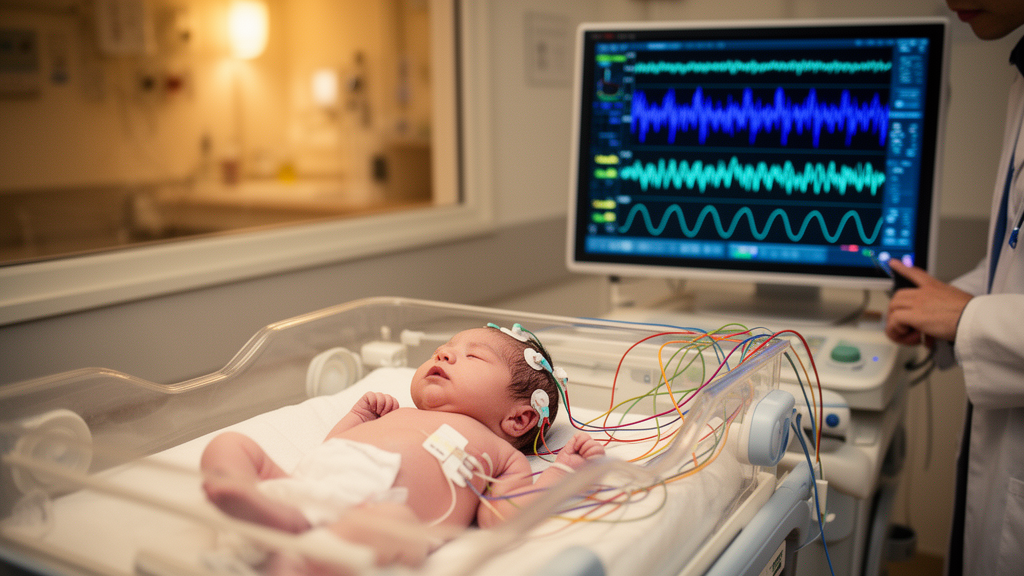
Deep learning model spots neonatal seizures from EEG brain maps with 97% accuracy

by
October 29, 2026
in Health, Technology
Reading Time: 2 mins read
0
Deep learning model spots neonatal seizures from EEG brain maps with 97% accuracy

Deep learning model spots neonatal seizures from EEG brain maps with 97% accuracy

Share on FacebookShare on TwitterShare on LinkedinShare on RedditShare on Telegram

Researchers have developed an automated framework that classifies seizures in newborns by feeding topographic maps of brain electrical activity into deep transfer learning models, reporting a peak subject-wise accuracy of 97.1 percent. The study, published in Brain Informatics as an open-access research article, addresses a pressing clinical need: epilepsy is among the most common neonatal neurological disorders, and early detection of seizures is critical for timely intervention and for reducing long-term neurological consequences.

The team, led by Athar Al-azzawi with colleagues including Saif Al-jumaili, Adil Deniz Duru, Osman Nuri Uçan and Ivan Miguel Pires, built its approach on electroencephalography (EEG) signals. Rather than analyzing raw waveforms directly, the method uses topographic brainpower maps extracted from EEG signals. These images are then processed using deep transfer learning architectures.

Three widely used architectures were rigorously evaluated: GoogLeNet, ResNet-18 and ShuffleNet. The underlying data came from a publicly accessible dataset comprising recordings from 79 newborns. To probe how the length of the analysis window affects performance, the researchers tested three temporal window scenarios of 1, 5 and 8 seconds each.

A key methodological distinction in the study lies in how the models were validated. In initial results, performance approached the optimal accuracy across all temporal windows. To ensure clinical generalizability, they implemented a stricter subject-wise protocol in which the models were tested on entirely unseen patients.

Under this strict validation, ResNet-18 emerged as the superior architecture, achieving the remarkable peak subject-wise accuracy of 97.1 percent in the 8-second window scenario. The authors state that these findings confirm the proposed framework is highly robust against inter-patient variability, and they describe it as a reliable and methodologically sound strategy for automated neonatal intensive care monitoring. Because the article was shared early as an accepted, peer-reviewed manuscript with a permanent DOI, some details may be refined in the final version of record.

Subject of Research: Automated detection of neonatal seizures using deep transfer learning on EEG topographic maps

Article Title: Discrimination of seizure topographical images utilizing transfer learning approaches

Article References: Al-azzawi, A., Al-jumaili, S., Duru, A. D., Uçan, O. N., & Pires, I. M. (2026). Discrimination of seizure topographical images utilizing transfer learning approaches. Brain Informatics. https://doi.org/10.1186/s40708-026-00330-0

Image Credits: AI Generated

DOI: 10.1186/s40708-026-00330-0

Keywords: neonatal seizures, epilepsy, EEG, transfer learning, ResNet-18, GoogLeNet, ShuffleNet, deep learning, brain topographic maps, neonatal intensive care, subject-wise validation, Brain Informatics

News Source: Cassandra Pierce. (October 29, 2026). Deep learning model spots neonatal seizures from EEG brain maps with 97% accuracy. Scienmag.

Tags: Brain Informaticsbrain topographic mapsdeep learningEEGepilepsyGoogLeNetneonatal intensive careneonatal seizuresResNet-18ShuffleNetsubject-wise validationTransfer Learning
Share12Tweet7Share2ShareShareShare1

Related Posts

Only One in Eight Women in Somaliland Completes Maternal Care Continuum, Survey Analysis Finds

Only One in Eight Women in Somaliland Completes Maternal Care Continuum, Survey Analysis Finds

October 29, 2026
Blue laser light plus porphyrin drug pushes lung cancer cells into senescence

Blue laser light plus porphyrin drug pushes lung cancer cells into senescence

October 29, 2026

Heart Transplantation Offers Acceptable Long-Term Survival in Chagas Heart Disease

October 29, 2026

Survey maps organizational profiles of Italy’s bed-based intermediate care services

October 29, 2026

POPULAR NEWS

  • Health literacy varies widely among women after breast cancer surgery, study finds

    Health literacy varies widely among women after breast cancer surgery, study finds

    29 shares
    Share 12 Tweet 7
  • Water Levels, Not Rainfall, Decide Where Colonial Waterbirds Nest in Southern India

    29 shares
    Share 12 Tweet 7
  • Fuzzy utility framework tackles financial risks where probabilities fail

    29 shares
    Share 12 Tweet 7
  • TCTP and Mcl-1 Proteins Rise in Chronic Lymphocytic Leukemia, Study Finds

    29 shares
    Share 12 Tweet 7

About

We bring you the latest biotechnology news from best research centers and universities around the world. Check our website.

Follow us

Recent News

Only One in Eight Women in Somaliland Completes Maternal Care Continuum, Survey Analysis Finds

Genomic scan points to seven kidney genes, but only one earns diabetes-specific support

Gender makes no difference to ESG reporting in Asian agri-food firms, survey finds

Subscribe to Blog via Email

Enter your email address to subscribe to this blog and receive notifications of new posts by email.

Join 85 other subscribers
  • Contact Us

Bioengineer.org © Copyright 2023 All Rights Reserved.

Welcome Back!

Login to your account below

Forgotten Password?

Retrieve your password

Please enter your username or email address to reset your password.

Log In
No Result
View All Result
  • Homepages
    • Home Page 1
    • Home Page 2
  • News
  • National
  • Business
  • Health
  • Lifestyle
  • Science

Bioengineer.org © Copyright 2023 All Rights Reserved.