


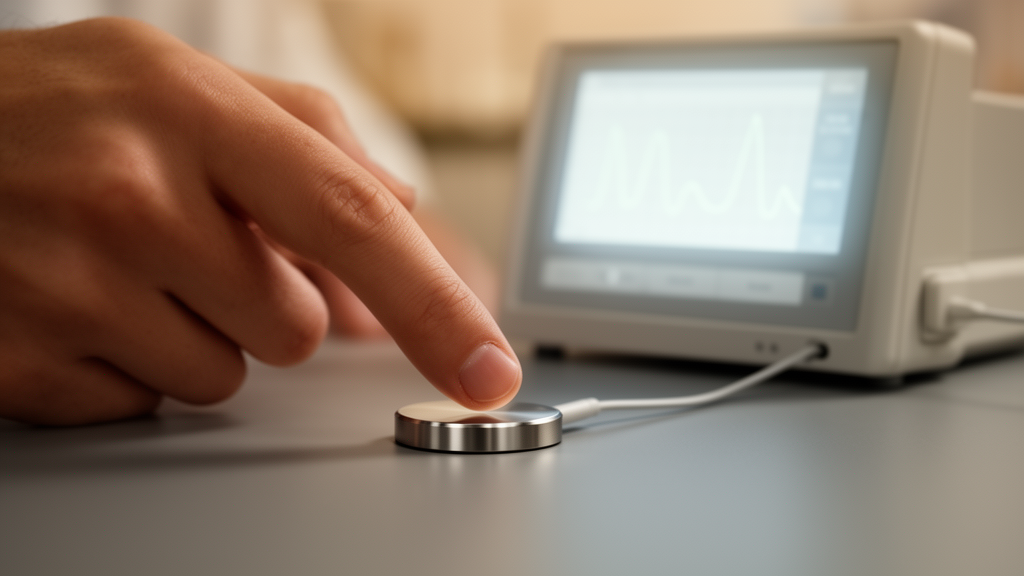
Engineers in Egypt have built a small, low-cost microwave sensor that can distinguish glucose concentrations in liquids and in a limited human fingertip study without drawing blood, and they have paired it with machine learning that lifts classification accuracy from 35 percent to 80 percent. The device, described in Advanced Modeling and Simulation in Engineering Sciences, is a planar resonator printed on an inexpensive FR4 circuit board, and its developers report a sensitivity of 10 MHz per mg/dL in resonant frequency shift and 3 dB per mg/dL in transmission loss across glucose levels from 0 to 350 mg/dL.
The sensor belongs to a family of devices known as complementary split ring resonators, or CSRRs. These are concentric, slotted metal rings etched into the copper ground plane of a printed circuit board. When a microwave signal travels along a microstrip transmission line above them, the rings resonate at characteristic frequencies, and anything that changes the dielectric environment around the rings, such as a glucose solution or a fingertip, shifts those resonances. The team, led by Dalia N. Elsheakh of the Electronics Research Institute, arranged four compact, irregularly curved CSRR cells in a square pattern, a configuration they say creates an extended sensing region that improves the signal-to-noise ratio through stronger tissue interaction while averaging out local tissue inhomogeneities.
The new geometry matters because size drives cost and portability. By corrugating the circular rings and adding a U-shaped inner split, the designers lengthened the current path and pushed the resonant frequency down to 2.1 GHz, with a second band at 3.8 GHz, while shrinking the structure by 40 percent compared with a conventional CSRR design resonating at 3 GHz. The dual-band arrangement lets the sensor probe two frequency ranges where glucose measurably alters the complex permittivity of tissue, and the authors report quality factors between 185 and 225, which they argue is well above the 50 to 150 typical of comparable microwave glucose sensors. A high Q-factor sharpens the resonance peak, making small frequency shifts easier to detect and filtering out out-of-band noise.
Testing proceeded in stages. In simulation, using CST Studio Suite, the team first placed glucose solutions in a polypropylene container over the sensor, sweeping concentrations of 0, 100, 200 and 350 mg/dL and recording shifts in resonant frequency, transmission magnitude and phase. They then built a four-layer finger phantom based on the Cole-Cole model of biological tissue dielectric properties, so the sensor could be evaluated against a structure resembling a real fingertip. The operating frequencies of 2.1 and 3.8 GHz were chosen, the authors say, because they offer sufficient penetration to reach glucose-rich interstitial fluid while keeping the resonator dimensions small enough for a portable device.
Safety was assessed through specific absorption rate calculations, which quantify how much microwave energy is absorbed by tissue. Simulated SAR values at the resonant frequency were 1.6 W/kg averaged over 1 gram of tissue and 2 W/kg over 10 grams, evaluated under the IEEE C95.3 standard. The team also measured SAR with a commercial cSAR3D system using head and body phantoms that meet FCC and IEC requirements. The authors note that their evaluation covered acute exposure under standardized conditions, with the device used for only about five minutes per day in testing, and that long-term or repeated-use effects were outside the scope of the initial study.
Fabrication used standard photolithography in the Microstrip Department of the Electronics Research Institute, and the finished sensor was characterized with a Rohde & Schwarz ZVA 67 vector network analyzer over 1 to 7 GHz. Glucose solutions were prepared by dissolving glucose granules in deionized water at concentrations of 0, 50, 100, 150, 200 and 350 mg/dL, with concentrations verified by a commercial glucometer and dielectric properties measured with a Dielectric Assessment Kit across 1 to 8 GHz. The measurements showed that as concentration increased, the change in dielectric constant grew, and the sensor’s transmission and reflection responses shifted accordingly. The authors explain the physics through the effective relative dielectric constant: glucose lowers the permittivity of the solution relative to water, which reduces attenuation and raises the transmitted signal, while perturbing the resonant frequency in a way that scales with the square root of the relative permittivity change.
The human experiment was a small proof-of-concept with ten volunteers, approved by the ethics committee of the National Institute of Laser Enhanced Science at Cairo University on August 1, 2024. Volunteers fasted for five hours after their last meal, rested for ten minutes, washed their hands, and placed a finger on the sensor with a 1 mm glass buffer layer ensuring consistent, light contact. Measurements were taken with a Nano Vector Network Analyzer operating from 50 kHz to 6.3 GHz. The authors report that one volunteer’s measured glucose level was 68 mg/dL before the fasting period and 500 mg/dL afterward, and that the resonant frequency shifted with these levels; simulated resonant frequencies at 100 and 350 mg/dL were 2.15 and 2.14 GHz, which they describe as in good agreement with the measured values. They emphasize that the trial was designed to demonstrate feasibility rather than statistical generalization, and that accounting for variability across users will be a primary focus of larger future trials.
The machine learning pipeline is where the team claims its most distinctive contribution. Raw S-parameters proved poor classifiers, with differences between concentrations so small that accuracy reached only about 35 percent. The researchers therefore engineered additional features, including magnitude ratios, interaction terms between S11 magnitude and S21 phase, and higher-order polynomial features, and they restricted the analysis to informative frequency regions. The key step, however, was extracting what they call sensor pattern noise, a unique fingerprint arising from manufacturing imperfections in each sensor. Using a two-level discrete wavelet transform with Daubechies db2 filters, they decomposed the S-parameter signals, zeroed the low-frequency approximation components, and reconstructed the high-frequency detail as the pattern noise signature. Feeding these features to ensemble classifiers, including Random Forest, Gradient Boosting, XGBoost, LightGBM and Extra Trees, raised cross-validation accuracy to 80 percent. Extra Trees showed the most consistent performance between laboratory and real-world data, and the most influential feature was the S21 magnitude.
The authors are candid about the limits of the work. The sensor was tested primarily on glucose solutions and synthetic finger models rather than on human blood directly, and genuine blood contains electrolytes, proteins and cells that could produce false positives. Skin moisture, temperature, motion artifacts and contact pressure could all perturb the microwave signals, and finger size affects the contact area and field distribution, potentially requiring per-user calibration. The prototype uses standard, non-optimized components that make it unsuitable for miniaturization into a wearable device, and power consumption for continuous operation has not yet been addressed. The 80 percent classification rate, the team notes, still requires improvement, and phantom-based results may not fully replicate human tissue complexity.
The sensor’s compact footprint, dual-band operation and reported sensitivity of 10 MHz per mg/dL compare favorably with earlier microwave designs in the authors’ comparison tables, and the machine learning approach avoids the enormous datasets that deep learning would demand by relying on deliberate feature engineering instead. The team’s stated future work includes large-scale studies across diverse populations, supplementary sensors for real-time compensation of confounding factors, a custom integrated circuit for power efficiency, and algorithms for true continuous glucose monitoring with alarms.
Subject of Research: A compact microwave CSRR resonator sensor for non-invasive glucose monitoring enhanced by machine learning classification
Article Title: A compact microwave CSRR resonator for non-invasive glucose sensing enhanced by machine learning
Article References: Elsheakh, D. N., Sallam, E., El-Shal, I. H., & Fahmy, O. M. (2026). A compact microwave CSRR resonator for non-invasive glucose sensing enhanced by machine learning. Advanced Modeling and Simulation in Engineering Sciences, 13(1), Article 15. https://doi.org/10.1186/s40323-026-00327-8
Image Credits: AI Generated
DOI: 10.1186/s40323-026-00327-8
Keywords: non-invasive glucose monitoring, microwave sensor, CSRR resonator, machine learning, discrete wavelet transform, S-parameters, diabetes, fingertip sensing, specific absorption rate, sensor pattern noise, FR4 substrate, biomedical engineering
News Source: Teresa Odom. (October 29, 2026). Compact microwave resonator pairs with machine learning to read glucose through the fingertip. Scienmag.



