


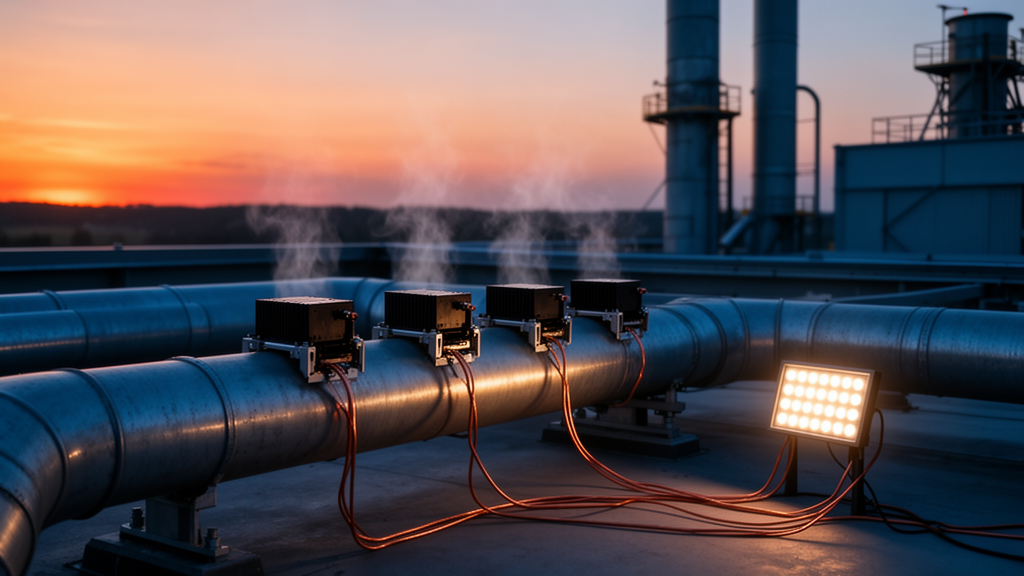
Waste heat is a byproduct of all power generation and industrial processes, and it represents one of the largest sources of inexpensive, clean, fuel-free energy available. A newly published study in Energy, Sustainability and Society describes a prototype system designed to capture that heat and convert it directly into electricity using thermoelectric generation, a technology that requires no moving parts, no working fluids, and offers ease of scalability, low maintenance costs, the ability to operate under noncontinuous conditions, and a long lifespan.
The research team, led by Lukas Gupfinger with colleagues including Nadine Kleinbruckner, Christoph Beisteiner, Christoph Scherner, Peter Zellinger and Oliver Maier, developed a system for radiant waste heat recovery built around a bismuth-telluride-based thermoelectric module. Particular emphasis was placed on designing a resilient energy recovery system that can withstand the harsh conditions typical of energy-intensive industries while optimizing power output.
The design is supported by numerical and analytical computational models. Data obtained from experiments conducted on a high-temperature test stand, together with simulation results, were used to calculate the levelized cost of electricity for the system, providing an economic dimension alongside the technical performance figures.
The measured performance is striking for a laboratory-scale device. According to the study, the electrical power generated by the thermoelectric generator, as determined from measurement data and validated by computational models, was 4.68 W when a single thermoelectric module measuring 40 × 40 mm² was used.
Scaling the concept up is central to its industrial relevance. The researchers calculated that upscaling the system to one square metre, assuming a fill factor of 64%, would result in an output power of 1.87 kW. On that basis, the levelized cost of electricity ranges from 13.7 to 22.1 ct/kWh, a figure the authors describe as reflecting the economic feasibility of the technology and its competitive energy costs.
Thermoelectric generators work by converting a temperature difference directly into electrical energy, and the absence of moving parts or working fluids is among the advantages the study highlights for industrial deployment. The bismuth-telluride-based module used in this prototype is designed for the medium to high temperature range, making it relevant to energy-intensive industries where large volumes of radiant waste heat are produced.
The authors are careful to frame the results as laboratory findings rather than proven industrial performance. While laboratory testing has shown high performance, the study states that further evaluation is needed to assess the durability of the system under industrial conditions. The prototype has been developed for the medium to high temperature range, but its behaviour in real industrial environments remains to be demonstrated.
Ongoing work reflects that gap. The team lists as current tasks the determination of the lifespan of the thermoelectric modules through extended field tests, and the upscaling of the system while ensuring that industrial processes are not disrupted. These steps are intended to bridge the distance between a validated test-stand prototype and a technology that can be installed alongside operating industrial equipment.
The economics also carry caveats. Although the levelized cost of energy calculation suggests competitive energy costs, the authors note that further advancements and cost reductions are necessary for the technology to compete with renewable sources. The study therefore presents the prototype as a promising step for radiant waste heat recovery rather than a finished commercial solution, with durability, lifespan and cost reduction identified as the key open questions ahead.
Subject of Research: Development and laboratory testing of a bismuth-telluride thermoelectric generator prototype for recovering radiant industrial waste heat
Article Title: On the potential of waste heat recovery by means of thermoelectricity
Article References: Gupfinger, L., Kleinbruckner, N., Beisteiner, C., Scherner, C., Zellinger, P., & Maier, O. (2026). On the potential of waste heat recovery by means of thermoelectricity. Energy, Sustainability and Society. https://doi.org/10.1186/s13705-026-00609-4
Image Credits: AI Generated
DOI: 10.1186/s13705-026-00609-4
Keywords: thermoelectric generator, waste heat recovery, bismuth telluride, levelized cost of electricity, industrial waste heat, energy efficiency, prototype, radiant heat, power generation, Energy Sustainability and Society, potential, waste
News Source: Sloane Callahan. (October 29, 2026). Research report: On the potential of waste heat recovery by means of thermoelectricity. Scienmag.



