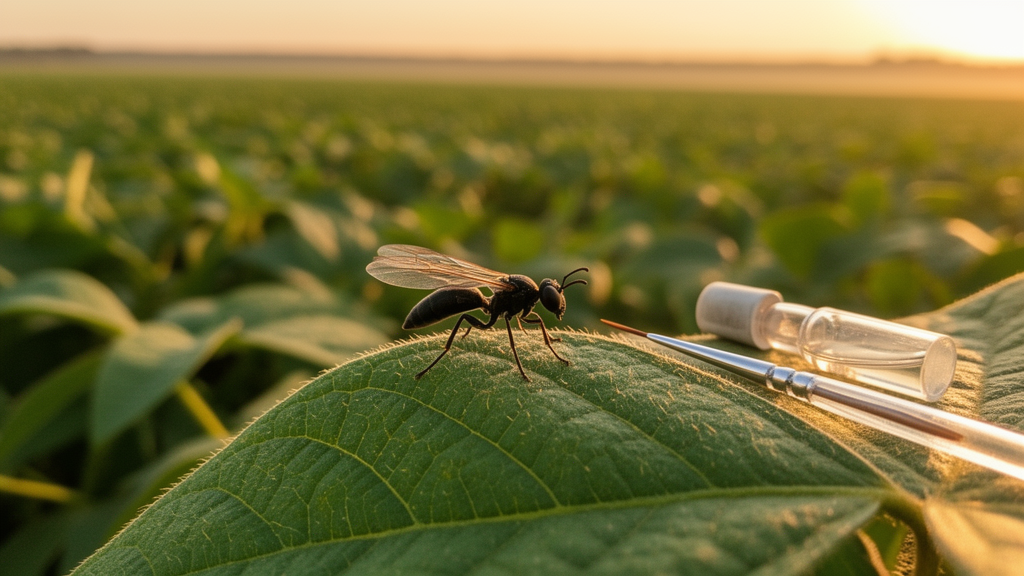
Two previously unknown species of aphid-parasitizing wasps have been discovered in the crop fields of Argentina, according to a new taxonomic study published in the Journal of Hymenoptera Research. With these additions, the total number of aphid parasitoid species recorded from maize, soybean and wheat fields in the country rises to ten, a modest but ecologically significant roster for a group of insects that helps keep some of the world’s most damaging crop pests in check.
The discovery emerged from a large-scale field experiment designed to evaluate how field margin management affects agricultural biodiversity, including parasitoids. Researchers deployed Malaise traps across agricultural fields within the Rolling Pampas, a temperate region receiving between 800 and 1,200 millimeters of rain annually.
The study initially involved twelve fields, each fitted with ten Malaise traps positioned at set distances from the field edge — 10, 50, 100 and 150 meters — plus two additional traps placed directly within field margins, in strips of semi-natural vegetation measuring 10 by 100 meters. One of these margin strips was experimentally manipulated by sowing selected plant species and avoiding herbicide application to promote biodiversity, while the other was left as an untreated control. Extreme drought and crop failures forced the researchers to discard three fields, leaving nine in the final analysis. Average field size was 77.25 hectares, ranging from 40 to 213 hectares.
Trapping ran from July 2022 to April 2024, but only during periods when crops were actually present in the fields. Traps were removed immediately before harvest and reinstalled a few days after sowing, with no sampling during fallow periods. In the first year, traps operated continuously and were emptied twice a month; in the second year, they ran for fifteen days each month. In total, 976 samples were analyzed for Aphidiinae and other agronomically relevant arthropods. The region itself is climatically distinctive, with summer temperatures often exceeding 30 degrees Celsius, winter temperatures dropping below freezing, and most precipitation falling in the summer months.
The haul was substantial: 2,276 aphid parasitoid specimens representing eight known species. The dominant species were Aphidius platensis, with 866 specimens accounting for 38.05 percent of the catch, and A. ervi, with 731 specimens or 32.12 percent. Diaeretiella rapae followed with 621 specimens, or 27.28 percent. Lysiphlebus testaceipes contributed 30 specimens at 1.32 percent, while A. rhopalosiphi, A. uzbekistanicus, A. matricariae and Praon gallicum each appeared only in small numbers, below one percent of the total. All of the collected parasitoid species are associated with pest aphids of the investigated crops, underscoring the role these tiny wasps play in the natural enemy community of Pampas agroecosystems.
Among the familiar species, however, were specimens that did not match anything in the literature: six individuals of an unrecognized Aphidius in the subgenus Lysaphidus, and two females of an unrecognized Trioxys. After detailed morphological examination, the researchers concluded that both were new to science. One complication is that DNA extraction was unsuccessful, probably due to poor preservation of the specimens, so the descriptions rest on comparative morphology.
Aphidius brethes, named in honor of Juan Brèthes, the Argentine naturalist and entomologist who described several aphid parasitoid species, is a mostly yellow to light brown wasp with a body length of 1.5 to 1.7 millimeters in females. Its wing venation pattern places it in the subgenus Lysaphidus, and it shares with other known South American Aphidius species a costulate anterolateral area of the petiole — the sculptured first segment of the wasp’s metasoma. What sets it apart is a combination of features: 16- to 17-segmented antennae, four maxillary and two labial palpomeres, where most other Lysaphidus species have 12- to 14-segmented antennae and usually three maxillary palpomeres. It most closely resembles A. viaticus and A. ramithyrus, but differs in measurable details: the proportion between the length and width of the petiole at the spiracle level is 2.3 to 2.4 times, compared with 3.0 to 3.5 in A. viaticus, and its first flagellomere is proportionally shorter than in A. ramithyrus, at 2.6 to 2.8 times as long as wide versus 3.0 to 3.2. It is also notably more yellow than its darker relatives.
The holotype of A. brethes was collected in November 2022 in a field margin of first-crop soybean in Leandro N. Alem County, with paratypes from Baradero and Exaltación de la Cruz counties taken in soybean and wheat fields between April and August 2023. Specimens are housed in the collections of the Bernardino Rivadavia Natural Sciences Argentine Museum in Buenos Aires, the Basel Natural History Museum in Switzerland, and the Institute of Zoology at the University of Belgrade. So far, the species is known only from Argentina, and its actual aphid host remains unknown, since the wasps were caught in traps rather than reared from aphids. The authors assume it parasitizes cereal or soybean aphids, but that remains a hypothesis to be tested.
The second new species, Trioxys pampas, carries even greater biogeographic weight. It is the first recorded species of the genus Trioxys in South America, and the only known winged Trioxys species from a crop-dominated landscape on the continent. Before this study, the sole Trioxys species known from South America was T. apterus, described by Gärdenfors in 1990 from Napo Province in Ecuador. Trioxys pampas is a small wasp — the female holotype measures just 1.3 millimeters in body length — with 11-segmented antennae, an irregularly carinated propodeum lacking a central areola, and a distinctive ovipositor sheath bearing almost straight, long prongs tipped with an apical clawlike bristle and two short setae. These characters separate it cleanly from its congeners: from the North American T. sunnysidensis, which attacks cereal aphids in North America, Europe and New Zealand and has a regular pentagonal propodeal areola and two simple bristles; and from T. californicus, which has 13-segmented antennae, more curved prongs, and parasitizes the aphid Eucallipterus tiliae on linden trees.
The two female specimens of T. pampas were collected in October and November 2022, one in a maize field margin and one in a wheat field, both in Leandro N. Alem County. The male remains unknown, and the aphid host, again, has not been identified. The researchers suspect the species parasitizes cereal aphids, noting that Trioxys wasps are not common in cereal crops generally: T. auctus has been reported on the bird cherry-oat aphid Rhopalosiphum padi in Europe, and T. sunnysidensis was described from the Pacific Northwest on the same host. A review of North American braconid parasitoids of soybean aphids found no Trioxys species among them, which makes the Argentine find all the more notable.
The broader context sharpens the significance of the discovery. Of the twelve aphid parasitoid species previously known from South American cereal crops, all except Aphidius platensis are introduced and not native to the region. If the authors’ suspicion is correct that A. brethes and T. pampas originate from South America — a reasonable inference, since neither has ever been sampled in crops or non-crop habitats outside the continent — then these would be rare examples of native aphid parasitoids in the region’s field crops. The authors are careful, however, to frame this as a suspicion rather than a demonstrated fact, and they stress that the distribution and biology of both newly described species, along with their host range patterns, should be evaluated by further research. For now, two tiny new residents of the Pampas have been given names, diagnoses and a place in the inventory of the insects that quietly shape the fate of the region’s maize, soybean and wheat.
Subject of Research: Discovery and taxonomic description of two new aphid parasitoid wasp species from crop fields in Argentina
Article Title: Two new aphid parasitoids ( Hymenoptera , Braconidae , Aphidiinae ) from field crops of South America
Article References: Tomanović, Ž., Kocić, K., Belén Forte, S., Nazareno Lentini, J., del Pilar Medialdea, M., Noemí Villar, C., Bustos, A., Gayan-Quijano, A. L., Peris-Felipo, F. J., & Devoto, M. (2025). Two new aphid parasitoids (Hymenoptera, Braconidae, Aphidiinae) from field crops of South America. Journal of Hymenoptera Research, 98, 311-324. https://doi.org/10.3897/jhr.98.144079
Image Credits: AI Generated
Keywords: aphid parasitoids, Aphidiinae, Braconidae, Argentina, Rolling Pampas, new species, Trioxys, Aphidius, biological control, Malaise traps, crop fields, Hymenoptera
News Source: Alan Morgan. (October 28, 2026). Two New Parasitoid Wasp Species Discovered in Argentine Crop Fields. Scienmag.