• HOME
  • NEWS
  • EXPLORE
    • CAREER
      • Companies
      • Jobs
    • EVENTS
    • iGEM
      • News
      • Team
    • PHOTOS
    • VIDEO
    • WIKI
  • BLOG
  • COMMUNITY
    • FACEBOOK
    • INSTAGRAM
    • TWITTER
Monday, October 26, 2026
BIOENGINEER.ORG
No Result
View All Result
  • Login
  • HOME
  • NEWS
  • EXPLORE
    • CAREER
      • Companies
      • Jobs
        • Lecturer
        • PhD Studentship
        • Postdoc
        • Research Assistant
    • EVENTS
    • iGEM
      • News
      • Team
    • PHOTOS
    • VIDEO
    • WIKI
  • BLOG
  • COMMUNITY
    • FACEBOOK
    • INSTAGRAM
    • TWITTER
No Result
View All Result
Bioengineer.org
No Result
View All Result
Home NEWS Science News Health

Free Healthy Food Access May Reduce Food Insecurity, Not Significantly Improve HbA1c

by
October 26, 2026
in Health
Reading Time: 2 mins read
0
Free Healthy Food Access May Reduce Food Insecurity, Not Significantly Improve HbA1c

Free Healthy Food Access May Reduce Food Insecurity, Not Significantly Improve HbA1c

Share on FacebookShare on TwitterShare on LinkedinShare on RedditShare on Telegram

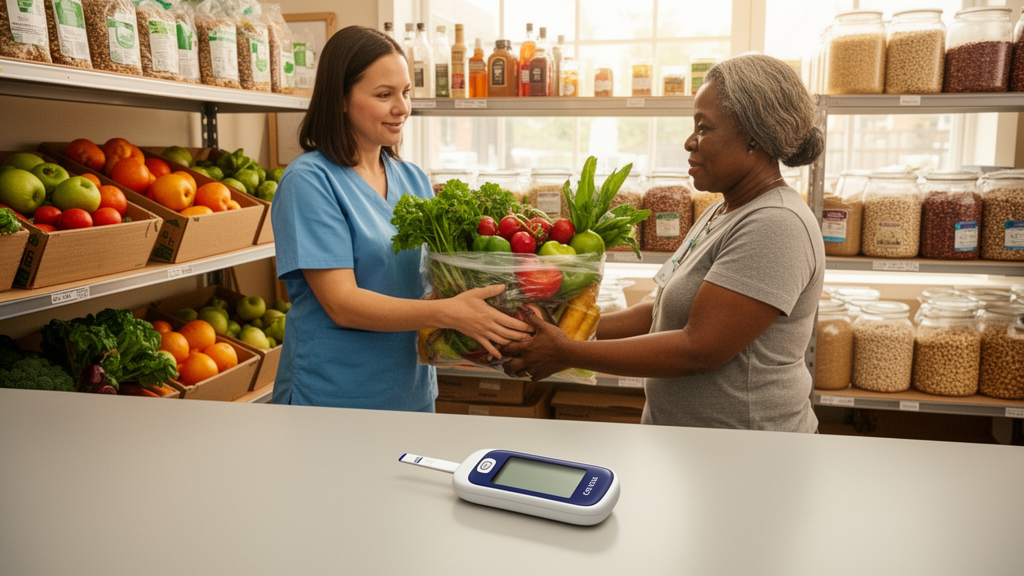
Free access to healthy food may reduce food insecurity among people with prediabetes or type 2 diabetes, but a living systematic review found only a small reduction in HbA1c that was not statistically significant. The review included seven trials, all judged to have a high risk of bias, limiting confidence in the findings. The review focused on interventions that provided healthy food options at no cost to people with type 2 diabetes or prediabetes who had low incomes or were experiencing food insecurity.

Researchers searched seven electronic databases on July 30, 2025, for controlled trials and quasi-experimental studies published from 1980 through the search date. Two independent reviewers screened titles, abstracts and full texts in Covidence. Two authors then independently extracted data and assessed bias and certainty.

Clinical trials were assessed with the ROB 2 tool, and results were pooled using random-effects meta-analyses. The review examined HbA1c, fruit and vegetable consumption, food security, financial security, health-care utilization, overall health and quality of life. For HbA1c, the pooled mean difference was −0.10, with a 95% confidence interval of −0.36 to 0.17.

The estimate was not statistically significant (p = 0.48), and the certainty of evidence was rated low. The result is consistent with a possible small reduction in HbA1c, but the review does not establish that free healthy-food access produces a meaningful improvement in this outcome. Food insecurity was the outcome with a statistically significant pooled association.

Interventions were associated with a risk ratio of 0.87, with a 95% confidence interval of 0.80 to 0.95 (p = 0.0013). The authors rated the certainty of this evidence as low, so the result supports a possible reduction in food insecurity rather than a definitive conclusion. The review also reported that interventions providing free access to healthy foods may improve diet quality, increase fruit and vegetable consumption, reduce blood pressure and improve overall health.

These findings were based on a small number of trials, and the authors emphasized that the data were limited. The review therefore does not provide firm evidence for these broader outcomes. All seven included studies had a high risk of bias, according to the review’s assessment.

Taken together, the findings suggest that free healthy-food access may help people facing food insecurity, while any effect on HbA1c appears small and uncertain. The review’s overall conclusion is that the interventions reduced food insecurity and may improve glycemic control, but the reduction in HbA1c was neither statistically significant nor large.

Subject of Research: Effects of free healthy-food access on diabetes outcomes in people with prediabetes or type 2 diabetes

Article Title: Effect of free healthy food access on diabetes control: a living systematic review

Article References: Muhiuddin, M., Ul Haq, M. Z., Workentin, A., Sinha, L., Ziegler, C., & Persaud, N. (2026). Effect of free healthy food access on diabetes control: a living systematic review. BMC Public Health. https://doi.org/10.1186/s12889-026-29337-2

Image Credits: AI Generated

DOI: 10.1186/s12889-026-29337-2

Keywords: type 2 diabetes, prediabetes, food insecurity, healthy food access, HbA1c, systematic review, meta-analysis, public health, glycemic control, Effect, free, healthy

News Source: Ophelia Keating. (October 26, 2026). Free Healthy Food Access May Reduce Food Insecurity, Not Significantly Improve HbA1c. Scienmag.


Tags: effectfood insecurityfreeglycemic controlHbA1cHealthyhealthy food accessMeta-analysisprediabetesPublic Healthsystematic reviewType 2 diabetes
Share12Tweet7Share2ShareShareShare1

Related Posts

Observational cohort links baloxavir to faster influenza A fever resolution in children

Observational cohort links baloxavir to faster influenza A fever resolution in children

October 26, 2026
Outpatient antibiotic use rose sixfold at one Ghanaian regional hospital

Outpatient antibiotic use rose sixfold at one Ghanaian regional hospital

October 26, 2026

CDC selects UCSF-led center to improve dementia care nationwide

October 26, 2026

Behavioural risk profiles associated with non-communicable diseases in Tlokweng, South-East District, Botswana

October 26, 2026

POPULAR NEWS

  • Review finds stronger causal evidence for senescence than mutations in aging

    Review finds stronger causal evidence for senescence than mutations in aging

    29 shares
    Share 12 Tweet 7
  • Observational cohort links baloxavir to faster influenza A fever resolution in children

    29 shares
    Share 12 Tweet 7
  • Robotics and AI Reveal Hidden Pathway in 135-Year-Old Biginelli Reaction

    29 shares
    Share 12 Tweet 7
  • Mycology opens submissions for fungal biomanufacturing collection

    29 shares
    Share 12 Tweet 7

About

We bring you the latest biotechnology news from best research centers and universities around the world. Check our website.

Follow us

Recent News

Review finds stronger causal evidence for senescence than mutations in aging

Monk parakeet aggression shows no major sex-based difference

Observational cohort links baloxavir to faster influenza A fever resolution in children

Subscribe to Blog via Email

Enter your email address to subscribe to this blog and receive notifications of new posts by email.

Join 85 other subscribers
  • Contact Us

Bioengineer.org © Copyright 2023 All Rights Reserved.

Welcome Back!

Login to your account below

Forgotten Password?

Retrieve your password

Please enter your username or email address to reset your password.

Log In
No Result
View All Result
  • Homepages
    • Home Page 1
    • Home Page 2
  • News
  • National
  • Business
  • Health
  • Lifestyle
  • Science

Bioengineer.org © Copyright 2023 All Rights Reserved.