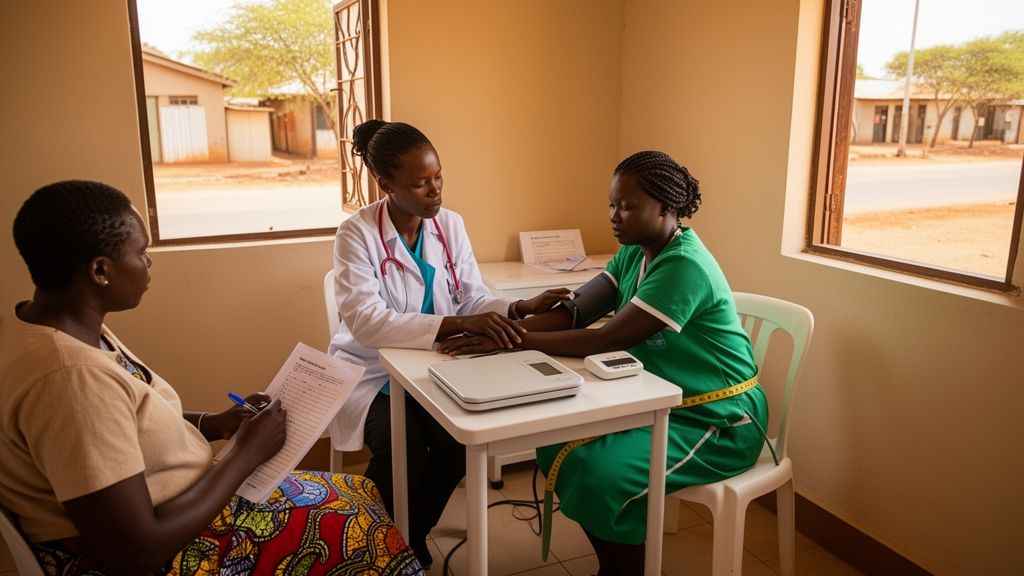
A facility-based cross-sectional study of 349 adults seeking care at a primary healthcare facility in Tlokweng, South-East District, Botswana, found a high burden of behavioural risk factors associated with non-communicable diseases and variation across demographic and socioeconomic groups. The research, conducted from 16 September to 4 December 2025, assessed smoking, alcohol consumption and discretionary salt use among primary healthcare users. It was designed to characterize locally observed risk profiles rather than determine changes over time or establish causal relationships.
Because the participants were recruited from a healthcare setting, the findings may not represent all residents of Tlokweng or the wider rural Botswana population. Researchers used systematic random sampling to enroll the 349 participants, who were 18 years of age or older. A culturally adapted questionnaire collected information on smoking, alcohol consumption and the addition of salt to served food.
The analysis combined descriptive statistics with multivariable logistic regression, allowing the researchers to estimate adjusted associations between each behaviour and characteristics including age, sex, education, employment, household income and marital status. The study therefore examined distinct outcomes separately and reported associations in terms of adjusted odds rather than causal effects. Age and sex were associated with smoking and alcohol consumption.
In the adjusted analysis, adults aged 45–54 years had lower odds of smoking than those aged 18–24 years (adjusted odds ratio, or AOR, 0.16; 95% confidence interval, 0.03–0.75; P < 0.021), as did participants aged 55 years or older (AOR, 0.15; 95% CI, 0.02–0.99; P < 0.048). Females had lower adjusted odds than males of alcohol consumption (AOR, 0.23; 95% CI, 0.14–0.38; P < 0.001) and smoking (AOR, 0.15; 95% CI, 0.05–0.12; P < 0.001). These estimates describe differences within the clinic-based sample after adjustment for variables included in the models; they do not show that age or sex caused the reported behaviours.
Educational attainment was associated with smoking and alcohol consumption in different ways. Compared with participants holding a university diploma or bachelor’s degree, those with junior secondary education had higher adjusted odds of smoking (AOR, 2.87; 95% CI, 1.07–7.70; P < 0.04), as did participants with trade, technical or vocational education (AOR, 3.13; 95% CI, 1.19–8.27; P < 0.02). Participants with senior secondary education, by contrast, had higher adjusted odds of alcohol consumption than university diploma or bachelor’s degree holders (AOR, 1.87; 95% CI, 1.05–3.33; P < 0.03).
The confidence intervals for these estimates were comparatively wide, indicating greater uncertainty around the education-related associations than around some of the other reported results. Employment, income and marital status were associated with alcohol consumption and discretionary salt use. Unemployed participants had higher adjusted odds of alcohol consumption than employed participants (AOR, 4.45; 95% CI, 1.39–14.26; P < 0.012) and of adding salt to served food (AOR, 4.16; 95% CI, 1.31–13.19; P < 0.015).
Participants reporting household income of at least P20,000 had lower adjusted odds of discretionary salt use than those earning less than P4,000 (AOR, 0.21; 95% CI, 0.05–0.89; P < 0.033). Married participants also had lower adjusted odds of adding salt to served food than single participants (AOR, 0.33; 95% CI, 0.12–0.86; P < 0.020). Taken together, the results show that the three measured behaviours had different association patterns rather than following one uniform demographic or socioeconomic pattern.
The authors described the findings as evidence of a high burden and clustering of non-communicable-disease risk factors among primary healthcare users, underscoring the potential value of integrated, gender-responsive primary care, stronger surveillance and cross-sector action.
Subject of Research: Associations between demographic, socioeconomic factors and three behavioural non-communicable-disease risks among primary healthcare users in Tlokweng, Botswana
Article Title: Behavioural risk profiles associated with non-communicable diseases in Tlokweng, South-East District, Botswana
Article References: Sejie, G. A., Tsholofelo, E., & Freeman, T. (2026). Behavioural risk profiles associated with non-communicable diseases in Tlokweng, South-East District, Botswana. BMC Public Health. https://doi.org/10.1186/s12889-026-29753-4
Image Credits: AI Generated
DOI: 10.1186/s12889-026-29753-4
Keywords: Botswana, non-communicable diseases, behavioural risk factors, smoking, alcohol consumption, discretionary salt use, primary healthcare, cross-sectional study, health inequalities, Tlokweng, Behavioural, risk
News Source: Ophelia Keating. (October 26, 2026). Behavioural risk profiles associated with non-communicable diseases in Tlokweng, South-East District, Botswana. Scienmag.