Nearly one million people in the United States are living with Parkinson’s disease, making it the second-most common neurodegenerative disease after Alzheimer’s. Current medical treatments for Parkinson’s are focused on helping people manage symptoms. But the underlying mechanisms of the neurological disorder remain poorly understood.
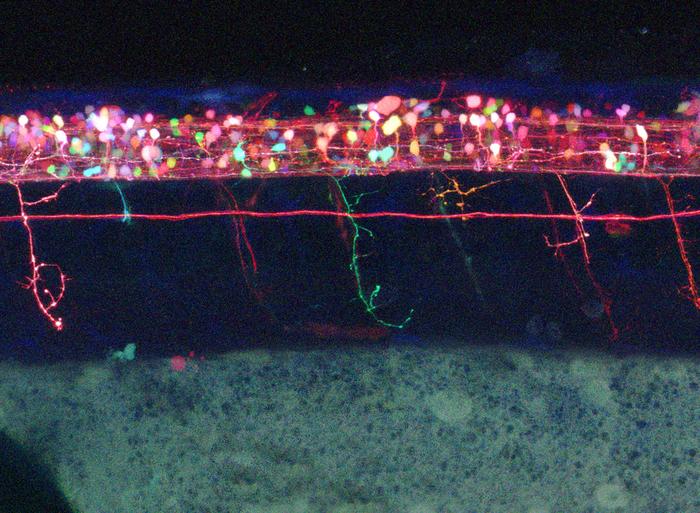
Credit: Zachary Tobias, in Weissman Lab at Lewis & Clark College
Nearly one million people in the United States are living with Parkinson’s disease, making it the second-most common neurodegenerative disease after Alzheimer’s. Current medical treatments for Parkinson’s are focused on helping people manage symptoms. But the underlying mechanisms of the neurological disorder remain poorly understood.
Tamily Weissman, associate professor of biology and department chair, is working to change that. Parkinson’s symptoms occur because of a drop in dopamine levels when certain brain cells die. Scientists know that abnormal clumping of certain proteins inside key neurons is involved; however, the exact mechanisms are unclear.
“Something is causing these proteins to bind together and form aggregates,” says Weissman. “And we don’t yet understand what that mechanism does to cells or why the cells are dying.”
Similar protein aggregation is associated with other neurological disorders, including Alzheimer’s, amyotrophic lateral sclerosis (ALS), and Huntington’s disease. A better understanding of these protein clumps, known as Lewy Bodies, could lead to breakthrough discoveries and open up new paths to treatment.
Using Zebrafish Models
Weissman’s work is focused on alpha-synuclein, the abnormally clumping protein found in the brains of Parkinson’s patients. The National Institutes of Health (NIH) is funding her innovative approach, which examines how this protein behaves in zebrafish models. She and her team are looking at the factors surrounding the phosphorylation at a protein site known as serine 129. The site “gets tagged” with a phosphate group, explains Weissman, who is also known for her work on a multicolor cell-labeling technique called Brainbow.
“If you look at all of the aggregated alpha-synuclein, you’ll wonder, ‘Why has it all been tagged at that site? And in the same way? Nobody knows. It’s a total mystery,” she says.
Weissman and her colleagues recently provided one key clue by confirming that phosphorylation at serine 129 cannot be the sole driver of the protein clumping.
“Our question is, ‘What else, in addition to the tag, needs to be in place for the clumping to occur?’” says Weissman.
Faculty-Student Summer Research
Weissman conducts her research with undergraduate students who work in the Weissman Lab. Together, they conduct experiments that include injecting zebrafish embryos with alpha-synuclein DNA and manipulating the protein at different sites. They mark it with fluorescence and, because the embryo is transparent, can then observe its behavior using a confocal microscope. This specialized microscope allows them to image the process in a high-resolution way, as well as to make observations over time.
This summer, four students worked in the Weissman Lab as part of the 10-week John S. Rogers Science Research program, which helps prepare undergraduates for science careers through faculty-student research. The students―including Biology majors Brandon Apresa ’24 and Claire Zawadzki ’25, along with Biochemistry and Biology major Brendan Creeks ’24 and Psychology major Lily Schainker ’25―have spent the summer gaining hands-on lab experience through specialized training, as well as by conducting experiments and collecting data. Most of them will continue working in the lab into the fall semester as part of independent study courses. They also work closely with Weissman’s full-time lab technician, Nicole Brockway.
Brandon Apresa BA ’24 will pursue the work this year as part of his senior thesis.
“I’ve been declared as a biology major for a while,” said Apresa, who is also minoring neuroscience. “But I’ve never felt like a scientist until now. I feel like I’m doing work that really matters. And it’s really freaking cool to be able to do all these things that we’re doing and have this opportunity to work with awesome people.”
In addition, the team is building collaborations with colleagues at Reed College and at Oregon Health & Science University, where researchers are also exploring the mechanisms behind alpha-synuclein. Dr. Vivek Unni’s lab is a direct collaborator on this research.
Weissman is excited about the work ahead and grateful for the support of the NIH and for the Office of Sponsored Projects and Research Compliance (SPARC) at Lewis & Clark.
Says Weissman, “The SPARC office is one of the reasons why Lewis & Clark has done such a good job with securing and managing important research grants like this one.”