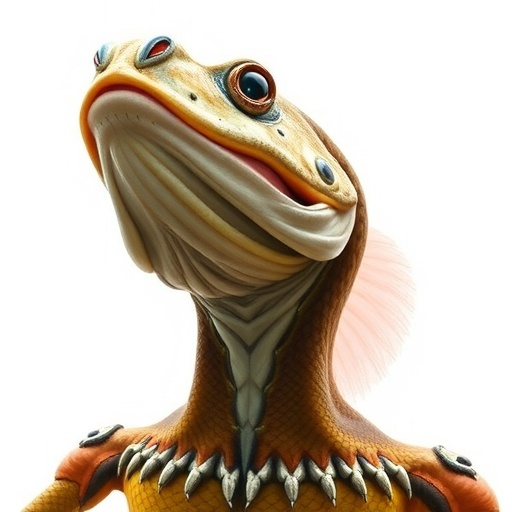
New research challenges the traditional definition of the “neck” in vertebrates, expanding its scope beyond mammals to include fishes and amphibians. Historically, the neck has been defined morphologically as the region of the vertebral column between the skull and shoulders, enabling three-dimensional independent movement of the head. However, this definition has left out many vertebrates with distinct anatomy, such as fish and salamanders, prompting scientists to reconsider what truly constitutes a neck.
A team led by Dr. Roxana Taszus at the University of Liverpool is spearheading this evolutionary inquiry. By integrating functional analysis with anatomical studies, the researchers aim to redefine the neck in a way that accounts for both vertebral morphology and the ability of the head to move independently from the body across various vertebrate groups. Their approach combines advanced imaging techniques with biomechanical modeling to unravel these complexities.
Using X-ray video recordings of feeding behaviors and 3D computer reconstructions, the team has been able to pinpoint specific regions of the vertebral column responsible for head and neck motion in different species. In fish, for example, they differentiate between the “morphological neck”—vertebrae that differ structurally near the head—and the “functional neck,” the vertebrae actively enabling independent head movement. These findings illuminate how diverse vertebrate anatomy can produce similar functional outcomes.
Salamanders, integral to understanding the transition from aquatic to terrestrial life, are the next focus. While it is acknowledged that salamanders possess a neck, the exact vertebrae involved and their biomechanical use during feeding remain unclear. The team recently gathered extensive underwater and terrestrial feeding footage to map out these motion patterns, hoping to shed light on early tetrapod evolution.
This research also addresses inconsistencies in the scientific literature regarding neck definitions. Historically, a lack of universal criteria has impeded comparative evolutionary studies. By developing an inclusive, functional definition of the neck, the team intends to unify vertebrate anatomy research and resolve ambiguities that have persisted for decades.
Notably, the study highlights the astonishing variability among fish species, where anatomical neck structures range from complete absence to fusion of cranial vertebrae or highly specialized formations. This contrasts strongly with mammals, which consistently possess seven cervical vertebrae. The diversity seen in fishes challenges the longstanding assumption that a neck in the traditional sense is absent outside tetrapods.
These advances provide a fresh lens through which to view vertebrate evolution, especially concerning the first vertebrates that ventured onto land. By understanding how the earliest tetrapods coordinated head and spine movement, informed by modern salamander studies, scientists gain vital clues about adaptive strategies that made terrestrial life possible.
Funded by the Leverhulme Trust and presented at the Society for Experimental Biology conference, this interdisciplinary project exemplifies how cutting-edge imaging and biomechanical analysis can redefine fundamental anatomical concepts and inspire new questions about vertebrate form and function.
Subject of Research: Vertebral column morphology and function across vertebrates, with focus on fishes and amphibians
Article Title: Rethinking the Vertebrate Neck: New Insights from Fish and Salamander Vertebral Function
News Publication Date: Not specified
Web References: Not specified
Image Credits: Ariel Camp
Keywords: vertebrate neck, vertebral column, fish anatomy, salamander morphology, functional morphology, evolutionary biology, X-ray videography, biomechanics
Tags: 3D reconstructions of vertebral columnsadvanced imaging in vertebrate studiesamphibian vertebral structurebiomechanical modeling of head movementevolutionary biology of neck structuresexpanding vertebrate anatomical classificationsfish and amphibian anatomyfish feeding biomechanicsmorphological and functional analysis of neckredefinition of neck in vertebratessignificance of independent head movementvertebrate neck evolution