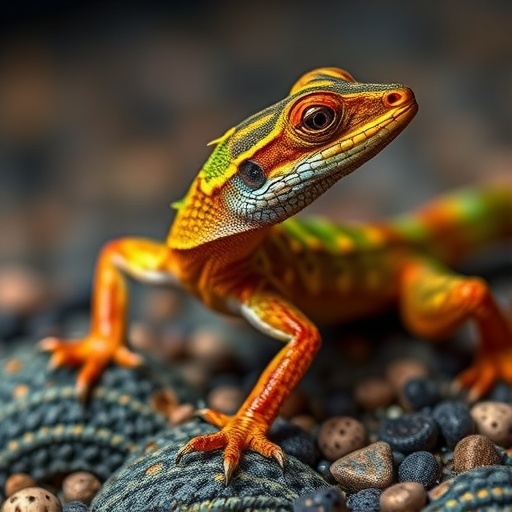
To the human eye, a white lizard is simply a white lizard. But to another lizard, the world is a very different place. A new study has revealed that the common wall lizard (Podarcis muralis), long celebrated as a textbook example of colour polymorphism, harbours a hidden form of diversity that has escaped detection for decades: two distinct types of “white” that differ dramatically in the ultraviolet part of the spectrum. One type reflects near-ultraviolet light, the other absorbs it, and according to visual modelling, the lizards themselves perceive these as two entirely different colours. The discovery means that what scientists have counted as five colour morphs in this species may actually be seven, and it serves as a striking warning about the limits of judging animal colouration through human eyes alone.
The common wall lizard is one of the most intensively studied colour polymorphic animals in Europe. Across much of mainland Europe, and in introduced populations in southern Britain and North America, adults display one of several discrete ventral colour patterns: pure white, pure yellow, or pure orange, along with two mosaic forms combining white-orange or yellow-orange patches. These colours appear in both sexes, are fixed before or around sexual maturity, and are genetically determined. Previous work has shown that two independently segregating autosomal genes tied to the metabolism of pterins and carotenoids explain the presence of yellow and orange pigments, with epistatic interactions between them modulating variation within morphs. Decades of research have examined how these morphs are maintained, whether they correlate with alternative reproductive tactics, and how their frequencies vary across populations and environments.
Yet the entire framework of this research programme has rested on an assumption so basic that it went unchallenged: that lizards classified as “white” are all, in some meaningful sense, the same colour. The new study, conducted by Guillem Pérez i de Lanuza and Enrique Font of the Ethology Lab at the Cavanilles Institute of Biodiversity and Evolutionary Biology, University of Valencia, and published in The Science of Nature, demonstrates that this assumption is wrong. The key lies in the ultraviolet range, wavelengths between roughly 320 and 400 nanometres that are invisible to humans but perceivable by many animals, including lacertid lizards, which possess cone photoreceptors with peak sensitivities in the near UV.
The biological logic is elegant. A surface that reflects all wavelengths equally across the human visible spectrum (400 to 700 nanometres) is perceived by us as white. But for a lizard with UV-sensitive cones, a surface that reflects from 400 to 700 nanometres while absorbing everything below 400 nanometres is not white at all. True “lizard white” must reflect across the entire sensitivity range of the lizard visual system, from roughly 320 to 700 nanometres. The researchers had actually noticed hints of this in earlier work: spectra from some white females in Pyrenean populations showed two different reflectance profiles, one reflecting in the near UV and another absorbing there. Juveniles, too, are UV-reflecting across their entire ventral surface, losing this coloration during development. But the implications for the adult polymorphism had never been systematically explored.
To close that gap, the team sampled 1,068 adult wall lizards across 17 Pyrenean populations during the breeding seasons of 2018 to 2020, focusing their spectral analyses on the 614 individuals belonging to the white or white-orange morphs. Reflectance spectra from throats and bellies were collected using a USB-2000 portable spectrometer with a PX-2 xenon light source, calibrated against a Spectralon white diffuse reflectance standard. Individuals showing a pre-moulting appearance were excluded to avoid spectral distortion, and measurements on white-orange mosaics were only taken when white patches exceeded roughly two millimetres in diameter, preventing contamination of spectra by neighbouring colours.
The classification of spectra rested on a parameter called Rmid: the wavelength at which reflectance reaches the halfway point between its minimum and maximum values within the 300 to 450 nanometre range. Spectra with Rmid values at or below 345 nanometres were classified as UV-reflecting white (UV+white), while those at or above 365 nanometres were classified as UV-absorbing white (UV−white). The distinction proved remarkably clean. Some 96.4 percent of the 1,321 spectra analysed fell unambiguously into one category or the other, and the distribution of Rmid values was clearly bimodal, with no continuous gradient bridging the two types. This is exactly the kind of discrete, categorical variation that characterises a true polymorphism rather than continuous colour variation.
The differences between the two whites are substantial in spectral terms. Beyond the Rmid split, the two whites differ significantly in luminance and especially in ultraviolet chroma, a measure of the proportion of total reflectance concentrated in the UV band. Statistical analyses using linear mixed models, with morph and sex as fixed factors, snout-vent length as a continuous predictor, and population as a random factor, confirmed these differences across white throats, white bellies, and the white patches of white-orange mosaics. Sex and body size played only a secondary role in this variation. Notably, no orange, yellow, or yellow-orange animals showed UV reflectance, with the single exception of one yellow individual displaying a minor secondary reflectance peak in the near UV, about one percent of yellow animals sampled. The cryptic variation is confined to the white component of the polymorphism.
Critically, the researchers then asked whether the lizards themselves could tell the two whites apart. Using Vorobyev and Osorio’s receptor noise model, built on the cone sensitivities of P. muralis and assuming a cone abundance ratio of 1:1:1:4 for the ultraviolet-, short-, middle-, and long-wavelength-sensitive cones, they calculated chromatic distances in just noticeable differences (JNDs). Values above 3 JNDs are considered easily discriminable. The mean pairwise chromatic distance between the two whites was 5.07 JNDs, with bootstrapped 95 percent confidence intervals of 4.84 to 5.27, and a distance-based PERMANOVA confirmed the separation was highly significant (F1,1361 = 1368.7, P < 0.0001). For comparison, the spectral difference between the two whites, roughly 100 nanometres in slope, is similar in magnitude to the difference between the white and yellow morphs, or between yellow and orange, categories the lizards have already been shown experimentally to discriminate. In other words, to a wall lizard, the two whites are probably as different from each other as white is from yellow.
The geographic dimension of the discovery adds another layer of intrigue. The frequencies of the two white types vary enormously across populations. In some localities, such as Tor de Querol, UV+white lizards are almost entirely absent, making up less than 10 percent of white animals. In others, such as Lusenac, the UV+white morph dominates, reaching up to 88 percent of white individuals. The researchers acknowledge that this geographic mosaicism may explain why the cryptic polymorphism went undetected for so long: in their primary study area on the central Cerdanya plateau, UV+white individuals were so rare that they were initially dismissed as developmental anomalies, akin to melanic or axanthic individuals. Only systematic sampling across many populations revealed that the phenomenon is widespread and structured.
The broader survey extended beyond the focal species. Using archived spectra from their cumulative database, the team examined ventrally white adults from numerous other lacertid species, including Podarcis lusitanicus, P. carbonelli, P. liolepis, P. lilfordi, P. vaucheri, P. peloponnesiacus, P. ionicus, P. thais, and P. milensis, as well as representatives of other genera such as Psammodromus edwarsianus, Acanthodactylus erythrurus, A. lineomaculatus, Atlantolacerta andreanskyi, Timon nevadensis, and Scelarcis perspicillata. The sample was opportunistic but covered all the major groups within the family Lacertidae. The results were telling: both types of white occur across the family, sometimes within the same species and even the same population. Most species showed UV+white, or both types. Two species, P. lilfordi and P. vaucheri, displayed only the UV-absorbing form. Crucially, some species previously considered monomorphic, such as P. milensis, in fact harbour both whites, meaning they should be regarded as cryptically colour polymorphic. The phenomenon is thus not a derived peculiarity of P. muralis but a family-wide pattern with deep roots, though whether it represents an ancestral state or repeated convergent evolution remains unresolved.
The authors frame their findings as a case study in what has been called “anthropomorphism by omission”: the pervasive tendency to describe other species’ perceptual worlds using our own sensory categories. By ignoring the ultraviolet dimension of lizard vision, decades of research, including the authors’ own earlier studies, oversimplified the complexity of the polymorphism. The correction has practical consequences: animals assigned to the “white” category may belong to two different morphs, and white-orange mosaics likewise split into UV+white-orange and UV−white-orange variants. With no cryptic variation among yellow, orange, or yellow-orange animals, the species’ ventral polymorphism should now be described as comprising seven morphs rather than five. Previous studies of morph function, mating patterns, and morph frequency dynamics may need revisiting, since pooling two perceptually distinct morphs into one “white” category could have masked meaningful patterns.
Open questions remain. Whether the two whites are genetically determined, as the yellow and orange morphs are, is unknown, and this matters because a polymorphism, strictly defined, involves genetically determined phenotypes coexisting in a breeding population; if environmental factors trigger the difference, the phenomenon would instead be a polyphenism. The cellular and subcellular mechanisms producing the two reflectance profiles also remain unidentified, and longitudinal data tracking individuals over time will be needed to determine at what age the white morphs are fixed, and whether plasticity plays any role. Meanwhile, hints from other clades suggest the pattern extends beyond lacertids: spectrally distinct whites have also been reported in Sceloporus lizards, though as interspecific rather than intrapopulation variation.
The message for the field is unambiguous. Even in a common, well-studied European lizard, objective colour measurement and visual modelling can overturn decades of received wisdom. As the authors put it, there is more than meets the (human) eye, and understanding colour polymorphism requires seeing the world through the senses of the animals that actually wear and read the colours.
Subject of Research: Cryptic ultraviolet-based colour polymorphism in the common wall lizard, Podarcis muralis, and other lacertid lizards
Subject of Research: Biology
Article Title: More than meets the (human) eye: Cryptic chromatic diversity in a colour polymorphic lizard
Article References: Pérez i de Lanuza, G., & Font, E. (2026). More than meets the (human) eye: Cryptic chromatic diversity in a colour polymorphic lizard. The Science of Nature, 113(3), Article 58. https://doi.org/10.1007/s00114-026-02106-2
Image Credits: AI Generated
DOI: 10.1007/s00114-026-02106-2
Keywords: colour polymorphism, cryptic polymorphism, Podarcis muralis, ultraviolet reflectance, lacertid lizards, visual modelling, reflectance spectrophotometry, ventral coloration, cryptic morphs, lizard vision, UV white, morph diversity
Cite Scienmag News
APA MLA Chicago
Drew Townsend. (September 10, 2026). Hidden colour diversity revealed in a polymorphic lizard species. Scienmag. https://scienmag.com/hidden-colour-diversity-revealed-in-a-polymorphic-lizard-species/
Drew Townsend. “Hidden colour diversity revealed in a polymorphic lizard species.” Scienmag, 10 September 2026, https://scienmag.com/hidden-colour-diversity-revealed-in-a-polymorphic-lizard-species/. Accessed 10 September 2026.
Drew Townsend. “Hidden colour diversity revealed in a polymorphic lizard species.” Scienmag. September 10, 2026. https://scienmag.com/hidden-colour-diversity-revealed-in-a-polymorphic-lizard-species/
Copy citation Download RIS
Tags: animal colour detection limitsanimal colour spectrum analysisbiological significance of hidden colour variationcolour detection limits in animal studiesEuropean wall lizard colour diversityEuropean wall lizard colour morphsevolutionary significance of colour polymorphismhidden colour diversity in reptileshidden colour diversity in wall lizardsimpact of ultraviolet light on animal perceptionLizard colour polymorphismpolymorphic lizard speciespolymorphic species in Europereptile colouration and sexual dimorphismspecies-specific colour morphsultraviolet light in animal colorationultraviolet perception in reptilesultraviolet reflectance in reptilesultraviolet spectrum in reptilesUV-based colour variation in animalsvisual modeling of animal coloursvisual modelling of animal coloursvisual perception in lizards