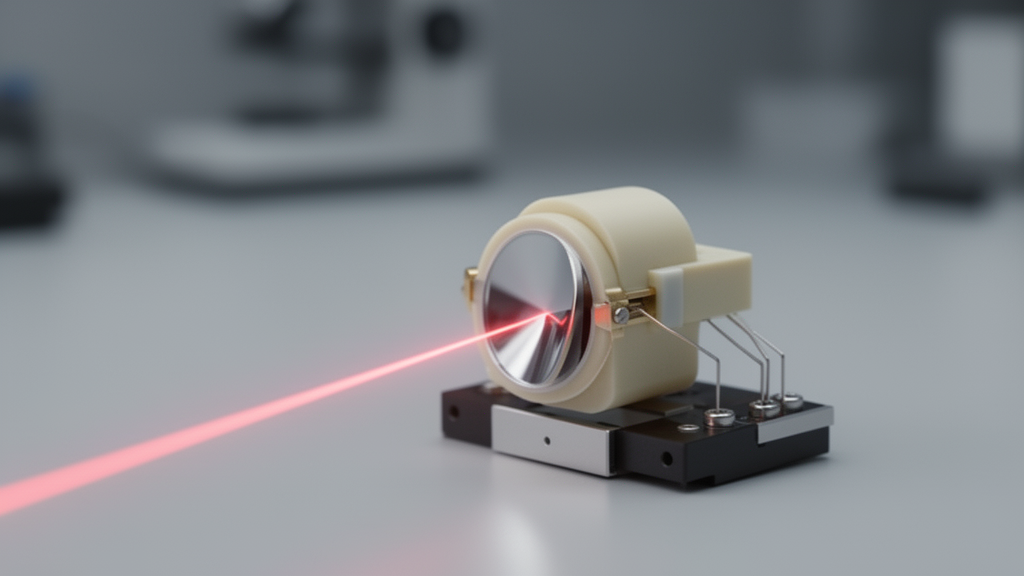
A millimeter-scale piezoelectric micromirror can steer a laser beam along two axes while independently changing the beam’s focal depth, giving a single experimental device control over light in three dimensions. Penn State researchers measured the reflective surface changing its focus within microseconds and shifted a scanned laser pattern by 63 millimeters, restoring sharp focus at the new depth. The device could help make future optical systems smaller and faster for applications including biological imaging, augmented-reality displays and precision manufacturing, but those larger applications were not yet demonstrated.
The mirror is a micro-electromechanical system, or MEMS, device: a microscopic machine fabricated on a chip using methods also used to manufacture computer chips. Its reflective element is about a millimeter across, roughly the thickness of a penny. Structures surrounding the mirror tilt it in two directions, allowing it to sweep a reflected beam across an area.
The mirror can also alter the curvature of its reflective surface. Making that surface flatter or more bowl-shaped changes the point at which the reflected light converges and therefore shifts its focal depth. The study was an experimental engineering investigation published in Microsystems & Nanoengineering .
Optical systems commonly assign steering and focusing to separate components. One element can direct a beam across a sample or screen, while another changes where the beam comes into focus. The researchers’ micromirror integrates two-axis steering and adjustable focusing into one compact element.
Their result establishes the mirror’s optical behavior in laboratory tests; it does not demonstrate a complete microscope, headset or manufacturing instrument. Aluminum nitride provides the mechanical action that tilts and reshapes the mirror. It is a piezoelectric material, meaning it develops an electrical charge when mechanical force is applied and deforms when voltage is applied.
Thin aluminum-nitride layers flex in response to electrical signals. One piezoelectric layer acts through surrounding structures that tilt the mirror along two axes, while another changes the shape of the mirror itself. Because the moving element is only about a millimeter in size, it can respond rapidly.
The researchers measured changes in focus within millionths of a second, establishing the speed of the experimental mechanism rather than a measured advantage over complete commercial instruments. The team tested the device by varying the voltage applied to the mirror and shifting the focus of a laser-scanned pattern by 63 millimeters. The pattern quickly returned to sharp focus at the new depth.
The researchers then built a simple laser-scanning microscope around the micromirror. In that demonstration, changing the mirror’s shape altered which depth of a test image appeared in focus. Together, these experiments showed that one small optical element could control both the lateral position of a scanned beam and its focal depth, while preserving control over the shape of the scanned pattern.
One proposed application is a smaller, mountable microscope for neuroscience. Neurons are tightly packed nerve cells that send and receive signals in the brain and can become active within thousandths of a second. Tools for examining this activity therefore require rapid optical movement and precise targeting of small regions.
A device that can direct and refocus a beam quickly could support future microscopes designed to study brain activity in moving subjects or focus on very small areas of the brain. The experiment itself used a test image in a simple scanning microscope and did not report brain imaging, animal experiments or improved measurements of neural activity. Faster scanning may also benefit other forms of biological imaging because sensitive samples can be damaged or fade when exposed to excessive light.
If a future system can acquire an image in less time, it may be able to reduce the illumination reaching each sample while limiting those effects. That is a potential benefit of integrating rapid optical control into an imaging instrument, not a biological result measured in the mirror study. The amount of exposure required would also depend on the sensitivity and performance of the complete microscope, and the researchers did not quantify changes in sample damage, fading or image quality attributable to the micromirror.
In augmented reality, variable focusing could address the mismatch between where a viewer looks and where the eyes focus. Virtual objects can appear near or far away even though the display remains focused at a fixed distance. Fixed-focus displays can contribute to eye strain, while adjustable screen distances can accommodate differences in users’ vision but do not eliminate the mismatch.
Because the micromirror can vary the focal distance of outgoing light, it could eventually help a display make virtual objects at different apparent distances look and feel more natural. The reported study did not build or test an augmented-reality headset, so the device’s ability to reduce visual fatigue or improve a user’s experience remains prospective. Precision manufacturing offers another possible use.
In laser micromachining, a tightly focused laser cuts or shapes manufactured parts and creates microscopic features. If the surface being processed rises or falls, a fixed-focus beam can slip out of focus and create defects. Rapidly adjusting the focal point to follow surface changes could help manufacturers work more consistently on small, precise components.
The micromirror’s measured varifocal response is compatible with that concept, but the study did not test machining accuracy, defect rates, production yield or efficiency. The researchers fabricated the mirror from materials compatible with established semiconductor-manufacturing processes, which could make it easier eventually to combine compact optical devices with electronics. They also identified remaining challenges, including distortions caused by slight asymmetry in the mirror and the need for still faster performance in applications that demand more rapid scanning.
Other proposed uses include quantum control, structured illumination microscopy and optogenetics, where rapid optical manipulation or detection in three dimensions is important. The central experimental advance is therefore a compact MEMS mirror that combines high-speed two-axis steering with variable focusing; the next stage is to translate that optical capability into complete systems and show practical benefits.
Subject of Research: Experimental high-speed MEMS micromirror with biaxial steering and adjustable focal depth
Article Title: Tiny mirror controls light in 3D, could make microscopes smaller and faster
Article References: Tiny mirror controls light in 3D, could make microscopes smaller and faster. Original publication (Bibliographic details unavailable.)
Image Credits: AI Generated
DOI: Not provided
Keywords: MEMS, micromirror, piezoelectric actuation, varifocal optics, three-dimensional laser scanning, biological imaging, augmented reality, laser micromachining, semiconductor manufacturing, micro-optics, Tiny, mirror
News Source: Bethany Barker. (October 26, 2026). Tiny piezoelectric mirror steers and refocuses light at microsecond speeds. Scienmag.