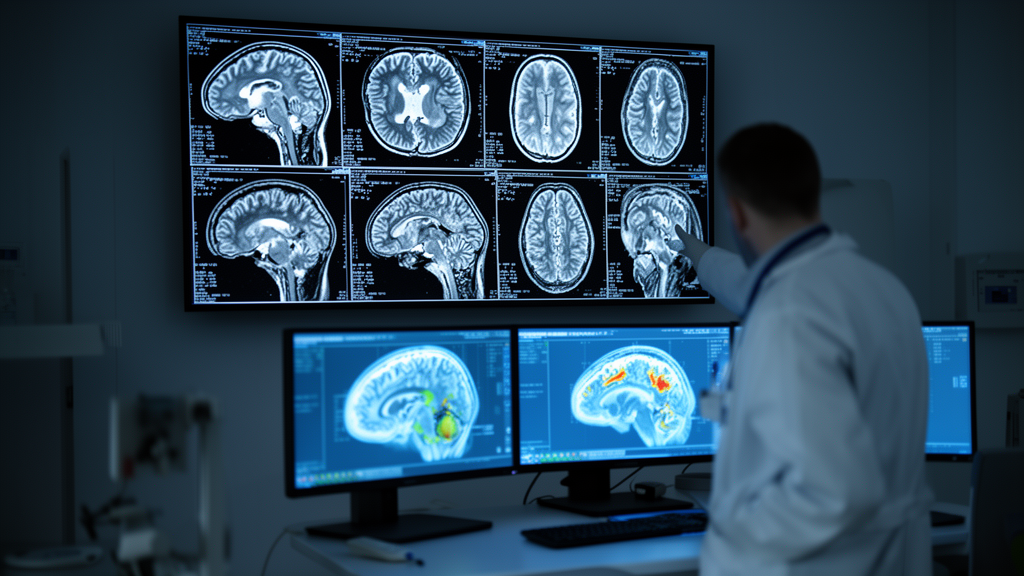
Researchers have built a deep learning pipeline that combines image enhancement, transfer learning, and biologically inspired optimization to sort magnetic resonance imaging (MRI) scans into four categories of Alzheimer’s disease, and it posted striking benchmark numbers. On a Kaggle dataset, the best-performing configuration reached 99.72 percent accuracy, 99.86 percent precision, 99.80 percent recall, 99.83 percent F1-score, and 99.94 percent specificity. On the clinically curated ADNI dataset, the same model achieved 97.68 percent accuracy, 97.54 percent precision, 97.41 percent recall, 97.47 percent F1-score, and 99.19 percent specificity.
Alzheimer’s disease is a progressive neurodegenerative disorder that severely affects memory, cognition, and daily functioning, which makes early and accurate diagnosis essential for effective clinical intervention. Deep learning applied to MRI has shown significant potential for automated classification, but challenges related to image quality, feature extraction, and model optimization continue to limit diagnostic performance. The new study, published in Neural Computing and Applications by S. Mahalakshmi, K. Ramalakshmi, and K. Valarmathi, proposes a Metaheuristically Optimized Super-Resolution Generative Adversarial Network (SRGAN) framework that targets these obstacles together.
The framework’s first stage is SRGAN-based image enhancement. MRI images were preprocessed through normalization, augmentation, and super-resolution reconstruction to improve image quality and feature representation. The enhanced images were then classified into four categories using transfer learning with two established convolutional architectures, ResNet50 and DenseNet121.
The distinctive element is the optimization layer. Rather than hand-tuning hyperparameters, the team applied two metaheuristic algorithms: Particle Swarm Optimization (PSO) and Manta Ray Foraging Optimization (MRFO). These algorithms searched for hyperparameter settings for the transfer learning models, and the resulting configurations were compared across the experiments.
A methodological detail deserves attention because it guards against one of the most common failures in medical machine learning: data leakage. The researchers performed dataset partitioning before augmentation, so that artificially transformed copies of images could not appear on both sides of the evaluation boundary. Hyperparameter optimization was likewise conducted exclusively on training and validation data, keeping the test sets untouched until final measurement.
Across the experiments, the SRGAN-plus-PSO-optimized ResNet50 configuration emerged as the strongest performer on both datasets. An ablation analysis, in which components are systematically removed to measure their individual contributions, confirmed that both the SRGAN-based image enhancement and the metaheuristic optimization contributed positively to classification performance, rather than the gains coming from a single component.
The authors conclude that integrating image enhancement, transfer learning, and intelligent optimization can significantly improve Alzheimer’s disease diagnosis. The results are retrospective benchmark figures on two research datasets rather than evidence from prospective clinical use, and the reported metrics reflect performance under the study’s own partitioning scheme. Even so, the work illustrates how stacking complementary techniques, so that enhanced images feed optimized transfer learning models, can raise the measured accuracy of automated multi-class Alzheimer’s classification from MRI.
Subject of Research: A metaheuristically optimized super-resolution GAN and transfer learning framework for multi-class Alzheimer's disease classification from MRI images
Article Title: A metaheuristically optimized transfer learning framework with super-resolution G. A. N. for multi-class Alzheimer’s disease classification from M. R. I. images
Article References: Mahalakshmi, S., Ramalakshmi, K., & Valarmathi, K. (2026). A metaheuristically optimized transfer learning framework with super-resolution G. A. N. for multi-class Alzheimer’s disease classification from M. R. I. images. Neural Computing and Applications, 38(19), Article 783. https://doi.org/10.1007/s00521-026-12558-2
Image Credits: AI Generated
DOI: 10.1007/s00521-026-12558-2
Keywords: Alzheimer's disease, MRI, super-resolution GAN, transfer learning, ResNet50, DenseNet121, Particle Swarm Optimization, Manta Ray Foraging Optimization, deep learning, medical image classification, ADNI, hyperparameter optimization
News Source: Cassandra Pierce. (October 23, 2026). Super-resolution GAN and swarm-optimized transfer learning sharpen Alzheimer’s MRI classification. Scienmag.