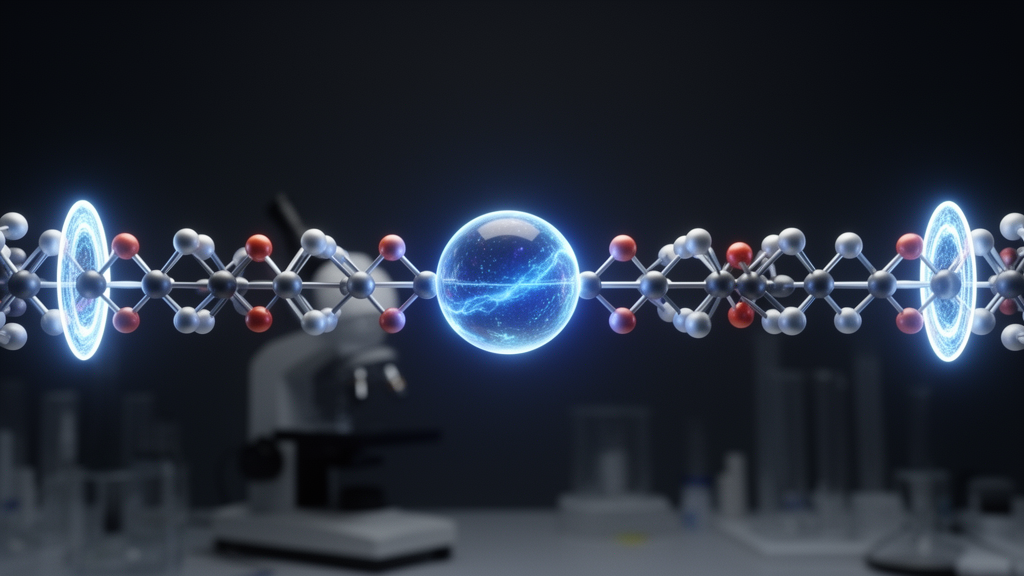
Topological phases of matter are widely expected to protect quantum information, but the promise has often been stated more confidently than it has been understood. A new theoretical and computational study published in Quantum Information Processing takes that promise apart piece by piece, asking exactly which ingredient of a topological system actually protects a qubit's coherence and which merely comes along for the ride. The answer, the authors report, is that two separate mechanisms contribute in distinct and measurable ways, and that neither one alone tells the whole story.
The team, led by Lalitha Nallamothula, Victor Prybutok and Prince Nallamothula, worked with the Su–Schrieffer–Heeger model, a one-dimensional chain that has become a workhorse of topological physics. In its topological phase, the chain supports localized edge modes that can host a pair of states at effectively the same energy. Encoding a logical qubit in those two edge states is the standard route to exploiting topology for quantum memory, because the degeneracy of the pair is enforced by a property called chiral symmetry, while the states' physical separation from the middle of the chain suppresses their mutual overlap.
Those two ingredients, localization and symmetry, are usually lumped together under the single label of topological protection. The new study separates them by simulating the qubit's evolution with a Lindblad master equation, the standard tool for modeling open quantum systems subject to environmental noise. Crucially, the researchers interpolated continuously between two kinds of noise: on-site noise, which breaks chiral symmetry, and bond noise, which preserves it.
By comparing how the topological encoding fares against a trivial encoding under each channel, they could assign a protection factor to each scenario and see which mechanism was doing the work. The headline result is that the topological encoding shows a larger dynamical coherence advantage under on-site noise than under bond noise, with protection factors of 3.15 versus 2.12. That ordering might seem paradoxical, since on-site noise is the channel that breaks the very symmetry thought to guarantee protection.
The authors therefore checked whether the comparison was fair: the two noise channels carry different effective dephasing power, so they normalized them to equal dissipation power and to equal trivial-encoding decay rate. The on-site advantage survived, persisting at a factor of about 1.6 whenever the dissipation rate exceeded the finite-size edge splitting. The effect, in other words, is not an artifact of comparing unequal channels.
The mechanism behind the advantage turns out to be subtle and, in part, surprisingly exact. Chiral symmetry contributes through an exact cancellation of the pure dephasing channel between the two edge states: noise processes that would normally randomize the relative phase of the qubit's two components cancel precisely between the edge modes. The researchers confirmed this with a chiral-breaking control, in which the cancellation disappears.
Meanwhile, the length dependence of the protection is governed not by symmetry but by the hybridization splitting between the two edge states, which shrinks exponentially with chain length as the wavefunctions' tails overlap less and less. The scale of that splitting is set by the localization length. Quantitatively, the on-site protection factor grows with chain length, rising from 1.4 to 3.5 before saturating.
The saturation value is independent of the dissipation rate as long as that rate stays below the bulk gap, while the chain length at which saturation occurs follows a formula the authors derive, depending logarithmically on the ratio of disorder strength to dissipation rate and on the ratio of the model's two hopping amplitudes. The team also derived the logical dephasing rate analytically from the Lindbladian itself, and the resulting expression reproduces the simulated coherence floor with no free parameters, a strong consistency check on the mechanism-resolved picture. Symmetry fixes the height of the coherence floor, determining how low the dephasing can go in the long-chain limit.
Localization sets the length dependence, determining how long the chain must be before that floor is reached. Neither mechanism alone is the sole driver of protection, which means that the common shorthand of calling edge states protected without specifying the mechanism can obscure which physical ingredient is responsible in a given noise environment. As a hardware benchmark, the authors executed the Trotterized version of the dynamics on IBM's ibm_kingston superconducting processor.
The qualitative dynamical contrast between the two encodings, a monotonic decay of edge population for the topological qubit versus ballistic oscillations in the bulk for the trivial one, survived the device's intrinsic noise up to a transpiled circuit depth of 222. A device-calibrated noise simulation with no fitted parameters reproduced both the trivial-encoding loss and the depth dependence of the topological loss, indicating that the simulator's noise model tracks the real processor faithfully. It is, they write, a proof of execution of the dynamical signature, not a measurement of logical coherence.
What the benchmark establishes is that the mechanism-resolved contrast between the two encodings is visible in principle on present-day superconducting hardware, while the quantitative protection factors reported in the simulations remain the study's central, analytically grounded result. For the broader effort to understand protected qubits, the study shows that protection factors measured under one noise channel need not match those under another, and that the geometry of the noise relative to the protecting symmetry matters as much as the symmetry itself. By disentangling localization from chiral symmetry in the simplest topological model available, the work turns a vague expectation into a mechanism-resolved account, backed by an analytic derivation that matches simulation with no free parameters.
Subject of Research: Mechanism-resolved analysis of topological protection of qubit coherence in the Su–Schrieffer–Heeger model
Article Title: Mechanism-resolved topological protection of qubit coherence: disentangling localization and chiral symmetry in the Su–Schrieffer–Heeger model
Article References: Nallamothula, L., Prybutok, V., & Nallamothula, P. (2026). Mechanism-resolved topological protection of qubit coherence: disentangling localization and chiral symmetry in the Su–Schrieffer–Heeger model. Quantum Information Processing, 25(11), Article 346. https://doi.org/10.1007/s11128-026-05371-2
Image Credits: AI Generated
DOI: 10.1007/s11128-026-05371-2
Keywords: topological phases, qubit coherence, Su–Schrieffer–Heeger model, chiral symmetry, edge states, Lindblad dynamics, dephasing, localization, superconducting processor, quantum information, Mechanism-resolved, topological
News Source: Denise Maddox. (October 23, 2026). Research report: Mechanism-resolved topological protection of qubit coherence: disentangling localization and chiral symmetry in the Su–Schrieffer–Heeger model. Scienmag.