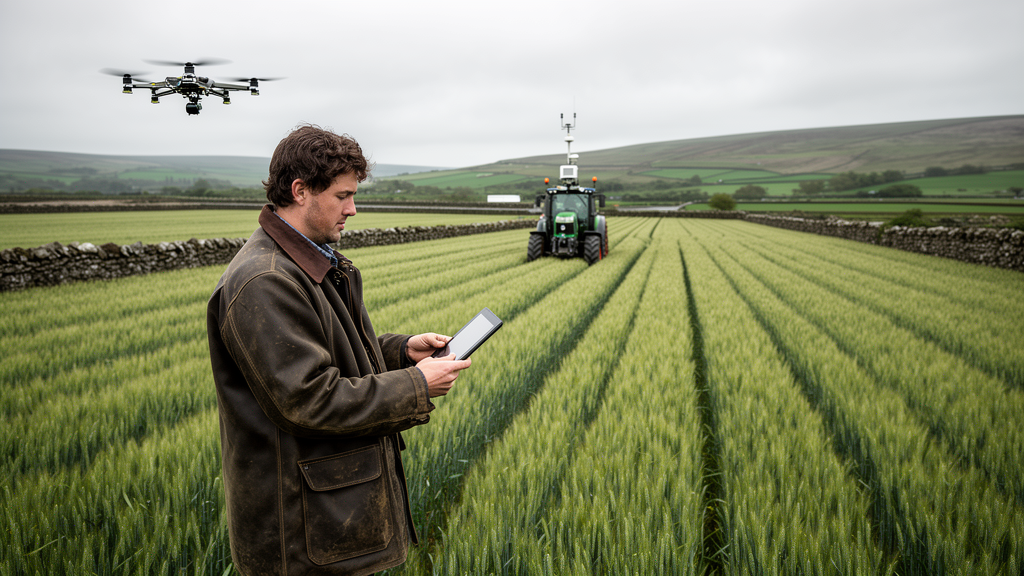
Digital agricultural technologies are steadily permeating Irish arable farming, according to a repeated cross-sectional survey that asked the same questions of tillage farmers in late 2020 and again in late 2025. Across almost every technology category surveyed, adoption rose over the five-year interval, with the largest gains in satellite-guided steering, automated tractor control, and yield monitoring. Yet the study also shows that Irish arable farmers remain reluctant to embrace the most data-intensive tools, particularly imagery-based pesticide decisions and full variable-rate application systems, suggesting the sector’s digital transition is incremental rather than transformational.
The research, conducted through anonymous online questionnaires distributed via The Irish Farmers Journal, social media, and University College Dublin networks, captured 106 farmers in 2020 and 72 in 2025. Respondents were concentrated in the south, east, and south-east of Ireland, the country’s main arable regions, and the land they farmed totalled 23,497.5 hectares in the first survey and 13,814 hectares in the second, roughly 8.11% and 4.64% of the national cropping area respectively. Because the samples were self-selecting and skewed towards younger and larger operators than national averages, the findings describe the surveyed population rather than a statistically representative portrait of all 4,447 specialist tillage farms in Ireland.
The clearest signal concerned satellite navigation. Farmers reporting no GPS guidance on tractors or combines fell from 23.30% in 2020 to 11.11% in 2025, while basic lightbar systems declined from 36.89% to 30.56%. Both losses were absorbed by a sharp rise in real-time kinematic (RTK) guidance, the centimetre-accurate form of positioning, which climbed from 39.81% to 58.33% of respondents. In 2025, the difference between RTK users and basic GPS users was statistically significant within the survey year, underlining how the technology hierarchy has shifted towards precision-grade guidance. None of the year-on-year changes survived correction for multiple comparisons, so the trends should be read as consistent directional movement rather than proven change.
Automated steering followed the same pattern. The share of farmers who owned auto-steer-capable machinery and actually used it rose from 52.88% to 61.11%, those planning to buy it in the near future increased from 20.19% to 25.00%, and the proportion not considering it at all dropped by more than half, from 21.15% to 9.72%. GPS section control on sprayers, which switches individual nozzle sections off to prevent overlap, rose from 50.96% to 61.11%, and GPS-controlled fertiliser application rose from 42.72% to 51.39%. These guidance-layer technologies deliver immediate operational benefits, including reduced operator fatigue, fuel savings, and more accurate coverage, which the authors identify as the reason they diffuse fastest across all demographic groups, echoing international evidence that guidance systems are the primary entry point into precision agriculture.
Yield monitoring, the practice of recording harvest data combine by combine, showed one of the larger upward movements, from 14.85% to 25.00% of respondents. Interestingly, the number of farmers owning a monitor but not fully convinced of its value also rose, from 5.94% to 11.67%, while those waiting for accuracy or cost issues to be resolved fell from 24.75% to 13.33%. This suggests many farmers have now been exposed to yield monitors and found their earlier reservations overstated. Yield data feeds directly into prescription maps, which guide how much fertiliser to apply in different parts of a field, and prescription map use rose from 9.90% to 15.25%, although most farmers in both years said they were considering them rather than using them.
Variable-rate technology (VRT), which adjusts seed, fertiliser, or spray rates automatically across a field, remains the stubborn frontier. Overall VRT adoption barely moved, with about one in five farmers applying it to fertiliser or spraying in both years. The notable exception was variable-rate sowing, which jumped from 0.99% to 10.34% of respondents. Half of those without VRT said they planned to adopt it soon in both surveys, a figure that rose from 42.57% to 51.72%. The bottleneck, the study argues, is not hardware but the data pipeline: deploying VRT requires farmers to assemble historical data layers such as yield maps or soil conductivity grids, process them in specialised software, and generate accurate field prescriptions, a workflow demanding time and digital expertise that many busy operators lack.
Imagery tells a similar story of stalled confidence. Use of satellite or drone imagery for crop or grass monitoring rose from 12.00% to 22.03%, but imagery-based pesticide and fungicide decisions stayed essentially flat at around 3% in both years. Among non-users, the reasons for abstaining shifted: the share saying imagery is not commercially proven rose from 12.33% to 33.33%, and those doubting its accuracy rose from 4.11% to 17.95%, though neither change was statistically significant. The authors suggest this hardening scepticism reflects farmers’ real exposure to start-up-era imagery services, where early errors and technical failures shaped lasting opinions.
The socio-demographic findings challenge a familiar stereotype. Farmer age was not a statistically significant predictor of adoption in either survey year, and the differences between age groups actually narrowed by 2025, hinting that the historic digital divide is closing. The most striking shift came among operators aged 61 and over: in 2020, 22.73% of this cohort owned auto-steer machinery but chose not to use it; by 2025 that active non-use had collapsed to 4.17%, while those intending to acquire the technology surged from 13.64% to 41.67%. The authors attribute this to intuitive touchscreen terminals resembling smartphones, now owned by 100% of respondents, and to older farmers valuing automation as an ergonomics tool that reduces physical strain and fatigue, consistent with classic innovation theory holding that adoption accelerates when a technology proves compatible with users’ wellbeing.
Farm size, by contrast, remained the dominant driver, though its grip is loosening. In 2020, eight of eleven technology questions showed significant differences between farm-size strata; by 2025 only one did. Large farms of 201 hectares or more approached saturation, with 94.44% actively using auto-steer, 88.89% on RTK guidance, and 83.33% on sprayer section control in 2025. Smaller farms lagged but grew fastest, reaching 44.44% RTK adoption. The authors point to two equalising forces: government capital grants under the Targeted Agricultural Modernisation Schemes, which fund 40% to 60% of equipment costs and had supported 620 auto-steer systems for tillage farmers by mid-2026, equivalent to roughly 13.94% of Irish tillage farms, and the rise of agri-contractors who carry the technology investment and deliver its benefits to small clients without capital outlay. Notably, small farms outpaced medium-sized ones in yield monitoring, possibly because contractors equipped with monitors harvest their crops. Post-2022 fertiliser and fuel price spikes have further improved the return on investment for input-saving technologies.
The study’s limitations frame how far its conclusions travel. The sample shrank between waves, online recruitment skewed towards younger and larger operations, self-reported adoption may overstate routine use, and repeated cross-sections cannot track individual farmers’ trajectories. Even so, the consistent direction of change across technologies, its coherence with global adoption patterns, and its alignment with grant-funding records sketch a clear picture: Irish arable farming has largely mastered the infrastructure layer of digital agriculture, with guidance and automation nearing widespread use, while the decision-support layer, imagery, full variable-rate systems, and data interpretation, now constitutes the adoption challenge. The authors argue that future policy should look beyond equipment grants towards independent agronomic support, standardised data platforms, and trusted advisory networks that help farmers convert raw field data into economic and environmental returns, and that repeating the survey will show whether the narrowing of socio-demographic gaps is a durable structural change or a feature of the years sampled.
Subject of Research: Five-year trends in digital agricultural technology adoption among Irish arable farmers
Article Title: The progression of Agri-technology adoption among arable farmers in Ireland
Article References: Kehoe, C. J., McDonnell, K. P., & Gillespie, G. D. (2026). The progression of Agri-technology adoption among arable farmers in Ireland. Smart Agricultural Technology, 15, Article 102655. https://doi.org/10.1016/j.atech.2026.102655
Image Credits: AI Generated
DOI: 10.1016/j.atech.2026.102655
Keywords: precision agriculture, digital agriculture, Ireland, tillage farming, GPS guidance, auto-steer, yield monitoring, variable-rate technology, agri-contractors, TAMS grants, farm size, technology adoption
News Source: Alan Morgan. (October 23, 2026). Digital farming spreads across Irish arable farms, but the data-driven frontier lags. Scienmag.