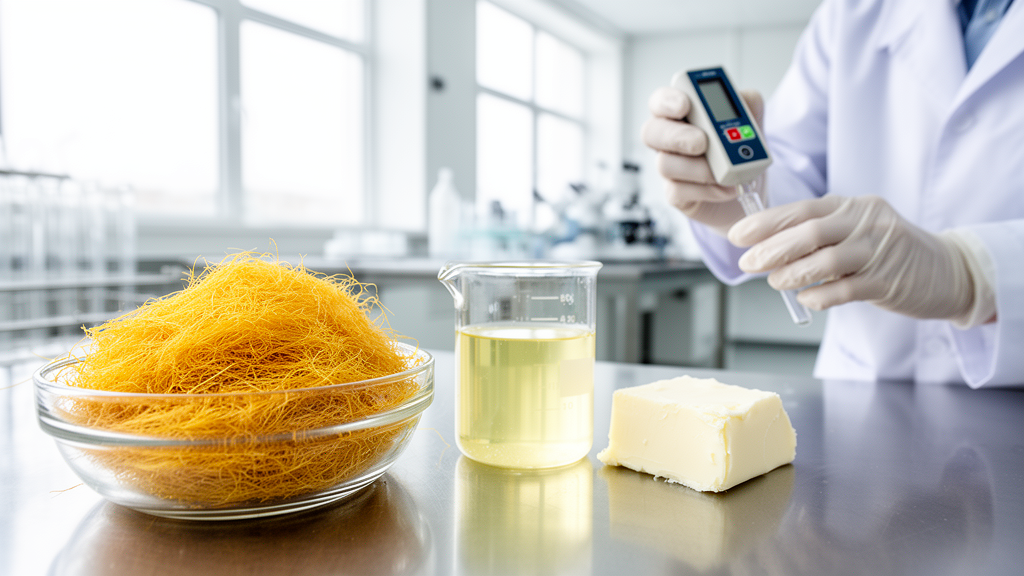
Corn silk, the thread-like tangle of stigma and style that most corn processing plants throw away, has been quietly sitting on a bank of usable protein. A new study reports that protein extracted from this agricultural by-product can be coaxed, with a simple pH adjustment, into acting as an effective natural emulsifier capable of structuring liquid corn oil into a semi-solid oleogel. The finding positions one of the food industry’s more persistent waste streams as a candidate ingredient for replacing saturated and trans fats in processed foods, all without relying on soybean protein, the usual plant-based workhorse in this field.
The research, conducted by a team including Chuxin Ke and Bo Pang, began with corn silk harvested from fresh maize in Nanning, in China’s Guangxi Province. The researchers extracted the protein using an alkaline solubilization and acid precipitation method: ground silk was dispersed in sodium hydroxide, centrifuged, and then the supernatant was brought to pH 4.0 with hydrochloric acid to precipitate the protein, which was dialyzed and freeze-dried. What came next was the study’s central question. The team suspected that the pH of the protein solution itself could reshape the molecule’s structure and, in doing so, tune how well it performs at an oil-water interface.
To test that idea, the researchers adjusted corn silk protein solutions to pH 3, 5, 7, 9, and 11, alongside an untreated control at pH 6.55, and then read out the structural consequences with several complementary techniques. Free sulfhydryl content, measured with Ellman’s reagent, served as a proxy for how much of the protein’s buried cysteine chemistry had been exposed. The numbers told a nuanced story. Mild acid at pH 5 raised free sulfhydryl content to 4.44 micromoles per gram from the control value of 2.33, and pH 9 pushed it further to 5.64, both consistent with partial unfolding that makes previously hidden groups accessible. But at pH 11, the measured content actually dropped to 1.07 micromoles per gram, likely not because unfolding stopped but because a strongly alkaline environment promotes thiol oxidation and thiol-disulfide exchange, converting free thiols into new disulfide bonds.
Fourier transform infrared spectroscopy added a second layer of evidence. The amide I band was deconvoluted to quantify secondary structure, revealing that beta-sheet and beta-turn structures dominate corn silk protein. After pH treatment, beta-sheet content fell while beta-turn structures rose, a rearrangement the authors associate with partial unfolding. The amide A band shifted toward lower wavenumbers after both acidic and alkaline treatments, signaling altered hydrogen-bonding environments, while alkaline conditions shifted the amide II band in a way that points to changes in the peptide backbone’s local surroundings. Scanning electron microscopy then put a face on these molecular shifts. The untreated protein appeared as smooth ellipsoidal to sub-spherical particles roughly 1.5 to 1.6 micrometers across, with some aggregation. At pH 3, near the protein’s isoelectric point of approximately 3.5, the spherical structure collapsed into aggregates, exactly as reduced electrostatic repulsion would predict. At pH 11, the defined particle morphology disappeared entirely, replaced by irregular, fragmented features indicative of extensive structural disruption.
Those structural changes translated directly into functional performance. Solubility rose under alkaline conditions, from 69.7 percent in the control to 72.3 percent at pH 9 and 75.8 percent at pH 11, while acidic pH 3 produced the lowest solubility at 57.5 percent. The emulsifying results were more striking still. At pH 11, corn silk protein achieved an emulsifying activity index of 15.11 square meters per gram and an emulsifying stability index of 214.11 minutes, the highest values across all conditions tested. The authors attribute this to unfolding and increased molecular dispersion, which allow protein molecules to diffuse rapidly to the interface and reorganize into a continuous, mechanically stable film. By contrast, pH 9 produced lower values, 13.08 square meters per gram and 50.23 minutes, plausibly because unfolding was incomplete and residual aggregates limited interfacial coverage.
Differential scanning calorimetry completed the structural picture. The thermal denaturation temperature of the control protein was 125.84 degrees Celsius, and pH treatments reduced it to varying degrees, down to 115.98 degrees at pH 3 and 122.02 degrees at pH 11. Lower denaturation temperatures signal a less tightly packed structure, consistent with the microscopy and spectroscopy findings. Taken together, the data supported the team’s hypothesis: strong alkaline treatment opens up the protein, exposes hydrophobic regions, and primes the molecule to wrap around oil droplets.
With pH 11 protein in hand, the researchers built emulsion templates at five water-to-oil volume ratios, from 5/5 down to 1/9, homogenized at 28,800 rpm and then dried in an oven at 40 degrees Celsius for 24 hours. The oven-drying choice matters for scalability; unlike freeze-drying, it consumes less energy, needs simpler equipment, and avoids ice-crystal damage to the forming network. Emulsions at water-to-oil ratios of 5/5, 4/6, and 3/7 came out homogeneous, but the 2/8 and 1/9 formulations developed free oil layers, indicating the protein available could no longer cover the vastly expanded interfacial area. Zeta-potential measurements reinforced the picture: the 3/7 emulsion showed the highest absolute zeta-potential at 49.51 millivolts, a strong electrostatic barrier against droplet flocculation, while values fell as oil fractions climbed beyond the protein’s coverage capacity.
Confocal laser scanning microscopy showed what happened after drying. In the gels made from the three stable emulsions, protein formed a continuous three-dimensional scaffold with the oil embedded within it, and the 3/7 formulation, designated O7, produced the most integrated network. The functional payoff was measurable. O7 was the hardest of the gels in texture analysis and held 98.00 percent of its oil under centrifugation, significantly more than the 84.73 and 85.08 percent recorded for the lower-oil gels. All three gels showed shear-thinning viscosity and, in oscillatory rheology, a storage modulus consistently above the loss modulus across the tested frequency range, confirming true solid-like behavior. At oil fractions above 70 percent, oleogel formation failed altogether, with the samples remaining flowable liquids because there was not enough protein to stabilize the interface and build a network.
Oxidative stability added a further dimension, and an honest caveat. Peroxide values of the oleogels rose over seven days of storage at 25 degrees Celsius but were lower than those of treated liquid corn oil from day 3 onward, suggesting the protein network acts as a physical barrier restricting oxygen diffusion. Secondary oxidation, tracked as thiobarbituric acid reactive substances, told a less clean story: the gels showed higher TBARS than liquid oil through day 5, and only O7, with its dense continuous network, posted the lowest TBARS on day 7. The authors note that hydroperoxides generated during processing may have decomposed more readily into secondary products, and that protein-lipid oxidation interactions complicate the picture. They also acknowledge that their alkaline extraction left residual carbohydrates in the protein preparation, which could influence emulsification and oxidation behavior, and they recommend further purification plus molecular-level analyses such as circular dichroism and fluorescence spectroscopy to confirm the proposed structural mechanisms.
The bigger significance lies in what this means for both waste streams and fat chemistry. Soybean protein remains the most studied plant protein for emulsion-templated oleogels, but its low interfacial activity often demands added polysaccharides, and its beany flavor and allergenicity limit consumer acceptance; zein, another candidate, needs exogenous surfactants because it barely dissolves in water. Corn silk protein, treated at pH 11, delivered high emulsifying activity on its own, from a by-product that is otherwise discarded or confined to traditional herbal use. The proposed mechanism is elegant in its simplicity: pH-driven unfolding exposes hydrophobic domains, the protein adsorbs at the oil-water interface with hydrophobic groups facing the oil, and during drying the shrinking aqueous phase draws interfacial protein films together through hydrophobic interactions, hydrogen bonding, electrostatic forces, and disulfide exchange, locking liquid oil into a solid-like scaffold. The authors frame the work as preliminary, a foundation for applications in fat reduction, nutritional enhancement, and delivery of lipid-soluble bioactives, with the explicit warning that oil phase volume fraction is a decisive design variable. For now, the study demonstrates feasibility in the laboratory, not a finished food ingredient, but it suggests that the silky waste of the corn harvest may one day help bind the oils in healthier spreads, shortenings, and structured food products.
Subject of Research: pH-modulated corn silk protein as an emulsifier for emulsion-templated oleogel fabrication
Article Title: Valorization of Corn Silk Protein: pH-Driven Structural Modulation for Emulsion-Templated Oleogel Fabrication
Article References: Ke, C., He, J., Hao, F., & Pang, B. (2026). Valorization of Corn Silk Protein: pH-Driven Structural Modulation for Emulsion-Templated Oleogel Fabrication. Current Research in Food Science, Article 101607. https://doi.org/10.1016/j.crfs.2026.101607
Image Credits: AI Generated
DOI: 10.1016/j.crfs.2026.101607
Keywords: corn silk protein, oleogel, emulsion-templated method, pH treatment, plant protein, food waste valorization, solid fat replacement, emulsifying properties, rheology, oxidative stability, agricultural by-products, Valorization
News Source: Alan Morgan. (October 23, 2026). Corn Silk Waste Protein Turned Into Solid Fat Alternative by pH Trick. Scienmag.