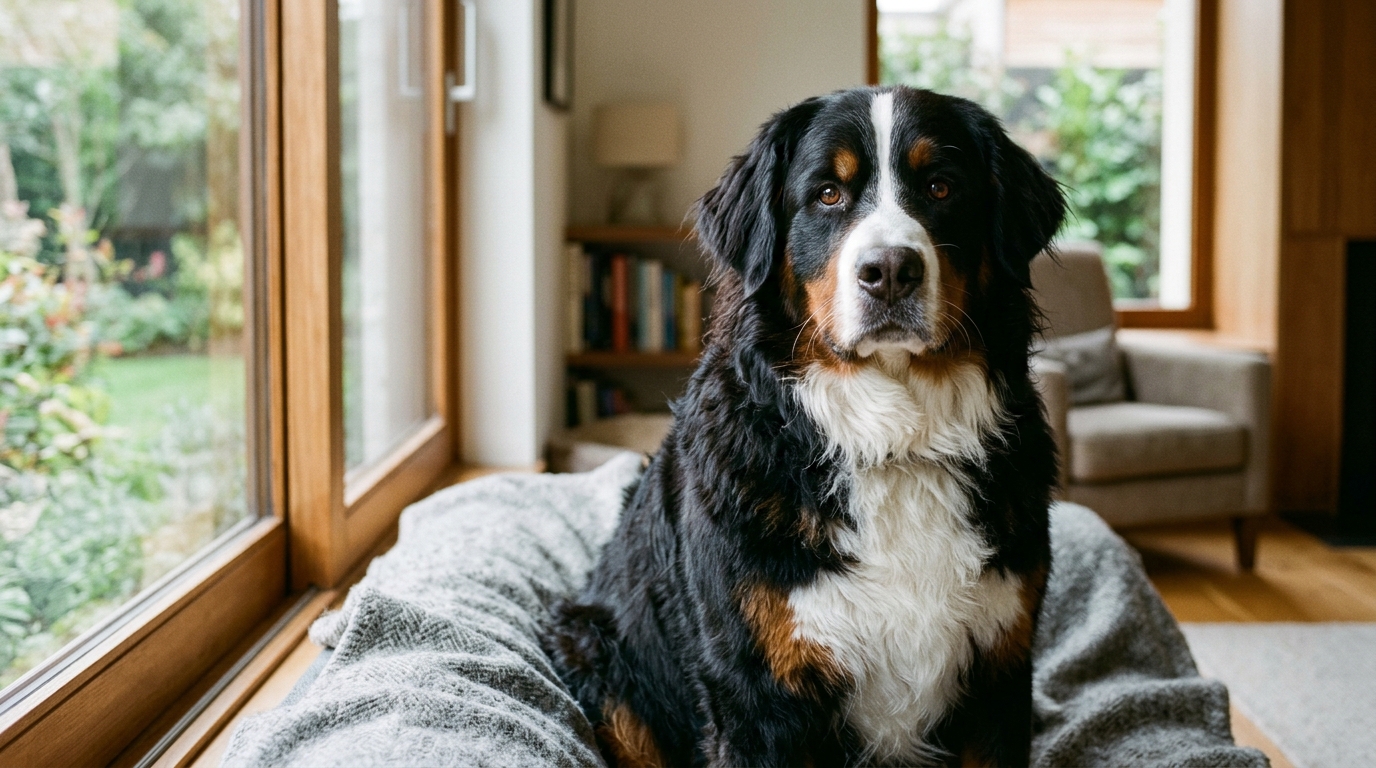
A targeted genomic analysis of 27 lymphoma specimens from Bernese Mountain dogs revealed somatic mutations in 96.3 percent of cases, identifying widespread alterations across known cancer drivers alongside an unusually prevalent mutation in the EP300 gene that may represent a distinct breed-specific molecular signature. Canine lymphoma closely mirrors human non-Hodgkin lymphoma in biological behavior, clinical presentation, and therapeutic response, making natural canine malignancies a critical translational model in comparative oncology. Bernese Mountain dogs are historically predisposed to developing both multicentric lymphoma and histiocytic sarcoma, yet the specific somatic mutational landscape underlying lymphoid neoplasms in this breed had remained largely uncharacterized. The investigation, drawing on archived specimens from the Michigan State University Berner-Garde Tissue Repository, provides the first systematic next-generation sequencing survey of somatic alterations across 499 cancer-associated genes in this high-risk breed, mapping single nucleotide variants, small indels, and recurrent copy number alterations to illuminate the genetic mechanisms driving canine lymphomagenesis.
High-grade multicentric lymphoma in dogs presents an aggressive clinical challenge analogous to high-grade non-Hodgkin lymphoma in human patients, where both species receive comparable multi-drug chemotherapy protocols as first-line intervention. While initial therapy induces remission in many patients, intrinsic or acquired therapeutic resistance causes treatment failure in 30 to 40 percent of human cases and in nearly all canine cases over time. Because selective breeding for distinct morphological traits has generated profound genetic homogeneity within individual dog breeds, breed-specific cohorts offer valuable models for studying cancer susceptibility and shared oncogenic pathways. Epidemiological studies have recognized the Bernese Mountain dog as one of eight breeds predisposed to lymphoma, particularly the centroblastic morphological variant of diffuse large B-cell lymphoma. Furthermore, the breed exhibits an extraordinary incidence of histiocytic sarcoma, with clinical and pedigree studies showing that over 40 percent of dogs diagnosed with histiocytic sarcoma develop secondary malignancies, with lymphoma occurring in approximately 3.1 percent of cases compared to an estimated general canine prevalence of only 0.02 percent.
To elucidate the somatic variants associated with lymphoma in this breed, the research team analyzed 27 fresh-frozen tumor specimens preserved within the Berner-Garde Tissue Repository at Michigan State University. The retrospective collection comprised surplus tissue obtained during diagnostic surgical resections or collected post-mortem during necropsies, submitted by veterinary practitioners and dog owners under informed signed consent. Every case underwent diagnostic confirmation of lymphoma by a board-certified veterinary pathologist, with tissue utilization authorized by the Michigan State University Institutional Animal Care and Use Committee under protocol AUF 08/15-127-00. Given the archival nature of the repository specimens, specific records concerning tumor anatomical origin, histological subtype, and prior therapeutic regimens were unavailable. Genomic DNA was isolated from frozen specimens using the DNeasy Blood and Tissue kit from Qiagen and subsequently quantified using the Qubit 2.0 fluorometer from Thermo Fisher Scientific to guarantee adequate template mass for downstream high-throughput targeted capture.
Library preparation employed CanCan Diagnostics proprietary K9-TMB/MSI enrichment platform, a hybridization-based capture system targeting all coding exons across 499 cancer-associated genes spanning roughly 1.74 megabases of the canine genome. Prepared libraries underwent quantitative validation via Qubit fluorometry and qualitative sizing using the Agilent Tapestation 4200 system before paired-end sequencing on an Illumina NextSeq 2000 instrument with 100-base-pair read lengths, reaching an average target raw coverage depth exceeding 500x. Bioinformatic analysis followed a custom pipeline implementing Genome Analysis Toolkit best practices. Adapter sequences and low-quality bases were removed using fastp version 0.23.4, after which cleaned reads were aligned to the CanFam3.1 canine reference genome using the Burrows-Wheeler Aligner BWA-MEM version 0.7.18. Polymerase chain reaction duplicates were identified and flagged using Picard version 2.23.8, while alignments with mapping quality scores below 30 were discarded to ensure robust data reliability prior to variant detection with GATK version 4.
Somatic single nucleotide variants and small insertions and deletions were called using Mutect2 within GATK version 4, followed by best-practice filtering to eliminate sequencing noise, low read support, and inferior base quality. Annotated Mutation Annotation Format files were generated using vcf2maf, integrating the Ensembl Variant Effect Predictor version 113 alongside canine polymorphism datasets from dbSNP. The pipeline incorporated the Sorting Intolerant From Tolerant algorithm to assess evolutionary conservation and predict the deleterious impact of non-synonymous amino acid substitutions. To prevent spurious calls, variants marked by technical flags—such as panel-of-normals matches, weak evidence, or complex haplotypes—were discarded, and variant allele frequencies were constrained between 3 percent and 95 percent to exclude sequencing artifacts and obvious germline loci. Somatic filtering was further reinforced by comparing tumor profiles against a panel of normals derived from 77 buffy-coat DNA samples from healthy dogs sequenced under identical conditions, as well as germline variants from the Dog 10k project, with downstream cohort analysis performed using R’s maftools package.
Copy number variations across the 499 targeted genes were identified using the GATK tumor-only copy number workflow. The CollectReadCounts tool calculated read depths across all targeted capture intervals, which were standardized and denoised against an expanded panel of normals comprising 145 healthy canines via DenoiseReadCounts. Allelic fractions across common biallelic single nucleotide polymorphisms from the Dog 10k dataset were captured using CollectAllelicCounts to normalize for hybridization kinetics and GC-content biases. Denoised log2 copy ratios and allelic proportions were jointly segmented through ModelSegments and classified using CallCopyRatioSegments. Because the enrichment panel targeted exonic coding intervals, copy number calls were evaluated at the gene level based on Ensembl CanFam3.1 release 104 coordinates. Segments displaying mean log2 copy ratios greater than 0.9 were defined as copy number gains, while segments with mean log2 copy ratios falling below negative 0.9 were classified as copy number losses, evaluated across samples maintaining a median on-target depth of at least 500x.
Somatic mutations were confirmed in 26 of the 27 evaluated tumors, representing a 96.3 percent detection rate, with individual specimens harboring between 1 and 22 filtered variants at a median burden of 6 variants per sample. Tumor necrosis factor receptor-associated factor 3, encoded by TRAF3, was the single most frequently mutated gene, altered in 25.9 percent of cases across vital regulatory domains including MATH_TRAF3 and RING, presenting missense, frameshift, splice-site, and nonsense mutations that disrupt its tumor-suppressive inhibition of nuclear factor kappa B signaling. Both TP53 and MYC exhibited somatic mutations in 22 percent of tumors, characterized entirely by missense substitutions, with MYC alterations clustering predominantly within the conserved Myc_N domain and TP53 substitutions impacting its critical DNA-binding and tetramerization regions. MAP3K14 mutations occurred in 19 percent of tumors in a mutually exclusive pattern, displaying missense, splice-site, in-frame deletion, and frameshift variants within the alternative NF-kappa-B pathway. Additional recurrently altered genes included CSMD3, ARID1A, LRP2, LRP1B, and CIC, each displaying mutation rates between 11 and 19 percent across the cohort.
Structural genomic profiling identified copy number variations in 66 percent of the lymphoma specimens, with 18 of 27 cases displaying alterations among the ten most frequently affected genes. Copy number gains were most prevalent in KMT2C, observed in 9 cases, followed by PIK3R1 gains in 5 cases and PTPN11 gains in 2 cases. Conversely, recurrent copy number losses affected TP53 in 4 cases, MTAP and PTEN in 3 cases each, and MET, SCRN1, SETD2, and TRAF3 in 2 cases each. Notably, in 3 of the 4 cases exhibiting TP53 copy number losses, the deletions occurred concurrently with somatic TP53 missense mutations, indicating that 50 percent of all TP53-mutant tumors in the cohort sustained potential biallelic inactivation. While concurrent TP53 mutations and deletions occurred in only 21 percent of DLBCL cases in prior canine literature, this elevated rate of dual disruption in Bernese Mountain dogs underscores the aggressive biology of the disease, even as human non-Hodgkin lymphoma studies show that monoallelic and biallelic TP53 losses confer similar reductions in overall survival compared to wild-type cases.
A pivotal revelation of the genomic analysis was the high frequency of mutations in EP300, which encodes the E1A-associated p300 histone acetyltransferase that directs chromatin remodeling, cell differentiation, and proliferation. In the Bernese Mountain dog cohort, EP300 was mutated in 22 percent of tumors, showing missense, frameshift, and multi-hit events that rarely overlapped with TRAF3 or MYC alterations. This elevated frequency marks a dramatic departure from broader canine lymphoma surveys, where EP300 mutations appeared in merely 3 percent of 238 lymphoma cases and 5 percent of B-cell lymphomas in a recent large-scale cohort, and were completely absent in another 77-case canine DLBCL study. Furthermore, while CREBBP mutations occurred in 25.9 percent of canine lymphomas in previous multi-breed studies, zero CREBBP mutations were detected in the Bernese Mountain dog specimens. Because canine and human EP300 proteins share 96.6 percent sequence homology, and EP300 mutations occur in roughly 10 percent of human DLBCL and 8.7 percent of follicular lymphomas, this breed-specific hotspot offers valuable translational opportunities for targeted epigenetic therapeutics.
Despite providing unprecedented genomic insights into Bernese Mountain dog lymphomagenesis, the authors emphasized several methodological constraints inherent to retrospective biorepository studies. The primary limitations included the absence of tumor immunophenotypic profiling to formally categorize B-cell versus T-cell lineage, lack of detailed clinical treatment histories, and the absence of paired germline DNA. Although peripheral blood mononuclear cell DNA was available for most dogs, high rates of shared variants raised concerns that circulating neoplastic cells in the blood could cause somatic mutations to be erroneously discarded as germline variants. Tumor-only filtering against public databases and a panel of normals yielded remaining variants with a median allele frequency of 0.24, with 6.9 percent exceeding 0.50, which may represent true clonal mutations, copy number losses, or rare uncatalogued germline alleles. The investigators concluded that future research must validate these findings in larger prospective Bernese Mountain dog cohorts, conduct functional in vitro assays on EP300 and TRAF3 alterations, and leverage comparative oncology frameworks to advance targeted diagnostics and therapies for canine and human lymphoid cancers.
Subject of Research: Genomic profiling of somatic mutations and copy number alterations in Bernese Mountain dog lymphomas
Article Title: Identification of somatic mutations in lymphomas of Bernese Mountain dogs
Article References: Granziera, V., Szafron, Ł., Daghir-Wojtkowiak, E., Schall, P., Grant, J., Takada, M., Yuzbasiyan-Gurkan, V., & Parys, M. (2026). Identification of somatic mutations in lymphomas of Bernese Mountain dogs. Veterinary Oncology, 3(1), Article 27. https://doi.org/10.1186/s44356-026-00078-z
Image Credits: AI Generated
DOI: 10.1186/s44356-026-00078-z
Keywords: veterinary oncology, canine lymphoma, Bernese Mountain dog, somatic mutations, comparative oncology, TRAF3, EP300, genomics, Identification, somatic, mutations, lymphomas
News Source: William Thompson. (November 6, 2026). Study Uncovers Distinct Somatic Mutations in Bernese Mountain Dog Lymphomas. Scienmag.