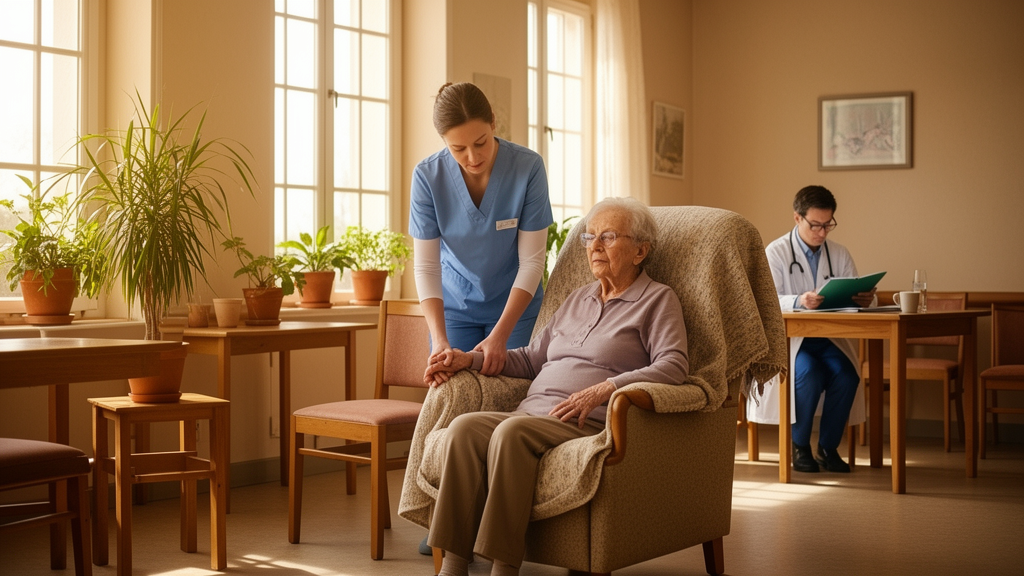
Providing quality palliative care to older people living in French nursing homes depends on a web of interacting factors, according to a multiple case study that gathered the perspectives of care professionals, facility leaders, residents, and family caregivers. The research, published in BMC Health Services Research, set out to explore what enables and what hinders the delivery of quality palliative care within these facilities, where access to such care remains suboptimal despite repeated efforts to strengthen it.
The integration of palliative care into nursing homes is increasingly recognised as a crucial strategy for improving access for a growing number of residents with complex, life-limiting conditions. Yet, as the study’s authors note, various strategies aimed at supporting this integration have not resolved the problem of suboptimal access. To understand why, the researchers conducted a multiple case study in which they held individual interviews with residents, family caregivers, and members of leadership teams, ran focus group discussions with healthcare professionals, and complemented these accounts with participant observation. Data collection ran from April 2021 to September 2022, and the material was analysed using thematic content analysis.
The analysis identified a complex, multi-contextual dynamic between four main groups of factors that influence the quality of palliative care provision: practice-based and organisational factors inherent to the nursing home, structural factors, and individual factors. These interact to either facilitate or constrain care. According to the findings, leadership, the availability of resources, the decision-making process, access to external palliative care support, and staff knowledge and attitudes towards palliative care all play critical roles in shaping both the care that is provided and the experiences of residents and their families with that care.
A central conclusion of the study is that these interrelated factors create a disconnect between the quality palliative care that is expected and the palliative care practices currently enacted in nursing homes. In other words, the gap between ideal and actual provision is not attributable to any single deficiency but emerges from the convergence of practice-based, organisational, structural, and individual dynamics. The authors argue that this pattern points to the need for a multifaceted, system-level response rather than isolated fixes.
Specifically, the study suggests that cultivating a supportive organisational culture, embedding palliative care principles across care practices, building the capacity of nursing home professionals, and including patients and families in decision-making are essential to closing the gap between ideal and actual palliative care provision. Such an approach, the authors write, offers the potential to improve the provision of timely, person-centred palliative care, enhance the experiences of residents and family caregivers, and support quality of life and quality of dying within nursing homes.
As a qualitative multiple case study drawing on interviews, focus groups, and observation in French facilities, the research describes perceived enablers and barriers from the viewpoints of those directly involved; it does not test the effectiveness of any particular intervention. Even so, by mapping how leadership, resources, decision-making, external support, and staff knowledge and attitudes interlock, the findings offer a structured picture of where system-level efforts to strengthen palliative care in nursing homes might most productively be directed.
Subject of Research: Enablers and barriers to quality palliative care provision for older people in French nursing homes
Article Title: Perceived enablers and barriers to the provision of quality palliative care to older persons in nursing homes in France: multiple case study with professionals, leaders, residents, and family caregivers
Article References: Bagaragaza, E., Umubyeyi, B., Guirimand, F., Aegerter, P., & Leboul, D. (2026). Perceived enablers and barriers to the provision of quality palliative care to older persons in nursing homes in France: multiple case study with professionals, leaders, residents, and family caregivers. BMC Health Services Research. https://doi.org/10.1186/s12913-026-15906-z
Image Credits: AI Generated
DOI: 10.1186/s12913-026-15906-z
Keywords: palliative care, nursing homes, older adults, France, qualitative research, multiple case study, health services research, caregivers, organisational culture, end-of-life care, Perceived, enablers
News Source: Ophelia Keating. (October 29, 2026). Study Maps What Helps and Hinders Palliative Care in French Nursing Homes. Scienmag.