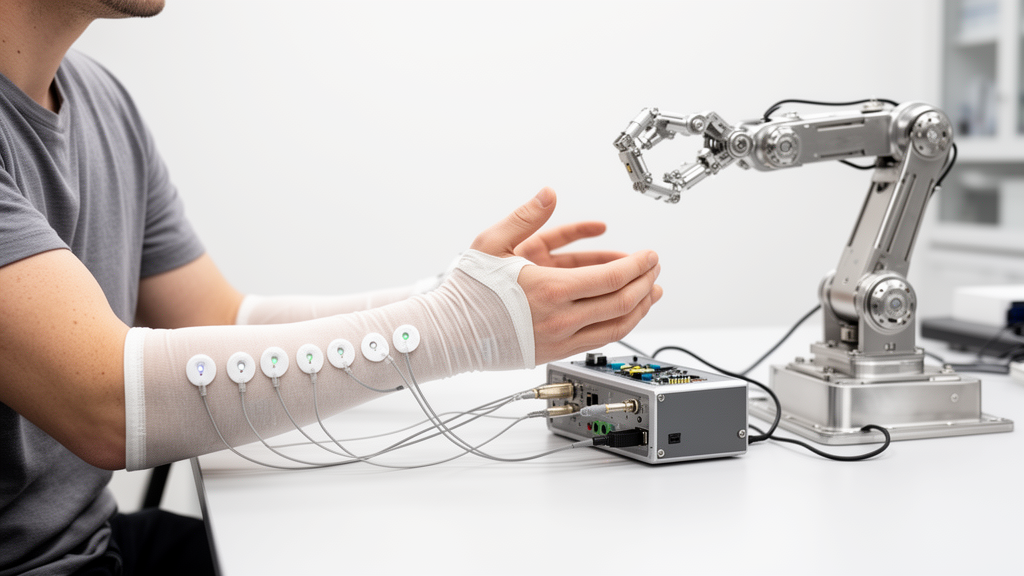
A robotic arm can mirror the multi-step movements of a human upper limb using nothing more than surface muscle signals and a deliberately simple processing pipeline, according to a new methods study from engineers at Cleveland State University. The work, published in Frontiers in Robotics and AI by John Niezgoda and Apostolos Kalatzis, explores whether a transparent, easy-to-interpret approach to electromyography could one day underpin more intuitive control of prosthetic devices. Upper-limb amputation can sharply reduce a patient's independence, and while myoelectric prostheses promise more natural control than body-powered devices, their real-world effectiveness is often undermined by the difficulties of collecting and interpreting surface EMG data.
The research team set out to test a simplified post-processing strategy: rather than relying on complex machine-learning models, the pipeline converts detected muscle activations directly into robotic arm commands, making each step of the signal chain visible and understandable. The experiment involved a single human subject whose upper limb was fitted with surface EMG electrodes at ten locations. The participant was instructed to perform four predefined motion sequences designed to span common everyday upper-limb movements.
Signals from the electrodes were routed through a custom processing pipeline built on the open-source NeuroKit2 library, which handled filtering and onset detection—the task of identifying precisely when a muscle activation begins in the noisy electrical record. Each muscle activation detected by the pipeline was then mapped to a command for a Baxter research robot, which served as a stand-in for a prosthetic device. In effect, the robot's joints were driven by the timing and location of the subject's muscle contractions, translating voluntary human motion into machine motion without any invasive measurement.
To judge how faithfully the system reproduced human movement, the researchers compared the robot's performance against the participant's using two measures: joint angle measurements and the time required to complete each motion sequence. This dual comparison captured both the geometry of the movements and the temporal dynamics of executing them in order. The results were encouraging on one front.
The proposed pipeline was able to reproduce the general structure and range of human motion, with the Baxter arm achieving joint movements similar to those of the participant across the four sequences. For a scheme this simple, capturing multi-step, sequential motion from raw surface EMG is a meaningful demonstration of basic functional fidelity. Timing told a different story.
The robot required a significantly longer time to complete each sequence of movements than the human subject did. The authors are careful to frame the study as a proof of concept rather than a clinical result. It was conducted on a single subject, used a research robot as a proxy for a prosthesis, and relied on predefined motion sequences rather than spontaneous, real-world tasks.
The findings establish what a simplified pipeline can do under controlled conditions, not how it would perform across diverse users or daily life. Even so, the study's central claim stands: a relatively simple, transparent post-processing approach to surface EMG can capture multi-step human motion well enough to drive a robotic arm through comparable joint movements. The approach remains fully inspectable, with filtering, onset detection and command mapping each carried out as explicit steps rather than hidden inside an opaque model.
The path forward, the researchers conclude, lies in improving speed and real-time performance so that onset-based control can meet the responsiveness demanded of practical prosthetic devices. Until then, the work offers a clear, reproducible baseline: a minimal EMG pipeline, a standard research robot, and a quantified account of both what such systems can replicate and where they still fall short.
Subject of Research: Surface EMG onset-based signal processing for controlling a robotic arm as a prosthetic proxy
Article Title: Surface electromyography onset-based processing for control of a robotic arm
Article References: Niezgoda, J., & Kalatazis, A. (2026). Surface electromyography onset-based processing for control of a robotic arm. Frontiers in Robotics and AI, 13, Article 1968921. https://doi.org/10.3389/frobt.2026.1968921
Image Credits: AI Generated
DOI: 10.3389/frobt.2026.1968921
Keywords: electromyography, surface EMG, robotic arm, prosthesis, signal processing, onset detection, NeuroKit2, myoelectric control, biomedical robotics, upper limb, Baxter robot, Surface
News Source: Denise Maddox. (October 26, 2026). Simple Muscle Signal Pipeline Drives Robotic Arm, But Speed Remains a Hurdle. Scienmag.