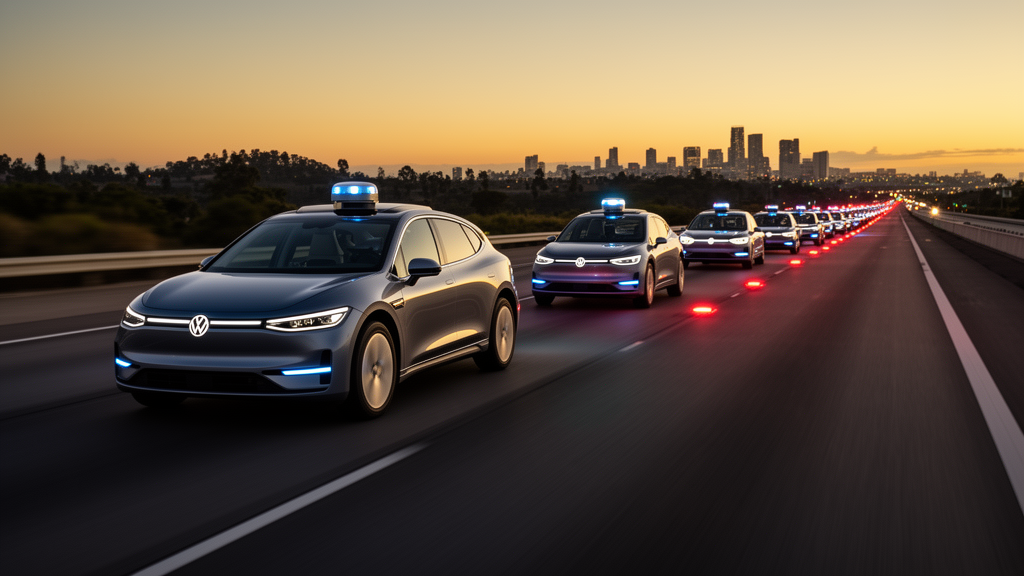
Wireless links between vehicles are never perfect, and a new study argues that the way automated cars respond to dropped packets may matter more than the packets themselves. In a paper published in Scientific Reports, researchers show that discontinuous headway switching on packet loss, rather than the loss of feedforward information alone, is the dominant destabilising mechanism in cooperative adaptive cruise control (CACC) platoons under vehicle-to-everything (V2X) dropout.
CACC systems rely on V2X communication to maintain short, string-stable gaps between vehicles, allowing platoons to travel closely and efficiently. Real wireless links, however, drop packets, and this erosion of communication has long been treated as the central threat to platoon stability. The team tested this assumption using a canonical plant-inverting controller design, examining what happens when the feedforward channel degrades at a fixed headway.
The result was striking: with the headway held constant, the controller remained string stable even as feedforward information was lost. Destabilisation appeared only when the system switched to a larger headway upon detecting packet loss. This discontinuous switching, the authors conclude, is the primary vulnerability of communication-dependent platooning, not the information loss itself.
The researchers then explored remedies. A continuous, non-learned scheduling strategy recovered stability at moderate packet loss but failed under severe loss. They also trained a dropout-aware controller using multi-agent reinforcement learning, specifically the TD3 algorithm, equipped with a learned V2X reliability gate that lets the policy judge when communication can be trusted.
Training outcomes were mixed in an instructive way. Four of five random training seeds converged to a policy that remained string stable at both 30 percent and 60 percent packet loss, outperforming the strongest classical scheduler when both operated under V2X-only information. One seed did not converge, and the authors note that frequency sensitivity, robustness to severe bursts, and training reliability were all seed-dependent.
The study is unusually candid about the limits of its comparison. The learned policy was not information-matched with its classical rivals: it also observed an idealised, always-exact onboard measurement of the predecessor’s acceleration that no classical controller in the study used. When a non-learned controller was given that signal alone, it proved competitive with the reinforcement-learning policy, limiting how much of the improvement can be attributed to learning itself.
This attribution problem matters for the field. Reinforcement learning is often presented as a route to robust platooning under imperfect communication, but these results suggest that part of the apparent advantage may come from richer sensing rather than the learned policy. The authors frame their contribution as both a mechanistic finding and a candid account of what a learning-based remedy actually owes to learning.
The practical takeaway is that platoon designers should focus on how vehicles change their following behaviour during communication failures. Smooth, continuous transitions between headways may preserve string stability where abrupt switching cannot, and any learned controller should be benchmarked against classical designs given equivalent information before its benefits are credited to the learning process.
Subject of Research: String stability of cooperative adaptive cruise control platoons under V2X packet loss
Article Title: Headway switching, rather than feedforward loss alone, destabilises cooperative platoons under V2X dropout
Article References: Haneesh, K. M., Jisha, P., Suresh, K., & Aravind, P. V. (2026). Headway switching, rather than feedforward loss alone, destabilises cooperative platoons under V2X dropout. Scientific Reports. https://doi.org/10.1038/s41598-026-76245-x
Image Credits: AI Generated
DOI: 10.1038/s41598-026-76245-x
Keywords: CACC, V2X communication, packet loss, string stability, platooning, reinforcement learning, TD3, headway control, connected vehicles, automated driving, Headway, switching
News Source: Denise Maddox. (October 27, 2026). Switching Headways, Not Lost Signals, Destabilises Self-Driving Platoons. Scienmag.