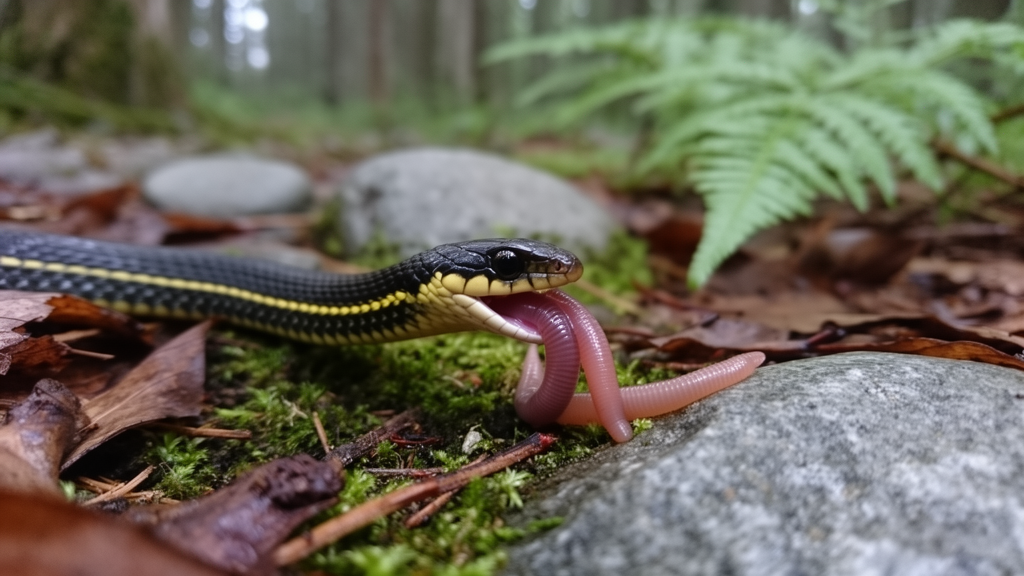
On a June afternoon in Isle Royale National Park, a remote island rising from the cold waters of Lake Superior, a tiny eastern gartersnake was photographed doing something no one had ever captured on camera there before: swallowing an earthworm. The snake, likely born in 2022 and barely larger than a pencil, was observed at 14:54 on 23 June 2023 at the South Lake Descor Campground, methodically ingesting a non-native earthworm. The event, documented digitally without capturing or handling the animal, marks the first photographic record of earthworm consumption by a snake on the island, even though both of Isle Royale's native snake species are known to eat earthworms on the mainland.
But for ecologists studying isolated island systems, the photograph carries real weight. It confirms that snakes isolated on Isle Royale are exploiting an introduced prey source, and it establishes a baseline for tracking how this relationship develops over the coming years. In ecosystems stripped down to a handful of species, a single new player can ripple through the entire food web.
Islands have long served as natural laboratories for studying predator-prey dynamics precisely because their species richness is reduced compared with mainland systems. With fewer species interacting, it becomes easier to observe how changes propagate through the ecosystem. Isle Royale is an especially clean example of this principle.
The island sits 29 kilometers from the Minnesota shore, 90 kilometers from the Michigan shore, and 24 kilometers from Ontario, Canada. The vast, cold waters of Lake Superior form a barrier that most organisms cannot cross, which is why the island was designated a National Park in 1940 and why 99 percent of it remains federally protected wilderness today. Only two native snake species live on Isle Royale: the eastern gartersnake, Thamnophis sirtalis, and the northern redbelly snake, Storeria occipitomaculata.
How either species reached the island remains unclear, but both are well established and widespread. Neither, however, has been well studied in this environment. The gartersnake is particularly notable on the island for its highly variable color morphs, and on the mainland it maintains a broad diet that includes frogs and toads, rodents, small fish, and invertebrates such as slugs and earthworms.
The redbelly snake feeds primarily on slugs and only occasionally takes earthworms. The earthworm at the other end of that fateful encounter is itself an invader. Once established, they spread with human help.
Although most earthworms move less than eight meters per year on their own, anglers dumping live bait and gardeners relocating compost have carried them into increasingly remote places. The scale of the invasion is staggering: estimates suggest roughly 268 worms per square meter of soil, and as many as 81.8 billion worms in Manistee County alone, a 3,320-square-kilometer area in Michigan's northern lower peninsula. In forested environments, these introduced earthworms are far from benign.
They can rapidly consume the surface plant litter that defines northern forest floors, alter understory vegetation, and disrupt soil physiology. Such changes can drastically restructure the ecosystem, and the effects are likely to be especially pronounced on islands, where space is limited and species have fewer alternatives. Minnesota hosts at least 15 introduced earthworm species, and neighboring Ontario, Canada, has at least 15 confirmed invasive species.
Identifying these worms to species is notoriously difficult, requiring counts of the body segments between the anterior end and the clitellum, measurements of total and clitellar length, and examination of the worm's underside. In the upper Midwest, islands, including those in Lake Superior, are typically the last places to be colonized by the invasion front. Isle Royale's earthworm record is sparse but suggestive.
Beyond the new photograph, there is a single historical record of an eastern gartersnake consuming the common nightcrawler Lumbricus terrestris, noted in 1909 at what was then the Ransom settlement on the island's northwestern side, near the present-day Daily Farm campground. During a July 2023 visit, two large nightcrawler-type earthworms were found near Malone Bay, one on the concrete platform of duplex housing and another under a log on the Ishpeming Trail near Siskiwit Lake. These scattered sightings hint that earthworms are present on the island, but their abundance, distribution, and date of original introduction remain unknown.
What happens to a snake population when a new, abundant prey source appears? Evidence from other systems suggests the consequences can be significant. The introduction of a plentiful prey source has been shown to lead to increases in body size and, with that, increased reproductive potential in another natricine snake, the family to which gartersnakes belong.
If earthworms prove to be widespread and abundant on Isle Royale, they may constitute an important food source for the island's gartersnakes, potentially reshaping the ecology of a predator that has, until now, operated within a very narrow prey community. The researchers caution that at this time they do not know how the introduction and range expansion of earthworms will affect the island's two native snake species. Nearby lake systems offer a preview of what may be unfolding.
The presence and impacts of earthworms in the Boundary Waters Canoe Area Wilderness, along the Minnesota-Ontario border, are well documented. Similar observations have emerged from Sand Island in the Apostle Islands of Wisconsin, where one of the study's authors recovered an earthworm from the regurgitate of an eastern gartersnake caught during an evening rainstorm, at a time when invasive earthworms had not yet been formally documented on that island. Given that earthworms are turning up on islands in and around Lake Superior, their presence on Isle Royale is not surprising.
It is, however, a reminder that even the most protected wilderness in the United States is not insulated from continental-scale biological change. The researchers argue that future surveys of Isle Royale should make a deliberate effort to document earthworm presence across the island's species and habitats, to establish how widespread and abundant the invaders have become. In the simplified food web of an isolated island, such baseline data are invaluable.
Subject of Research: Invasive earthworm consumption by the eastern gartersnake on Isle Royale National Park
Article Title: Earthworms as a prey source for the insular snake Thamnophis sirtalis (Linnaeus, 1758)
Article References: Ray, J. M., Wergeland, R. M., & Karafa, J. (2024). Earthworms as a prey source for the insular snake Thamnophis sirtalis (Linnaeus, 1758). Herpetozoa, 37, 197-200. https://doi.org/10.3897/herpetozoa.37.e123065
Image Credits: AI Generated
DOI: 10.3897/herpetozoa.37.e123065
Keywords: Isle Royale, eastern gartersnake, Thamnophis sirtalis, invasive earthworms, Lake Superior, island ecology, herpetology, prey source, invasive species, national park, food web, natricine snakes
News Source: Gavin Prescott. (October 27, 2026). Island Gartersnake Photographed Eating Invasive Earthworm on Isle Royale. Scienmag.