Researchers have unveiled a detailed protocol for manufacturing human blood vessel organoids in just six days, using a genetic programming strategy that sidesteps many of the problems that have long plagued conventional stem cell differentiation. The method, published in the journal Cell Regeneration, relies on doxycycline-inducible activation of two transcription factors, ETV2 and NKX3.1, to steer human pluripotent stem cells directly toward endothelial cells and mural cells, the two building blocks of blood vessel walls. Because these lineages are induced orthogonally, meaning each is programmed independently through its own master regulator, the resulting organoids contain precisely tunable ratios of the two cell types, a level of control that growth factor-based differentiation has struggled to achieve.
The work, led by Yun Zhao, Mengze Sun, Kun Zhang, Juan M. Melero-Martin, Xi Wang and Kai Wang, addresses a persistent bottleneck in tissue engineering, disease modeling and regenerative medicine. Functional human vasculature is essential to all three fields, yet existing approaches to generate it from human pluripotent stem cells often involve prolonged differentiation, variable lineage specification efficiency and limited control over cellular composition. Those shortcomings complicate experimental design and reproducibility, particularly when researchers need consistent batches of vascular tissue for screening experiments or transplantation studies. The new protocol, which the authors call synthetic vascular organoids, or Syn-VOs, was written as a step-by-step methodology article intended for other laboratories to adopt.
The biological logic behind the method draws on developmental biology. During embryogenesis, vascular progenitor cells arise from the lateral plate mesoderm and give rise to both endothelial cells, which form the vessel lining, and mural cells, which include pericytes and smooth muscle cells that wrap around and stabilize vessels. Most current differentiation protocols mimic this trajectory in two steps: they first push pluripotent stem cells into mesoderm progenitor cells, typically by activating Wnt signaling with the small molecule CHIR99021, and then specify vascular lineages using combinations of VEGF, FGF and TGF-beta pathway modulation. These two-dimensional strategies are well established, but the authors note they are often limited by variable efficiency, prolonged culture duration and batch-to-batch variability, producing heterogeneous cell populations.
Forward programming offers an alternative. Rather than nudging cells through developmental intermediates with growth factors, it directly induces target cell identities through transient activation of lineage-defining transcription factors. In the vascular system, ETV2 acts as a master regulator of endothelial specification, while NKX3.1 promotes mesenchymal and mural cell programs. Transient activation of either factor in pluripotent stem cells or mesoderm progenitors yields endothelial cells or mural cells, respectively, with reduced lineage ambiguity. The resulting cells are referred to in the protocol as Dox-ECs and Dox-MCs, reflecting their doxycycline-inducible origin. Importantly, the approach works across both human embryonic stem cells and human induced pluripotent stem cells with consistent differentiation efficiency, which the authors say makes it suitable for patient-derived iPSC applications where intrinsic heterogeneity is a concern.
The practical workflow begins with establishing stable stem cell lines carrying doxycycline-inducible cassettes for ETV2 or NKX3.1. The protocol details an electroporation method using the Lonza Nucleofector 2b for plasmid delivery, with specific guidance on DNA amounts, survival thresholds and clone screening. For 2 to 3 million cells, total DNA should not exceed 4 micrograms, since higher amounts cause substantial cell death, and a post-electroporation survival rate of at least 20 percent is required for proliferation to proceed. At least eight clones should be picked for screening to isolate pure inducible lines, and a 3-times HA epitope tag allows researchers to confirm expression and clonal purity. The authors recommend selecting two to three clones with high transgene expression levels, because insufficient expression may compromise differentiation efficiency and yield heterogeneous populations.
Once the inducible lines are established, organoid generation itself is remarkably fast. Doxycycline is added from day two to three to activate ETV2 and NKX3.1 simultaneously, and from day three to six the medium is supplemented with VEGF-A, FGF2 and EGF to promote maturation of both lineages. By day six, the organoids are ready for downstream use. When the researchers tested starting endothelial-to-mural ratios of 1:1, 2:1 and 1:2 across three stem cell lines, the proportion of CD31-positive endothelial cells in the final organoids came out at roughly 50, 67 and 33 percent respectively, closely tracking the input ratio. Generally, endothelial proportions above 30 percent are sufficient, and variations within the 30 to 70 percent range did not significantly affect vascular network formation in vitro or in vivo.
A distinctive feature of the platform is its built-in visualization system. Assessing vascular network organization typically requires whole-mount immunostaining or tissue clearing, both technically demanding and time-consuming steps that slow iterative optimization and screening assays. To eliminate this bottleneck, the authors combined the programming system with fluorescent reporter stem cell lines in which PECAM1, an endothelial marker, drives mRuby3 red fluorescence, and ACTA2, a mural cell marker, drives EGFP green fluorescence. These knock-in lines were generated using donor and guide RNA plasmids, validated across multiple stem cell lines, and confirmed by junction PCR and Sanger sequencing. With reporters in place, vascular networks forming inside hydrogels or under the kidney capsule of a mouse can be imaged directly by confocal microscopy, in real time, without tissue clearing or immunostaining.
The protocol demonstrates several applications. In vitro, organoids embedded in a collagen-Matrigel hydrogel sprout branched mRuby3-positive vascular structures covered by EGFP-positive mural cells within five days when stimulated with high concentrations of VEGF-A and FGF2. Adding hepatocyte growth factor enhanced branching, while the VEGF inhibitor SU5416 abolished network formation, illustrating how the system can be used to test pro-angiogenic and anti-angiogenic compounds. The authors propose a 1-2-2 screening workflow, with one day to initiate vascularization followed by two-day treatment windows, and suggest that combining high-content imaging with the visualized assay enables high-throughput drug screening on authentic human vasculature. The system is also compatible with disease modeling using patient-derived or genetically engineered stem cells, with candidate targets including inherited vascular disorders such as CADASIL, cerebral cavernous malformations and hereditary hemorrhagic telangiectasia, as well as malformations driven by somatic mutations in TEK and PIK3CA.
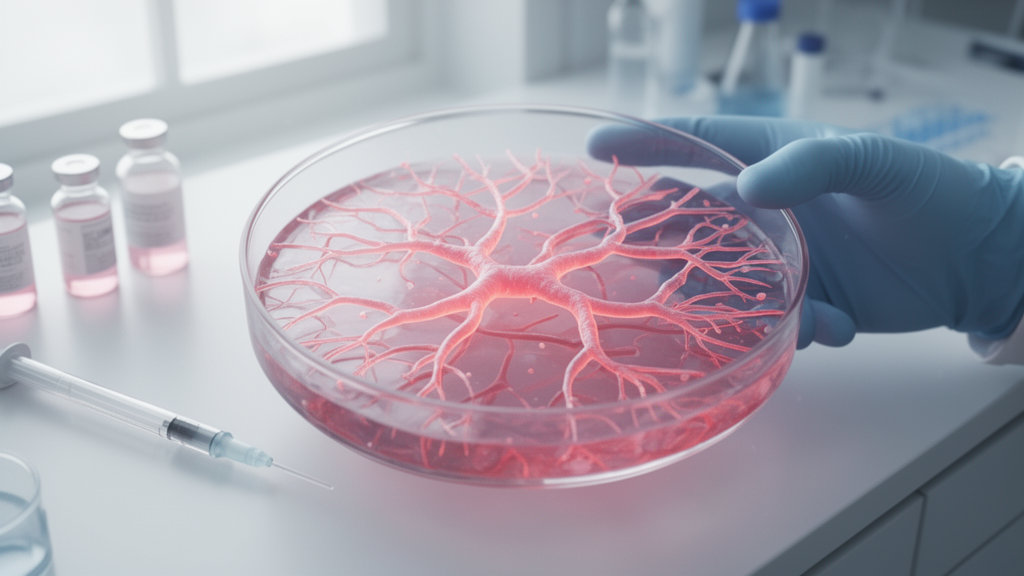
In vivo, the organoids proved transplantable in a strikingly simple way. Because free synthetic vascular organoids are injectable without any exogenous hydrogel, they can be loaded into an insulin syringe and delivered under the kidney capsule of immunodeficient mice. Within seven days of transplantation, vascular networks were observable, and they remained stable for at least one month. Intravenous injection of fluorescent tomato lectin or dextran before sacrifice revealed perfusion of the human vessels, demonstrating functional connection with the host circulation. Histology showed red blood cells within human vessels, and immunostaining confirmed that the human networks were enveloped by type IV collagen-positive basement membrane and covered by alpha-SMA-positive mural cells. Interestingly, a subset of endothelial cells shifted toward venous identity after transplantation, a plasticity the authors attribute to the hypoxic environment under the kidney capsule or to functional anastomosis with host circulation.
The authors also report translational results from prior work built on this platform. Co-transplantation of the synthetic organoids with mouse pancreatic islets under the kidney capsule formed functional intra-islet vasculature and improved islet performance when suboptimal islet numbers were transplanted, enabling reversal of hyperglycemia with reduced islet mass in diabetic mouse models. In murine hind-limb ischemia models, the organoids showed improved engraftment compared with transplantation of dissociated endothelial and mural cells, likely due to their preorganized three-dimensional architecture, and they restored perfusion and reduced ischemia-induced necrosis. An mRNA-based induction strategy, which leaves no permanent genetic footprint, is also described as supporting potential clinical translation.
The protocol is not without limitations, which the authors discuss candidly. Establishing and validating the engineered stem cell lines requires genome editing expertise and a significant initial time investment, and clonal variation can still influence differentiation outcomes. The organoids contain endothelial and mural cells but do not fully recapitulate the cellular diversity of native vasculature, lacking lymphatic endothelial cells and immune cells, so immune-vascular interactions cannot be modeled without additional co-culture or in vivo approaches. Prolonged suspension culture beyond day six is not supported, as mural cells overgrow and endothelial content gradually declines, possibly through endothelial-to-mesenchymal transition. Finally, the standard 24-hour doxycycline scheme yields a highly homogeneous arterial-like endothelial population, which aids reproducibility but limits studies of venous biology, although alternative induction schedules can produce mixed or venous-like populations. Even with these caveats, the platform offers laboratories a standardized, scalable and visually tractable tool for studying vascular biology, and the plasmids are publicly available through Addgene and Wekwik.
Subject of Research: A protocol for generating synthetic vascular organoids from human pluripotent stem cells via orthogonal doxycycline-inducible programming of endothelial and mural cell lineages
Article Title: Generation of synthetic vascular organoids via orthogonal programming of human pluripotent stem cells
Article References: Zhao, Y., Sun, M., Zhang, K., Melero-Martin, J. M., Wang, X., & Wang, K. (2026). Generation of synthetic vascular organoids via orthogonal programming of human pluripotent stem cells. Cell Regeneration, 15(1), Article 23. https://doi.org/10.1186/s13619-026-00298-6
Image Credits: AI Generated
DOI: 10.1186/s13619-026-00298-6
Keywords: vascular organoids, human pluripotent stem cells, ETV2, NKX3.1, endothelial cells, mural cells, angiogenesis, drug screening, kidney capsule transplantation, disease modeling, tissue engineering, regenerative medicine
News Source: Juliet Wilcox. (October 29, 2026). Scientists Build Blood Vessel Organoids in Six Days Using Genetic Programming. Scienmag.