


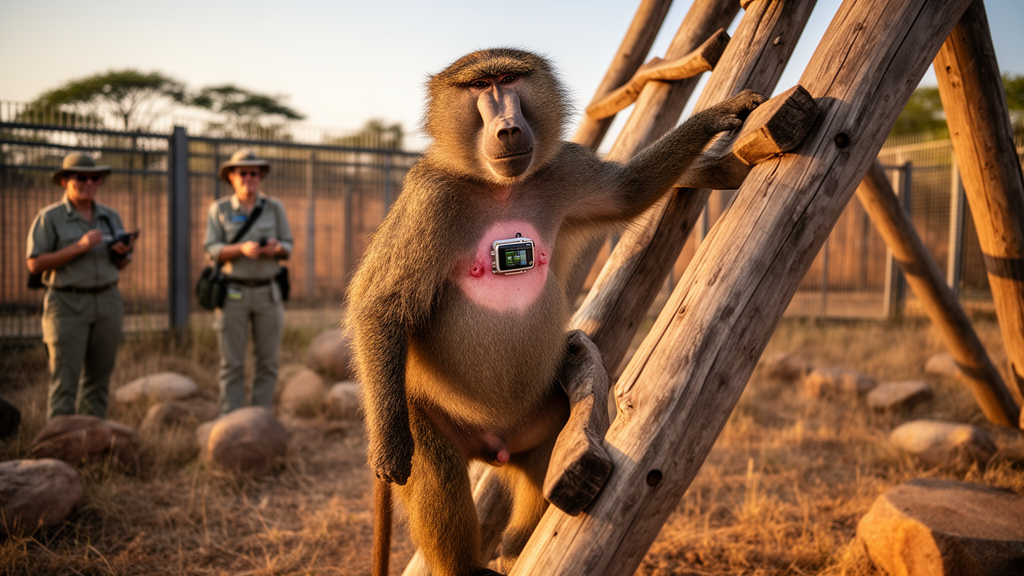
Insertable cardiac monitors, the tiny devices that cardiologists implant under the skin of people at risk of irregular heart rhythms, have now been tested in baboons. Researchers at the Kenya Institute of Primate Research, working with colleagues at several universities, implanted Reveal LINQ monitors from Medtronic in ten adult female baboons of two species, Papio anubis and Papio cynocephalus, and followed the animals for eight months.
The monitors continuously recorded cardiac electrical activity in unrestrained, conscious animals going about their normal daily routines in captivity. Over the study period, mean daytime heart rates across the ten baboons ranged from 89.6 to 128.0 beats per minute, while resting heart rates ranged from 74.4 to 98.2 beats per minute. The fastest R-wave interval validated by electrocardiogram was 230 milliseconds, equivalent to 260 beats per minute, and the slowest was 1270 milliseconds, or 47.4 beats per minute.
Heart rate is more than a plumbing metric. That has implications for animal health, cognition, welfare, and conservation, but only if the devices are safe, accurate, and biologically valid in the species being studied. The authors argue that their eight-month test in baboons establishes exactly that plausibility, supporting future use of insertable cardiac monitors to investigate physiological responses in these primates.
The most striking finding is how individualized heart rate turned out to be. Baboon identity explained 41 percent of the variation in heart rate across the study animals, while the same measure explained only 2 percent of the variation in activity levels. This individual signature matters for anyone hoping to use heart rate as a proxy for internal state, because it means a given heart rate means different things in different animals.
Activity itself did predict heart rate within animals. Heart rate was positively correlated with physical activity, and heart rates were highest during daylight hours, when the baboons were more active.
Social rank left its mark on the data as well. Dominant baboons had higher heart rates even after controlling for activity, and they were also more active than lower-ranking individuals.
The ovarian cycle also showed up in the cardiac record. Heart rate was higher when individuals were in the periovulatory and luteal phases of the cycle compared with the follicular phase.
The researchers also tested whether species, body mass, time of day, ambient temperature, social dominance rank, and ovarian cycle phase predicted heart rate and activity levels. The finding that identity dominated heart rate variation while barely touching activity variation suggests that heart rate and activity, though correlated, carry partly independent information about an animal’s internal state.
For the field of animal biotelemetry, the practical takeaway is methodological. Insertable cardiac monitors provided fine-grained, continuous cardiac data over months in animals that were never restrained for measurement, and the devices were tolerated without adverse reactions. The authors frame the devices’ demonstrated safety and validity as the plausibility condition for understanding inter-individual and inter-species variation in heart rate and activity in response to variation in the external environment and in individual internal state.
Subject of Research: Testing insertable cardiac monitors for safety and validity in captive baboons and identifying predictors of heart rate and activity
Article Title: Using insertable cardiac monitors to test determinants of heart rate and activity in captive baboons
Article References: Andreadis, C. R., Kulahci, I. G., Ndung’u, J., Kigen, D., Kimiti, P., Mugambi Kibe, K., Laske, N. R., Mwadime, J., Wanjala, N., Pontzer, H., Laske, T. G., Akinyi, M. Y., & Archie, E. A. (2026). Using insertable cardiac monitors to test determinants of heart rate and activity in captive baboons. Animal Biotelemetry. https://doi.org/10.1186/s40317-026-00485-x
Image Credits: AI Generated
DOI: 10.1186/s40317-026-00485-x
Keywords: baboons, insertable cardiac monitors, heart rate, animal biotelemetry, social dominance, ovarian cycle, physical activity, Primate Research, physiology, Medtronic, Kenya, insertable
News Source: Margaret Porter. (October 30, 2026). Implanted heart monitors track baboon heart rates and rank-linked activity. Scienmag.



