


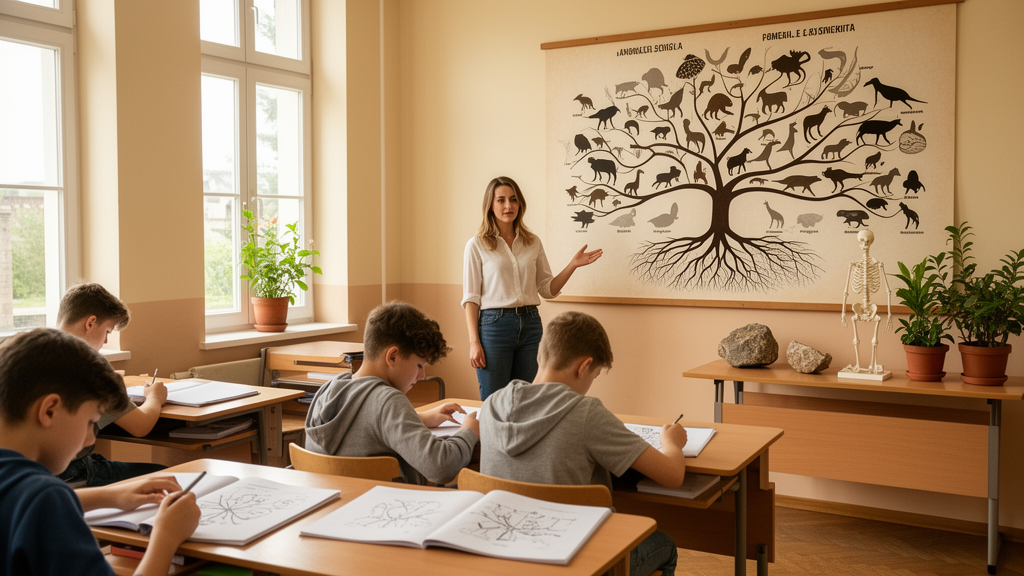
Evolution by natural selection is widely regarded as the unifying paradigm of modern biology, yet many students leave school without a coherent grasp of it. A new study from Slovenia has now mapped exactly where evolutionary concepts appear in the country’s school curricula, comparing the old framework with the revised curricula adopted in the 2025 educational reform. Using a structured coding instrument called the Framework for the Assessment of School Curricula on the Presence of Evolutionary Concepts, or FACE, the researchers found that the pre-reform curriculum delayed and fragmented evolution education, while the new curricula introduce substantially more evolutionary content in earlier grades, particularly in science subjects.
The analysis, published in the journal Developmental Biology Advances, was carried out by Gregor Torkar and Tanja Gregorčič, who examined the learning goals specified in curricula for Slovenia’s nine-year compulsory school and its general secondary education program, the Gymnasium. Data were collected during two periods: the 2018–2019 school year, as part of the European COST project Euro-Scitizen, and in 2025, after the revised curricula were formally adopted. The study focused on core science-related subjects, because these carry the bulk of biology learning objectives across the compulsory system, which runs from Learning about the Environment in Grades 1–3, through Science and Technology in Grades 4–5 and Science in Grades 6–7, to Biology in Grades 8–9.
FACE divides evolution education into six conceptual categories considered essential for scientific literacy: History of Life, Evidence for Evolution, Mechanisms of Evolution, Studying Evolution, Nature of Science, and Development of Scientific Practices. These categories are further split into 35 subcategories, ranging from the fossil record and rates of evolution to genetic drift, sexual selection, and speciation. The Slovenian analysis concentrated on the first four categories, which deal directly with evolutionary content, and added one extra subcategory under Evidence for Evolution to capture references to human evolution, a topic that previous research has shown is particularly prone to rejection among students and the public.
The results reveal a striking pattern in the old curricula. In the History of Life category, learning goals related to the link between anthropogenic environmental changes and biological evolution, and to the observation that rates of evolution vary, were absent from the nine-year compulsory school. Most other subcategories in this category appeared only in the Biology subjects at lower and upper secondary level. Knowledge of key turning points in the development of life in geological history was even relegated to the Geography subject rather than the sciences. The revised curricula show substantial improvement, with all History of Life subcategories except rates of evolution now introduced in the subject Science, and the content more thoroughly integrated into both lower secondary Biology and Science.
For Evidence for Evolution, the old curricula addressed only two subcategories across all subjects: the idea that similarities and differences among existing organisms provide evidence for evolution, and the notion that organisms’ features, when analyzed in relation to their environment, provide evidence for evolution. Every other subcategory, including the fossil record, appeared only in the Biology subjects. The reform changed this in one notable way: the fossil record as evidence for evolution is now introduced in the Science subject at the compulsory level, meaning students in Grades 6 or 7 encounter it rather than waiting for lower secondary Biology. Human evolution is first introduced in the lower secondary Biology curriculum, where students examine primates, including humans, to understand how the relatedness of organisms is reflected in the similarity of their DNA nucleotide sequences.
The Mechanisms of Evolution category showed the deepest gaps in compulsory education. Learning goals about offspring inheriting traits from parents without being identical were the most frequently represented across subjects in both old and new curricula. But several fundamental subcategories were entirely missing from the nine-year compulsory school and appeared only in upper secondary biology: evolution defined as a change in allele frequencies within a population, sexual selection, genetic drift, fitness as reproductive success measured by viable offspring, and speciation resulting from the splitting of an ancestral lineage. The revised curricula brought most of these into earlier grades, yet two remain unaddressed at the compulsory level: change in allele frequencies and fitness. These omissions matter because allele-frequency change is the formal definition of evolution in population genetics, and fitness is the concept that ties natural selection to measurable reproductive outcomes.
In the Studying Evolution category, the old curricula included only one subcategory in compulsory education: classification based on evolutionary relationships, which was addressed in both Science and Biology subjects. The other two subcategories, concerning the application and investigation of evolutionary principles, were covered only at the upper secondary level. The revised curricula closed this gap by incorporating all three subcategories into the lower secondary Biology curriculum. A new learning objective in 9th-grade Biology now requires students to apply evolutionary knowledge to contemporary scientific challenges facing human civilization, such as vaccine development, resistance evolution, and biodiversity conservation, connecting abstract evolutionary theory to practical problems in medicine, agriculture, and environmental management.
The authors argue that the old Slovenian curricula neither sufficiently acknowledged the importance of understanding evolution nor promoted its systematic instruction throughout compulsory education, despite longstanding recommendations from educational research bodies that evolutionary concepts should be integrated from the earliest grades. This shortfall is not unique to Slovenia and reflects similar patterns observed in several other European countries. However, Slovenian students completing general upper secondary education, approximately one-third of the country’s secondary school population, were exposed to the full range of key evolutionary concepts before entering academic or tertiary education. Following the 2025 school reform, the majority of previously missing evolutionary concepts were incorporated into the Biology curriculum at the lower secondary level, creating a more vertically integrated progression from primary school onward.
The study also highlights a subtler problem: the lack of gradual progression in the old curricula. Learning goals that could foster essential preconceptions, such as those related to ancient life forms, extinction, and fossils, were notably underrepresented before the formal introduction of Biology in Grade 9. The revised curricula have partially addressed these gaps, particularly by expanding the History of Life category, but significant omissions remain, especially in the Evidence for Evolution category. The researchers warn that the previous lack of focus on evolutionary evidence and mechanisms may hinder students’ grasp of deep time, a complex but essential concept for understanding macroevolutionary processes that is also linked to acceptance of evolution. Exposure to diverse lines of evidence has been shown to enhance students’ acceptance of evolutionary theory, making the broader age-appropriate coverage in the new curricula a meaningful step forward.
One persistent issue survived the reform unchanged. Learning goals targeting the explicit teaching that natural selection operates without purpose or intent, and that evolution does not follow a progressive or goal-directed path, were absent from all subjects prior to 9th-grade Biology in the old curricula, and this remains the case in the revised curricula. Without this clarification, students are prone to teleological misconceptions, the tendency to explain biological features as if they existed for a purpose. The authors also note that learning goals crucial for understanding how evolution is studied were scarce in both old and updated curricula, although the lower secondary Biology curriculum now incorporates all three relevant subcategories. Deeper engagement with evolutionary content, they point out, fosters stronger scientific reasoning and a better understanding of the nature of science, a key component of scientific literacy.
The researchers emphasize that a well-structured evolution curriculum is vital for promoting scientific literacy and preparing students to address pressing global issues, from biodiversity loss and climate change to public health and food security. Long-term solutions to sustainability problems must consider the evolutionary potential and histories of species and populations, and evolutionary biology plays a vital role in everyday life and across diverse fields such as forensic biology, law, foreign affairs, and national security. The next crucial step, according to the authors, involves examining the informal curriculum, namely how teachers and textbook authors interpret and enact the learning objectives specified in the formal curriculum. This informal layer can reinforce the intended learning objectives or dilute their impact, particularly when those goals are ambiguously defined. Effective implementation will require a strong focus on both preservice and in-service teacher education, as well as concrete and practical didactic guidelines to support teachers in enacting the new curricula.
Monitoring the impact of the reform will rely on existing assessment infrastructure. In Slovenia, the National Assessment of Knowledge evaluates whether students achieve the learning objectives and standards specified in subject curricula and serves a formative role in enhancing educational practices. It is mandatory for students at the end of the third, sixth, and ninth grades, and at the ninth grade it assesses mathematics, Slovenian, and an additional subject designated annually by the Minister of Education, often biology. These assessments, along with the matriculation examination known as Matura and international studies such as PISA and TIMSS, provide valuable tools for tracking students’ understanding of evolution and measuring the effect of the newly implemented curricula on evolution education over time.
The FACE framework itself proved to be a very useful instrument for the systematic assessment and implementation of evolutionary concepts into school curricula, the authors conclude. Building on a comparative analysis of school curricula from 18 European countries and Israel, which revealed considerable variation in how evolutionary content is presented, the Slovenian study demonstrates how a national curriculum reform can respond to identified gaps. While considerable progress has been made, the persistence of underrepresented concepts such as changes in allele frequencies and evolutionary fitness in compulsory education shows that the work of building a coherent, vertically integrated evolution curriculum is not yet finished. Attention to the informal curriculum, teacher preparation, and textbook interpretation will determine whether the formal improvements translate into a deeper and more widely accepted understanding of evolution among Slovenian students.
Subject of Research: Analysis of evolutionary concepts in Slovenian primary and secondary school curricula before and after the 2025 educational reform using the FACE framework
Article Title: Evolution education in slovenia: using the framework for the assessment of school curricula on the presence of evolutionary concepts (FACE) in curriculum reform
Article References: Torkar, G., & Gregorčič, T. (2026). Evolution education in slovenia: using the framework for the assessment of school curricula on the presence of evolutionary concepts (FACE) in curriculum reform. Developmental Biology Advances, 17(1), Article 6. https://doi.org/10.1186/s13227-026-00260-2
Image Credits: AI Generated
DOI: 10.1186/s13227-026-00260-2
Keywords: evolution education, Slovenia, curriculum reform, FACE framework, natural selection, scientific literacy, biology education, compulsory education, learning goals, teacher preparation, textbooks, deep time
News Source: Gavin Prescott. (October 30, 2026). Slovenia Rewrites Its Curriculum to Teach Evolution Earlier and More Completely. Scienmag.



