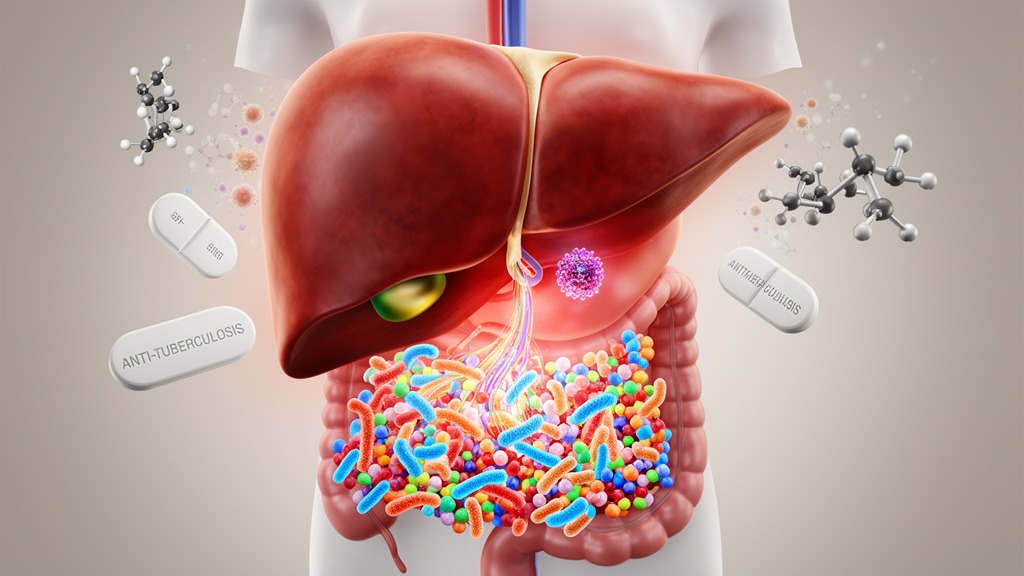
Network pharmacology and molecular docking identified gut microbial metabolites and human proteins that may participate in anti-tuberculosis drug-induced liver injury, according to a database-based computational study published in International Microbiology. The analysis narrowed 58 overlapping targets to six central genes—IL-6, NFE2L2, CXCL8, VEGFA, TLR4 and EGFR—and highlighted short-chain fatty acids, equol, phenylacetylglutamine, deoxycholic acid and 3-indolepropionic acid as candidate mediators. The work provides a testable model of an immune-metabolic gut–liver network, but it did not test patients, cultured human cells or animals and does not show that any metabolite prevents liver injury during tuberculosis treatment.
The researchers assembled the computational workflow from several stages: microbiota-metabolite information, disease-associated gene searches, target prediction, protein-interaction analysis, functional enrichment, network construction, drug-likeness and toxicity screening, and molecular docking. Gut microbial metabolites and associated human intestinal targets were retrieved from the gutMGene database. Their structures were represented as Simplified Molecular Input Line Entry System strings and submitted to the Similarity Ensemble Approach and SwissTargetPrediction to predict protein targets.
The two prediction systems shared 726 targets. In parallel, the team obtained 307 deduplicated targets related to anti-tuberculosis drug-induced liver injury from GeneCards and Online Mendelian Inheritance in Man. Fifty-eight targets appeared in both collections, and intersecting those 58 with the gut-microbiota-associated human target set reduced the list to 14 candidates considered pivotal in the proposed network.
The 14 candidates were used to construct a protein–protein interaction network in STRING, which was visualized with Cytoscape 3.10.4 and examined with the MCODE and cytoHubba plugins. The resulting graph had 13 nodes and 37 edges; ST6GAL1 was excluded because no interactions for it were predicted in the dataset. Intersecting the outputs of the two Cytoscape analyses identified IL-6, NFE2L2, CXCL8, VEGFA, TLR4 and EGFR as six core targets.
This convergence provides a systems-biology prioritization derived from database predictions and network topology, rather than direct evidence that any one protein causes or protects against anti-tuberculosis drug-induced liver injury. The broader functions of the targets were assessed with Gene Ontology, Kyoto Encyclopedia of Genes and Genes pathway analysis and a GeneMANIA functional-association network. Gene Ontology enrichment associated the targets with processes involving toxin and secondary metabolism, xenobiotic catabolism, long-chain fatty acid biosynthesis, reactive oxygen species metabolism and cellular responses to oxidative stress.
Molecular functions included monooxygenase activity, heme binding, cytokine activity and cytokine receptor binding, while cellular-component terms included membrane microdomains, basal and basolateral plasma membranes, Golgi cisternae and vesicle lumens. Enriched KEGG pathways included metabolism of xenobiotics by cytochrome P450, chemical-carcinogenesis pathways involving receptor activation or reactive oxygen species, HIF-1 signaling, PI3K–Akt signaling, IL-17 signaling and Toll-like receptor signaling. All listed terms had Benjamini–Hochberg-adjusted P values below 0.05.
Together, these results place drug handling, redox biology and immune signaling in the same predicted framework, although enrichment analysis does not establish causal direction or show that the network is active in an individual patient. GeneMANIA expansion of the six core genes produced a 26-gene set enriched for innate immune responses, leukocyte chemotaxis and migration, cellular responses to bacterial-derived molecules and MyD88-dependent Toll-like receptor signaling. Its KEGG results included Toll-like receptor, NOD-like receptor and nuclear factor-kappa B pathways, along with infection-associated pathways such as lipid and atherosclerosis and alcoholic liver disease.
The investigators then integrated 19 microbial species, 30 metabolites and the six core targets into a multilayered gut microbiota–metabolite–target network. IL-6 had the highest connectivity, with links to eight microbial species and 19 metabolites. CXCL8 was connected to 10 species, and TLR4 to four species and five metabolites.
In the network, Akkermansia muciniphila and Faecalibacterium prausnitzii were predominantly associated with innate immune targets including TLR4 and CXCL8, while Lactobacillus species tended to be connected to the inflammatory target IL-6. These are inferred links in the assembled network, not observed associations measured in a clinical cohort. Drug-likeness and toxicity screening selected seven metabolites that met the study’s combined criteria: butyrate, valeric acid, isovaleric acid, 3-indolepropionic acid, equol, deoxycholic acid and phenylacetylglutamine.
Butyrate, valeric acid, isovaleric acid, 3-indolepropionic acid and equol received predicted oral bioavailability scores of at least 0.85. Deoxycholic acid and phenylacetylglutamine each had a score of 0.56 and relatively high topological polar surface areas of 77.76 and 109.49 square angstroms, respectively, suggesting potential absorption constraints under the screening criteria. The tested toxicity endpoints included hERG blockade, human hepatotoxicity, drug-induced liver injury, the Ames bacterial reverse mutation assay, rat oral acute toxicity and carcinogenicity.
No significant alerts were predicted for butyrate, valeric acid, isovaleric acid, equol or phenylacetylglutamine, whereas deoxycholic acid and 3-indolepropionic acid produced positive results in the rat oral acute toxicity assay. Because these are computational predictions rather than human exposure or clinical-safety data, they require experimental confirmation. Molecular docking produced its strongest predicted interaction for equol, which bound TLR4 with an energy of −8.2 kilocalories per mole, the most favorable value among the tested complexes.
Phenylacetylglutamine bound EGFR at −7.1 kilocalories per mole; deoxycholic acid and 3-indolepropionic acid bound IL-6 at −6.7 and −5.9 kilocalories per mole, and 3-indolepropionic acid also bound TLR4 at −6.7 kilocalories per mole. The investigators classified energies at or below −5.0 kilocalories per mole as stable, and these five predictions met that threshold. By contrast, butyrate bound IL-6 and CXCL8 at −2.9 kilocalories per mole and TLR4 at −4.3, while valeric acid and isovaleric acid bound IL-6 at −4.2 and −4.0.
All tested complexes had energies below zero, but the short-chain fatty-acid interactions were classified as spontaneous yet weak under the study’s criteria. The authors note that weak docking affinity does not by itself rule out a biological role for short-chain fatty acids, which are products of microbial fermentation of dietary fiber and can reach millimolar concentrations in the intestinal lumen before reaching the liver through portal circulation. They also positioned the other highlighted compounds within established chemical categories: equol is a gut microbial metabolite of soy isoflavones, 3-indolepropionic acid is derived from tryptophan, deoxycholic acid is produced through microbial modification of host-derived primary bile acids, and phenylacetylglutamine is a product of microbial phenylalanine metabolism.
The docking results identify plausible structural fits for further experiments, but they do not demonstrate that a compound activates, inhibits or otherwise alters the activity of its proposed target in an intact organism. Several limitations constrain interpretation of the computational findings. The analysis depends heavily on existing databases that may contain publication bias, incomplete entries or species-specific variations.
Molecular docking supplies structural evidence of binding potential but cannot reproduce intracellular signaling, metabolite bioavailability, tissue distribution or in-vivo metabolism, and limited human-cell hepatotoxicity information was available for compounds including equol and 3-indolepropionic acid. The abundance dynamics of the identified microbial taxa in people with anti-tuberculosis drug-induced liver injury and their relationship to disease progression also require investigation in clinical samples. The authors propose complementary approaches including 16S ribosomal RNA sequencing, untargeted metabolomics and experimental validation at cellular and animal-model levels; they do not prescribe a required order among those studies.
They further caution that Lipinski and Veber rules assume passive diffusion and may not accurately characterize endogenous metabolites that depend on active transport. Overall, the study offers a computational map of possible communication among gut microbes, microbial metabolites and liver injury during anti-tuberculosis therapy. Its strongest structural predictions involved an immune-metabolic network linking IL-6, CXCL8 and TLR4, with equol emerging as the highest-affinity docking candidate and short-chain fatty acids appearing as weaker multi-target binders whose local concentrations could be biologically relevant.
Whether these relationships operate in patients, whether metabolite concentrations are sufficient to influence hepatic biology, and whether manipulating the relevant microbes or compounds would change the incidence or severity of liver injury remain unresolved. No datasets were generated or analyzed experimentally in the study, and its results constitute a mechanistic hypothesis and a set of candidates for preclinical testing—not evidence of a clinical intervention, diagnostic marker or treatment effect.
Subject of Research: Computational analysis of gut microbiota metabolites and candidate targets in anti-tuberculosis drug-induced liver injury
Article Title: Modulation of anti-tuberculosis drug-induced liver injury by gut microbiota metabolites: Insights from network pharmacology
Article References: Hong, M., Huang, X., Zhu, H., Ma, J., Sun, Y., & Li, F. (2026). Modulation of anti-tuberculosis drug-induced liver injury by gut microbiota metabolites: Insights from network pharmacology. International Microbiology. https://doi.org/10.1007/s10123-026-00911-3
Image Credits: AI Generated
DOI: 10.1007/s10123-026-00911-3
Keywords: anti-tuberculosis drug-induced liver injury, gut microbiota, gut–liver axis, network pharmacology, molecular docking, short-chain fatty acids, equol, TLR4, IL-6, drug-like metabolites, Modulation, anti-tuberculosis
News Source: Morgan Morrow. (October 22, 2026). Research report: Modulation of anti-tuberculosis drug-induced liver injury by gut microbiota metabolites: Insights from network pharmacology. Scienmag.