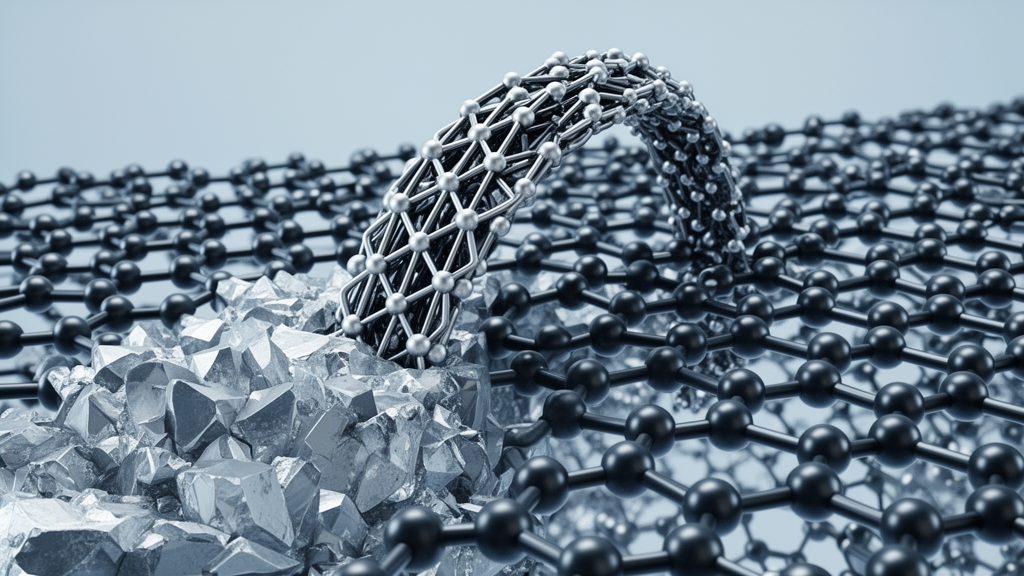
Nickel composites reinforced with three-dimensional graphene-like networks achieved substantially higher tensile performance than pure nickel in a laboratory materials study. Under optimized processing conditions, the 3D-GLN/nickel nanocomposite recorded a 33.53% increase in yield strength and a 54.93% increase in ultimate tensile strength, while maintaining a balance of strength, toughness and ductility. The researchers formed the reinforcement directly on nickel powder particles using a solid carbon precursor and rapid thermal annealing.
For the study, Omid Hatami Farzaneh and colleagues mixed sucrose homogeneously with nickel powders before rapidly annealing the mixture. During this treatment, the sucrose served as the carbon source and three-dimensional, multilayer graphene-like networks formed on the surfaces of the nickel particles. Importantly, the annealing process preserved the morphology of the powders, producing graphene-coated particles that could subsequently be consolidated into a bulk metal-matrix composite.
The fabrication sequence combined in-situ network formation with consolidation by spark plasma sintering. The source reports that this method enabled uniform and efficient incorporation of graphene within nickel, with the three-dimensional graphene-like networks serving as the reinforcing phase. Because the structures were grown from a precursor mixed directly with the metal powder, the process was designed to place the carbon network at the nickel-particle surfaces before the composite was consolidated.
Mechanical testing indicated that the optimized 3D-GLN/nickel nanocomposite outperformed the pure-nickel baseline in both yield strength and ultimate tensile strength. The reported improvements were relative to pure nickel and applied to the composite produced under the researchers’ optimized conditions. The results also showed that strengthening did not come solely at the expense of toughness or ductility: the authors described the material as combining notable gains in strength with those two mechanical properties.
The work offers a manufacturing strategy for metal-matrix composites in which a solid carbon precursor is mixed with metal powder and converted into a three-dimensional graphene-like reinforcement during rapid thermal annealing. The study’s evidence is limited to the reported fabrication and mechanical testing of nickel-based composites; the supplied article abstract does not provide detailed specimen specifications, test conditions, statistical uncertainty or results for other metal systems. The article was published in npj Advanced Manufacturing as an accepted, open-access research article, with the displayed version subject to further editorial changes before the final version of record.
Subject of Research: Mechanical strengthening of nickel composites using in-situ three-dimensional graphene-like networks
Article Title: Fabrication of three-dimensional graphene-like networks 3D-GLNs for strengthening nickel-based composites
Article References: Hatami Farzaneh, O., Dar, J., Abbott, S., Roach, D. J., & Lin, D. (2026). Fabrication of three-dimensional graphene-like networks 3D-GLNs for strengthening nickel-based composites. npj Advanced Manufacturing. https://doi.org/10.1038/s44334-026-00117-5
Image Credits: AI Generated
DOI: 10.1038/s44334-026-00117-5
Keywords: nickel composites, graphene-like networks, metal-matrix composites, rapid thermal annealing, spark plasma sintering, sucrose precursor, yield strength, tensile strength, nanocomposites, in-situ fabrication, Fabrication, three-dimensional
News Source: Neil Sanderson. (October 22, 2026). In-Situ Graphene Networks Strengthen Nickel Composites. Scienmag.