Researchers at Osaka University develop a new highly sensitive test for the SARS-CoV-2 virus that utilizes a fusion of artificial intelligence and nanopore technology which may enable rapid point-of-care testing for COVID
Osaka, Japan – A team of scientists headed by SANKEN (The Institute of Scientific and Industrial Research) at Osaka University demonstrated that single virus particles passing through a nanopore could be accurately identified using machine learning. The test platform they created was so sensitive that the coronaviruses responsible for the common cold, SARS, MERS, and COVID could be distinguished from each other. This work may lead to rapid, portable, and accurate screening tests for COVID and other viral diseases.
The global coronavirus pandemic has revealed the crucial need for rapid pathogen screening. However, the current gold-standard for detecting RNA viruses–including SARS-CoV-2, the virus that causes COVID–is reverse transcription-polymerase chain reaction (RT-PCR) testing. While accurate, this method is relatively slow, which hinders the timely interventions required to control an outbreak.
Now, scientists led by Osaka University have developed an intelligent nanopore system that can be used for the detection of SARS-CoV-2 virus particles. Using machine-learning methods, the platform can accurately discriminate between similarly sized coronaviruses responsible for different respiratory diseases. “Our innovative technology has high sensitivity and can even electrically identify single virus particles,” first author Professor Masateru Taniguchi says. Using this platform, the researchers were able to achieve a sensitivity of 90% and a specificity of 96% for SARS-CoV-2 detection in just five minutes using clinical saliva samples.
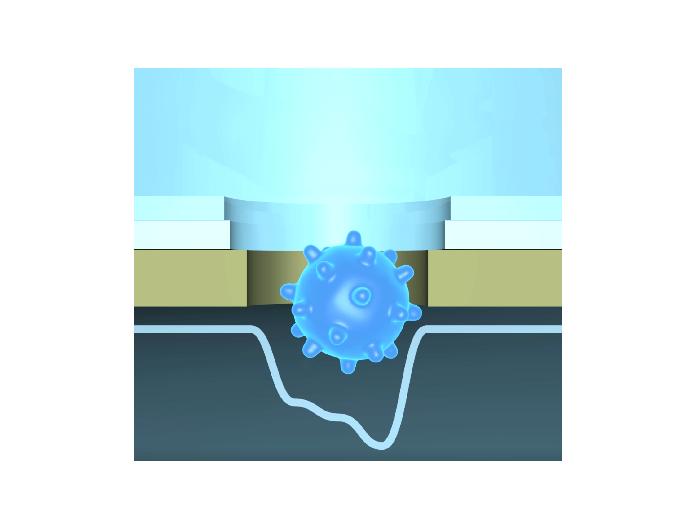
To fabricate the device, nanopores just 300 nanometers in diameter were bored into a silicon nitride membrane. When a virus was pulled through a nanopore by the electrophoretic force, the opening became partially blocked. This temporarily decreased the ionic flow inside the nanopore, which was detected as a change in the electrical current. The current as a function of time provided information on the volume, structure, and surface charge of the target being analyzed. However, to interpret the subtle signals, which could be as small as a few nanoamps, machine learning was needed. The team used 40 PCR-positive and 40 PCR-negative saliva samples to train the algorithm.
“We expect that this research will enable rapid point-of-care and screening tests for SARS-CoV-2 without the need for RNA extraction,” Professor Masateru Taniguchi explains. “A user-friendly and non-invasive method such as this is more amenable to immediate diagnosis in hospitals and screening in places where large crowds are gathered.” The complete test platform consists of machine learning software on a server, a portable high-precision current measuring instrument, and cost-effective semiconducting nanopore modules. By using a machine-learning method, the researchers expect that this system can be adapted for use in the detection of emerging infectious diseases in the future. The team hopes that this approach will revolutionize public health and disease control.
###
The article, “Combining machine learning and nanopore construction creates an artificial intelligence nanopore for coronavirus detection” was published in Nature Communications at DOI: https:/
About Osaka University
Osaka University was founded in 1931 as one of the seven imperial universities of Japan and is now one of Japan’s leading comprehensive universities with a broad disciplinary spectrum. This strength is coupled with a singular drive for innovation that extends throughout the scientific process, from fundamental research to the creation of applied technology with positive economic impacts. Its commitment to innovation has been recognized in Japan and around the world, being named Japan’s most innovative university in 2015 (Reuters 2015 Top 100) and one of the most innovative institutions in the world in 2017 (Innovative Universities and the Nature Index Innovation 2017). Now, Osaka University is leveraging its role as a Designated National University Corporation selected by the Ministry of Education, Culture, Sports, Science and Technology to contribute to innovation for human welfare, sustainable development of society, and social transformation.
Website: https:/
Media Contact
Saori Obayashi
[email protected]
Related Journal Article
http://dx.